Trump White House Report Accuses Bangladesh of China Tariff Evasion via Transshipment
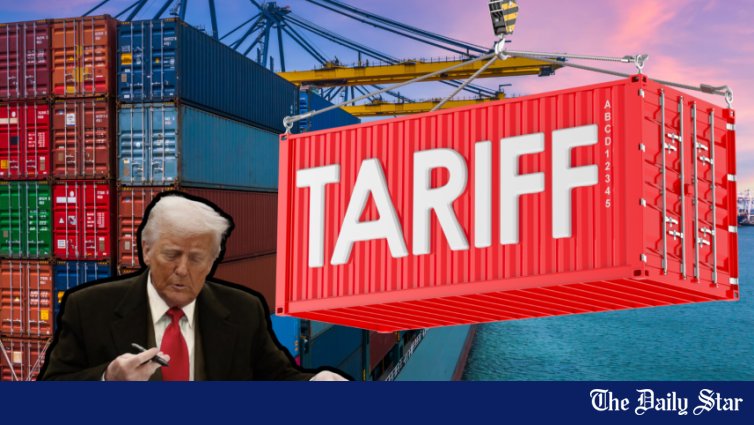
Dhaka, August 15, 2026 — The Trump White House has accused Bangladesh and more than 40 other countries of participating in a “shadow logistics network” that helps China evade US tariffs, depriving the American Treasury of tens of billions of dollars in annual revenue. The allegation, contained in a report published by the Office of Trade and Manufacturing Policy on Thursday, places Bangladesh in “Tier 3” of countries allegedly facilitating Chinese transshipment — a charge that Bangladeshi exporters have firmly rejected.
🇺🇨 The White House Report: Key Claims
The Trump administration's report accuses more than 40 countries of participating in what it calls the “Great Transshipment Scam” — a coordinated effort to reroute Chinese goods through third countries to evade US tariffs. The report's key claims:
- 📊 40+ countries implicated — in facilitating Chinese transshipment
- 💰 Tens of billions of dollars — in annual US Treasury revenue lost
- 🚢 Shadow logistics network — Chinese goods shipped under false labelling via third countries
- 🏛️ False origin labelling — products relabelled as third-country exports
- 💸 Tariff arbitrage — exploiting lower tax rates applied to third countries
The report names the European Union, Mexico, Canada, India, Japan, and South Korea as among China's biggest enablers — notably placing major US trading partners in the same category as smaller economies.
🏛️ Bangladesh Placed in Tier 3
The report categorises Bangladesh in “Tier 3” — a grouping of smaller economies allegedly attractive for China-linked rerouting due to:
- 💰 Low-cost labour — attractive for relabelling operations
- 🏭 Free zones — EPZs and economic zones with relaxed oversight
- 📦 Bonded warehouses — customs facilities allowing duty-free storage
- 🚧 Limited customs enforcement — perceived weakness in origin verification
The Tier 3 classification is concerning for Bangladesh because it could trigger heightened US customs scrutiny of Bangladeshi exports — potentially slowing clearance, increasing compliance costs, and undermining the country's positioning as a compliant, transparent sourcing destination.
🇧🇩 Bangladeshi Exporters Reject the Allegation
Local exporters have firmly rejected the US accusation, citing the structural reality of Bangladesh's export model. Mahmud Hasan Khan, President of the Bangladesh Garment Manufacturers and Exporters Association (BGMEA), provided a detailed rebuttal:
“We send 96 percent of our goods to the USA under the freight on board (FOB) method. So, it is not possible for local exporters to use third-country routes to evade US taxes,” Khan said.
Under the FOB method, local exporters send goods from factories to the port of departure (typically Chattogram), while importers bear the risks and pay the duties. This means Bangladeshi exporters do not control the shipment once it leaves the country — making transshipment schemes operationally infeasible from the Bangladesh side.
The BGMEA president emphasised that the issue is insignificant for Bangladesh because local exporters do not send goods directly to the US under arrangements that would allow relabelling.
🧵 BKMEA President: Legal Channels Only
Mohammad Hatem, President of the Bangladesh Knitwear Manufacturers and Exporters Association (BKMEA), echoed the rejection. “It is true that Bangladeshi exporters use Chinese fabrics and accessories, but they import them through legal channels,” Hatem said.
He emphasised that the Bangladesh government closely monitors the import-export process and had taken strict measures after similar allegations arose many years ago — strengthening customs verification, origin certification, and supply chain documentation. The current Bangladesh export regime includes:
- 📜 Origin verification — BGMEA/BKMEA certification of garment origin
- 📦 Customs documentation — full chain of custody from factory to port
- 💰 Legal channel imports — all Chinese fabric imports via formal LC channels
- 🔍 Customs enforcement — bonded warehouse audits and inspections
- 📊 EPB tracking — Export Promotion Bureau monitors export shipments
📊 Why FOB Export Model Matters
The FOB (Freight on Board) export model that dominates Bangladesh's apparel trade is structurally incompatible with transshipment schemes. Under FOB:
- 🏭 Exporter responsibility ends at port of departure — typically Chattogram
- 🚢 Importer (US buyer) controls shipping — books vessel, pays freight
- 💰 Importer pays US duties — Bangladesh exporter has no role
- 📜 Documentation chain is clean — factory → port → vessel → US port
- 🚧 No third-country routing — vessels sail directly to US ports
This contrasts with CIF (Cost, Insurance, Freight) or DDP (Delivered Duty Paid) models where the exporter controls the shipment end-to-end — creating more opportunities for transshipment manipulation. The 96% FOB share in Bangladesh-US trade is a structural safeguard against the kind of fraud alleged by the White House report.
🌐 Strategic Context: US-Bangladesh Trade at a Sensitive Moment
The accusation arrives at a delicate moment for US-Bangladesh trade relations. Bangladesh is preparing for LDC graduation in November 2026 (potentially extended to November 2029), which will affect its preferential market access. The country is also exploring a potential bilateral trade agreement with Washington, and a US business delegation visited Dhaka earlier this month to explore investment opportunities.
The Tier 3 classification — even if unfounded — could complicate these diplomatic and commercial efforts by:
- 🚧 Triggering heightened US customs scrutiny — slower clearance for Bangladeshi exports
- 💰 Raising compliance costs — additional documentation and verification
- 🤝 Complicating FTA negotiations — US may demand stricter origin rules
- 🏛️ Reputational risk — undermining Bangladesh's compliance brand
- 📈 Buyer hesitation — US buyers may diversify away from perceived-risky sources
🏛️ What Bangladesh Should Do Next
Industry stakeholders suggest several steps to defend Bangladesh's export integrity:
- 📜 Strengthen origin certification — BGMEA/BKMEA to issue blockchain-verified origin certificates
- 🤝 Engage US Customs and Border Protection — direct dialogue to address concerns
- 📊 Publish FOB trade data — transparent statistics showing shipment patterns
- 🔍 Third-party audits — independent verification of bonded warehouse operations
- 🌐 Diplomatic outreach — Commerce Ministry and Bangladesh Embassy in Washington to formally rebut
- 💰 Invest in customs modernisation — ASYCUDA World and digital tracking expansion
For an export economy that shipped $8.4 billion in apparel to the US in FY2024-25, the Tier 3 accusation — even if unfounded — carries real commercial weight. Bangladesh's export community will need to combine factual rebuttal with proactive transparency to defend its hard-won positioning as a compliant, reliable sourcing destination for American buyers.
This news was originally published by The Daily Star. For the full original report, please visit: https://www.thedailystar.net/business/news/bangladesh-40-nations-helping-china-evade-tariffs-4247936
Related on BangladeshExport
📬 Get Bangladesh Trade News in your inbox
Weekly digest of export industry news, policy updates, and market analysis.
📰 Related Stories