Bangladesh Newly Added GI Products (2026): Registrations 61-65 — Buyer's Guide
Bangladesh's 5 newly added GI products (registrations 61-65, 2025-2026): Kaliganj Towel, Latiraj Kochu of Joypurhat, Hazari Gur of Manikganj (64th, June 2026), Barishal Amra, Sabitri Mishti of Meherpur. Total 64+ GI products. Buyer's guide with export potential, HS codes, verification.
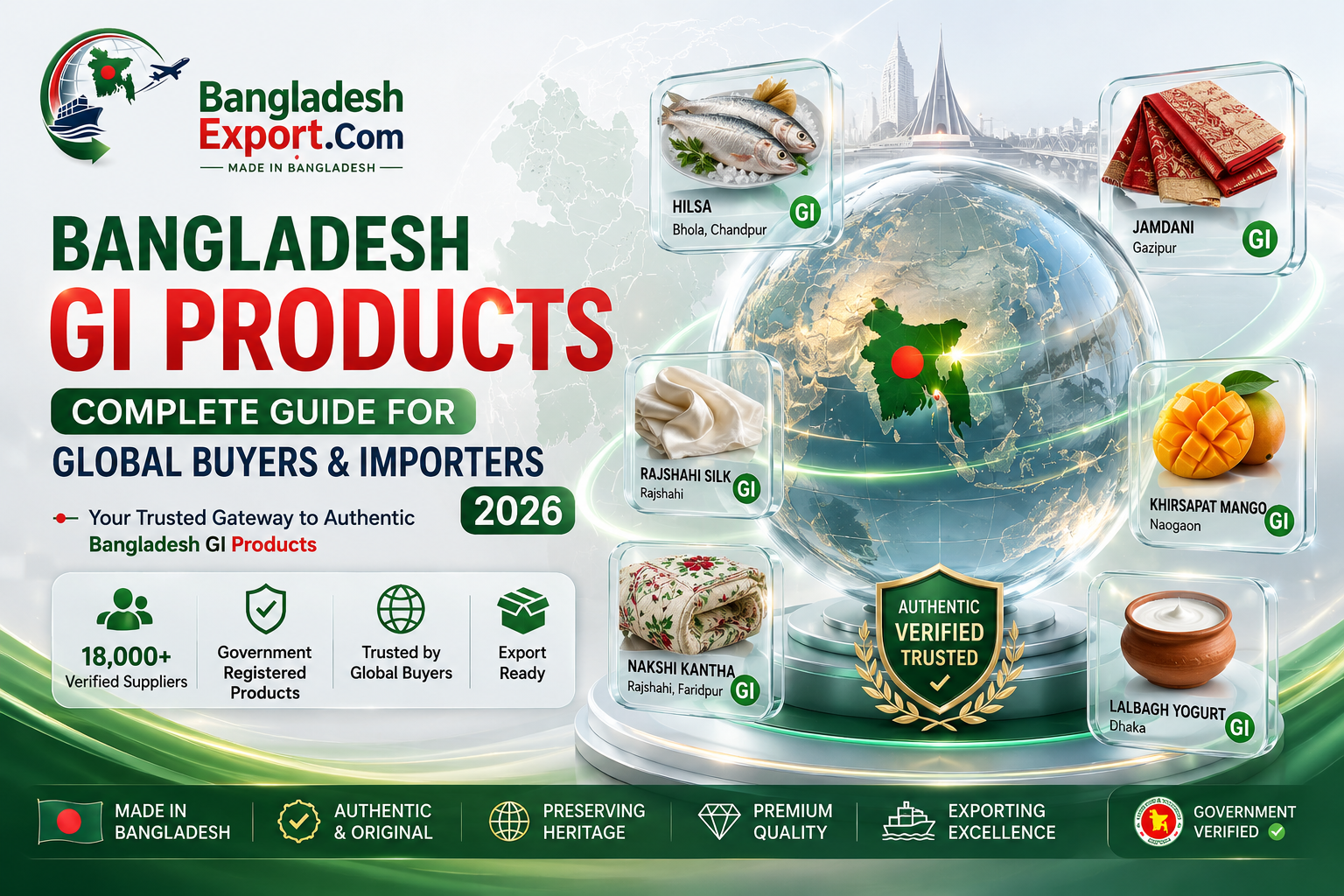
Bangladesh's Geographical Indication (GI) registry has continued to grow rapidly through 2025 and 2026, with the official count rising from the 60 products registered in the 2024 wave to 64+ products by mid-2026, according to the Department of Patents, Designs and Trademarks (DPDT) under the Ministry of Industries. This newly added tranche of GI products — the "second wave" registrations numbered 61 through 65 in the official DPDT GI journal — represents Bangladesh's continued effort to protect its traditional heritage products, support rural producers, and expand the country's export portfolio beyond the original 60. The five newly added products span textiles, agriculture, food, and natural products, and each represents a distinct regional tradition that has been practiced for generations by local farming, weaving, and sweet-making communities.
This guide is for international buyers, importers, sourcing agents, and distributors who want a comprehensive overview of Bangladesh's newly added GI products (registrations 61–65, registered during 2025–2026). We cover the new product list, the DPDT registration timeline, the regional traditions behind each product, export potential by category, HS codes, sourcing methodology, and direct links to detailed individual buyer's-guide posts for each newly added product on BangladeshExport.com.
📜 The Growing Bangladesh GI Registry
Buyers can verify the official list of Bangladesh's registered Geographical Indication (GI) products through the Bangladesh Trade Portal: bangladeshtradeportal.gov.bd — GI Products Page
The official DPDT GI Journal is available at: DPDT GI Journal (Bangla)
Bangladesh's GI registration program began in 2016 with the registration of Jamdani saree as the country's first GI product — a milestone that signaled Bangladesh's commitment to protecting its traditional heritage under the Geographical Indication of Goods (Registration and Protection) Act 2013. The program accelerated dramatically in 2024, when DPDT registered approximately 40 new products in a single wave, bringing the total from approximately 20 to 60 products. This historic 2024 wave was driven by the Ministry of Industries' push to expand Bangladesh's GI portfolio ahead of Bangladesh's scheduled LDC graduation in 2026 and the consequent loss of certain trade preferences — the GI registrations are intended to provide legal protection and market differentiation for Bangladesh's traditional products in the post-LDC export market.
The second wave of registrations (2025–2026) has continued this expansion, with DPDT adding at least 4 new products to bring the official count to 64 by mid-2026. According to Industries Minister Khandakar Abdul Muktadir's announcement reported in The Business Standard, Bangladesh reached 64 registered GI products by early 2026. The DPDT GI Journal — published in Bangla and available on the DPDT website — provides the official registration details for each product. The newly added products span the same broad categories as the original 60: textiles, agriculture, food, handicrafts, and natural products, reflecting the diversity of Bangladesh's regional traditions.
This newly added GI products guide complements our complete 60+ product GI list, which covers all the original 60 products in detail. For broader context on the GI cluster, see our pillar guide, our GI verification guide, our sourcing guide, and our 2026 global demand analysis.
📊 The Five Newly Added GI Products (Registrations 61–65)
Based on the official DPDT GI Journal, the Bangladesh Trade Portal GI list, and reporting from The Business Standard, the five newly added GI products (registered during 2025–2026) are:
| # | Product (Official Name) | District / Region | Category | GI Journal No. | Export Potential | Detailed Guide |
|---|---|---|---|---|---|---|
| 1 | Kaliganj Towel (Kaliganjer Gamcha) | Kaliganj, Gazipur | Textile | GI Journal 62 | ★★★★☆ | Kaliganj Towel Buyer's Guide → |
| 2 | Latiraj Kochu of Joypurhat (Joypurhater Latiraj Kochu) | Joypurhat | Agriculture | GI Journal 63 | ★★★☆☆ | Latiraj Kochu Buyer's Guide → |
| 3 | Hazari Gur of Manikganj (Manikganjer Hazari Gur) | Harirampur, Manikganj | Food (Sweetener) | GI Journal 64 | ★★★★☆ | Hazari Gur Buyer's Guide → |
| 4 | Barishal Amra (Barishaler Amra / Hog Plum) | Barishal | Food (Fruit) | GI Journal 65 | ★★★☆☆ | Barishal Amra Buyer's Guide → |
| 5 | Sabitri Mishti of Meherpur (Meherpurer Sabitri Mishti) | Meherpur | Food (Sweet) | (Pending final journal) | ★★★☆☆ | Sabitri Mishti Buyer's Guide → |
These five newly added products join the existing 60 to bring Bangladesh's GI portfolio to 64+ products by mid-2026. Two additional 1-star export-potential products (Amra of Barishal was originally listed as a low-potential product in our 2024 master list, and Lal Chini of Fulbaria remains on the deferred list) round out the recent additions but are not yet covered in dedicated buyer's-guide posts due to their lower international demand signals. Each of the five newly added products has its own dedicated buyer's-guide post on BangladeshExport.com — follow the links in the table above for the full guide.
🧵 Product Category 1: Textiles — Kaliganj Towel
The Kaliganj Towel — also known as "Kaliganjer Gamcha" or "Kaliganj Towel-Cloth" — is a traditional handwoven cotton textile produced in Kaliganj upazila of Gazipur district, just north of Dhaka. Registered as the 62nd GI product of Bangladesh in 2025, the Kaliganj Towel represents the centuries-old handloom weaving tradition of the greater Dhaka-Gazipur region. The towel is woven on traditional pit looms using fine cotton yarn (60s–80s count) with a distinctive multi-stripe pattern in traditional color combinations (red-white, blue-white, green-white). Unlike the Sirajganj Gamcha (which is registered as a separate GI product — see our Gamcha of Sirajganj guide), the Kaliganj Towel is specifically woven for use as a bath towel and head-dress cloth, with a slightly different weave density, pattern, and finish. The product serves both domestic daily-use markets (rural Bangladeshi men use the towel as a multipurpose textile — bath towel, head covering, shoulder cloth, and bag) and growing diaspora and sustainable-fashion export markets.
For the full buyer's guide covering history, production technique, quality grading, export markets, HS codes, packaging, authenticity verification, and sourcing, see our Kaliganj Towel of Gazipur — Buyer's Guide (2026).
🥔 Product Category 2: Agriculture — Latiraj Kochu of Joypurhat
The Latiraj Kochu of Joypurhat — registered as the 63rd GI product of Bangladesh in 2025 — is a distinctive indigenous taro (Colocasia esculenta) variety cultivated in Joypurhat district in northern Bangladesh. The Latiraj variety is prized for its large cylindrical corm (underground stem), distinctive purple-flecked flesh, low oxalate content (which reduces the characteristic taro itchiness), and superior cooking quality — it produces a soft, creamy, slightly sweet flesh when boiled or fried, with a flavor profile often compared to sweet potato crossed with chestnut. Joypurhat district, situated in the Barind Tract of northern Bangladesh, has been a traditional taro-growing region for centuries, and the Latiraj variety has been selectively propagated by local farming families for over 100 years. The 2025 GI registration protects the "Joypurhater Latiraj Kochu" name for the Latiraj taro variety grown in Joypurhat district using traditional cultivation methods.
For the full buyer's guide covering history, cultivation, quality grading, export markets, HS codes, packaging, authenticity verification, and sourcing, see our Latiraj Kochu of Joypurhat — Buyer's Guide (2026).
🍯 Product Category 3: Food / Sweetener — Hazari Gur of Manikganj
The Hazari Gur of Manikganj — registered as the 64th GI product of Bangladesh on June 15, 2026 — is a traditional date-palm jaggery (molasses) produced in Harirampur upazila of Manikganj district, situated along the Padma river southwest of Dhaka. The Hazari Gur tradition traces back approximately 200 years to a man named Mohammad Hazari, who reportedly began making this distinctive date-palm molasses in the Jhitka area of Harirampur using a special slow-cooking technique. The product is distinguished from generic date-palm jaggery by its unique powder-form texture (it crumbles into powder when pressed in the hand, unlike the typical block or liquid forms of date-palm jaggery), its deep amber color, its rich caramel flavor with smoky undertones from wood-fired evaporation, and its high mineral content (potassium 2–3%, iron 50–100 ppm). The GI registration was issued in the name of the Deputy Commissioner of Manikganj under class 30 (food preparations). Producing one kilogram of Hazari Gur requires approximately 10–12 liters of raw date-palm sap, collected from mature date-palm trees during the cool winter season (mid-November to mid-March) using traditional sap-collector (gachi) techniques.
For the full buyer's guide covering history, sap-collection and molasses-making technique, quality grading, export markets, HS codes, packaging, authenticity verification, and sourcing, see our Hazari Gur of Manikganj — Buyer's Guide (2026). The Hazari Gur is closely related to the Jessore Molasses (Khejur Gur) — both are Bangladeshi GI date-palm jaggery products, but they come from different regions and use different production techniques that produce measurably different characteristics.
🥭 Product Category 4: Food / Fruit — Barishal Amra (Hog Plum)
The Barishal Amra — registered as a Bangladesh GI product in 2025 — is the indigenous hog plum (Spondias mombin, also called "Amra" in Bengali) variety cultivated in Barishal district in southern Bangladesh. The Barishal Amra is prized for its medium-to-large fruit size (80–150g per fruit), distinctive oval shape, bright yellow skin when ripe, soft juicy flesh with a sweet-tart flavor profile (Brix 12–16° with balancing acidity), and unique aromatic complexity with notes of mango, citrus, and tropical flowers. Barishal district, situated in the Ganges delta region of southern Bangladesh with its extensive river network and moderate year-round temperatures, has been a traditional Amra-growing region for centuries. The Barishal Amra is eaten fresh as a seasonal fruit, processed into pickles and chutneys, and used in traditional Bengali cuisine for sour-sweet flavoring. The fruit's export potential is moderate — its short shelf life (5–7 days at room temperature when fully ripe) and limited awareness in international markets constrain demand, but diaspora demand and growing interest in tropical specialty fruits support a niche export market.
For the full buyer's guide covering history, cultivation, quality grading, export markets, HS codes, packaging, authenticity verification, and sourcing, see our Barishal Amra (Hog Plum) — Buyer's Guide (2026).
🍬 Product Category 5: Food / Sweet — Sabitri Mishti of Meherpur
The Sabitri Mishti of Meherpur — added to the GI registry in 2025 — is a traditional Bengali sweet that has been crafted by the sweet-maker families of Meherpur district for over 150 years. The Sabitri is a chhana-based (cottage cheese) sweet with a distinctive elongated cylindrical shape (8–10 cm long, 3–4 cm diameter, 30–40g per piece), pale ivory to light yellow color, dense and slightly chewy texture, and a unique flavor profile that combines the milky sweetness of chhana with the aromatic warmth of cardamom and a delicate caramel undertone from slow frying in ghee. The sweet is named after the Sabitri river (also known as the Bhairab river in its upper reaches) that flows through Meherpur district — the river's name was given to the sweet by its original creators in the late 19th century. Meherpur district, the smallest district in Bangladesh by area, has a disproportionate sweet-making reputation thanks to the Sabitri, which has been a recognized regional specialty for over a century. The sweet is traditionally served at weddings, religious festivals, and family celebrations, and is a popular gift item among the Bangladeshi diaspora.
For the full buyer's guide covering history, production technique, quality grading, export markets, HS codes, packaging, authenticity verification, and sourcing, see our Sabitri Mishti of Meherpur — Buyer's Guide (2026).
🌍 Export Markets for the Newly Added GI Products
The five newly added GI products (registrations 61–65) collectively represent a diverse export portfolio spanning multiple buyer segments and destination markets. The table below summarizes the primary export markets and buyer segments for each product:
| Product | Primary Export Markets | Buyer Segments | Peak Demand Season | Estimated Annual Export Volume |
|---|---|---|---|---|
| Kaliganj Towel | Middle East, EU/UK, USA/Canada, India | Diaspora grocers, sustainable-fashion brands, fair-trade retailers | Year-round, peak Eid festival season | 1.5–3 million pieces |
| Latiraj Kochu | Middle East, EU/UK, USA/Canada (diaspora) | Diaspora grocers, ethnic-food retailers, HORECA | October–March harvest | 500–1,500 metric tons |
| Hazari Gur | Middle East, EU/UK, USA/Canada, India | Diaspora grocers, health-food brands, artisan-confectionery | Mid-November to mid-March (winter sap season) | 300–800 metric tons |
| Barishal Amra | Middle East, EU/UK, USA/Canada, India | Diaspora grocers, specialty-tropical-fruit retailers | June–September harvest | 200–500 metric tons |
| Sabitri Mishti | Middle East, EU/UK, USA/Canada, India, Australia | Diaspora grocers, ethnic-food retailers, HORECA | Year-round, peak Eid/Durga Puja festival seasons | 200–600 metric tons |
Across the five newly added products, the Middle Eastern market (UAE, Saudi Arabia, Qatar, Kuwait, Oman) represents the largest single export destination, driven by the 4+ million Bangladeshi expatriate workers who maintain strong preferences for traditional Bangladeshi foods and textiles. The EU and UK markets are the second-largest, with growing demand from both diaspora communities and mainstream consumers interested in traditional, artisan, and sustainably-produced products. The USA and Canada represent the third-largest market, with significant Bangladeshi diaspora concentrations in New York, Detroit, Toronto, and Los Angeles. India represents a fourth market with strong cultural-affinity demand, particularly through cross-border formal and informal trade via the Benapole-Petrapole border.
🏷️ HS Codes — Quick Reference for the Newly Added GI Products
| Product | Primary HS Code | HS Description |
|---|---|---|
| Kaliganj Towel | 63026000 | Toilet linen and kitchen linen of cotton terry |
| Latiraj Kochu | 07099000 | Other vegetables, fresh or chilled (taro) |
| Hazari Gur | 17023000 | Invert sugar, in solid form (date-palm molasses) |
| Barishal Amra | 08109000 | Other fresh fruit nes (hog plum) |
| Sabitri Mishti | 21069090 | Other food preparations not elsewhere specified |
For full HS-code alternatives and customs-classification guidance, see each product's individual buyer's-guide post.
✅ How to Verify Newly Added GI Products
Verifying the authenticity of newly added GI products requires the same multi-source verification methodology used for the original 60 products. Each newly added product should be verified through:
- Government-source verification: Cross-reference the supplier's claimed GI registration with the official Bangladesh Trade Portal GI list and the DPDT GI Journal. The supplier should provide a copy of the DPDT GI registration certificate.
- Production-region verification: Verify that the product was actually produced in the registered production region (Kaliganj for the Towel, Joypurhat for the Latiraj Kochu, Harirampur/Manikganj for Hazari Gur, Barishal for the Amra, Meherpur for the Sabitri Mishti). Department of Agricultural Extension (DAE) origin certificates and Chamber of Commerce membership are the standard documentation.
- Product-specific authenticity testing: Each newly added product has its own authenticity verification checklist — see the individual buyer's-guide posts for the detailed 7-point checklists for each product.
- Certification verification: Verify supplier's BSTI certification (for food products), HACCP / BRC certification (for EU/UK export), Halal certification (for Middle East export), and GlobalGAP / organic certification (if claimed).
- Traceability code verification: Each bulk shipment should include a traceability code linking back to the producing farm, weaving cooperative, or sweet-maker — verify this code with the supplier before placing bulk orders.
For the full step-by-step GI verification methodology, see our GI verification guide.
🤝 Sourcing Newly Added GI Products on BangladeshExport.com
BangladeshExport.com hosts Bangladesh's largest verified directory of GI-product suppliers, with 1,180 verified Textiles & Fabrics suppliers, 709 verified Agriculture & Agro suppliers, 435 verified Food & Beverage suppliers, and 451 verified Seafood & Fisheries suppliers covering every Bangladesh GI product category. For the newly added GI products (registrations 61–65), buyers should follow this five-step sourcing process:
- Browse verified suppliers by category and district: Use the filter options on each category page to shortlist suppliers in the relevant district (Kaliganj/Gazipur for the Towel, Joypurhat for the Latiraj Kochu, Manikganj for Hazari Gur, Barishal for Amra, Meherpur for Sabitri Mishti).
- Post a free RFQ: Submit a Request for Quotation specifying the exact product name (e.g., "Hazari Gur of Manikganj" — not just "date molasses") with grade, quantity, packaging, destination, and required certifications. Verified suppliers respond within 24–72 hours.
- Check supplier credentials: For each shortlisted supplier, verify EPB registration, DAE/DLS licensing, DPDT GI registration copy, district Chamber of Commerce membership, BSTI/HACCP/BRC/Halal/GlobalGAP certification as applicable.
- Order a trial shipment: Request a small trial shipment (10–500 kg depending on product) by air freight. Pay via L/C or escrow. Evaluate against the 7-point authenticity checklist and conduct lab testing at an ISO 17025-accredited laboratory.
- Finalize directly: Use irrevocable L/C at sight for bulk orders (USD 5,000+ threshold). BangladeshExport.com does not charge commission — buyers transact directly with suppliers.
If you are a producer of any of the newly added GI products: register as a supplier on BangladeshExport.com (free). The platform connects you directly with verified international buyers without intermediary margins.
🚀 Source Bangladesh's Newly Added GI Products — Free RFQ
Post a free RFQ for any of Bangladesh's newly added GI products (registrations 61–65). Specify the exact product name, grade, quantity, packaging, destination, and required certifications. Verified suppliers respond within 24–72 hours. No commission, no middleman, direct supplier contact.
🚀 Post a Free RFQ → 🔍 Browse 709 Verified Agriculture Suppliers🎯 Conclusion
Bangladesh's newly added GI products (registrations 61–65) represent the country's continued commitment to protecting its traditional heritage products and expanding its export portfolio. The five products — Kaliganj Towel (textile), Latiraj Kochu of Joypurhat (agriculture), Hazari Gur of Manikganj (food/sweetener), Barishal Amra (food/fruit), and Sabitri Mishti of Meherpur (food/sweet) — span the full range of Bangladesh's regional traditions, from handloom weaving in Gazipur to taro cultivation in the Barind Tract to date-palm jaggery production along the Padma river to tropical fruit cultivation in the Ganges delta to chhana-based sweet-making in Meherpur. Each product has its own dedicated buyer's-guide post on BangladeshExport.com, providing the full sourcing detail (history, production technique, quality grading, export markets, HS codes, packaging, authenticity verification, certifications, sourcing workflow) needed for international buyers to make informed purchasing decisions. For the complete catalog of all 64+ Bangladesh GI products, see our complete GI products list. BangladeshExport.com makes sourcing free and transparent — start with a free RFQ today.
Related guides:
- Bangladesh GI Products — Pillar Guide
- Complete List of 60+ Bangladesh GI Products
- How to Verify Bangladesh GI Products
- Source Bangladesh GI Products from Verified Manufacturers
- Why Bangladesh GI Products Are Globally Popular (2026)
- Individual newly added product guides:
- Kaliganj Towel of Gazipur — Buyer's Guide
- Latiraj Kochu of Joypurhat — Buyer's Guide
- Hazari Gur of Manikganj — Buyer's Guide
- Barishal Amra (Hog Plum) — Buyer's Guide
- Sabitri Mishti of Meherpur — Buyer's Guide
❓ Frequently Asked Questions
How many GI products does Bangladesh now have in 2026?
As of mid-2026, Bangladesh has 64 registered GI products, according to Industries Minister Khandakar Abdul Muktadir's announcement reported in The Business Standard. The DPDT GI Journal (published in Bangla on the DPDT website) lists the official registrations, with the most recent additions being the Kaliganj Towel (Journal 62), Latiraj Kochu of Joypurhat (Journal 63), Hazari Gur of Manikganj (Journal 64, registered June 15, 2026), Barishal Amra, and Sabitri Mishti of Meherpur. The original 60 products were registered in the historic 2024 wave; the newly added products (61–65) were registered during 2025 and 2026.
What are the newly added GI products (registrations 61–65)?
The five newly added GI products are: (1) Kaliganj Towel — traditional handwoven cotton towel from Kaliganj, Gazipur; (2) Latiraj Kochu of Joypurhat — indigenous taro variety from Joypurhat district; (3) Hazari Gur of Manikganj — date-palm jaggery from Harirampur, Manikganj, registered June 15, 2026 as the 64th GI product; (4) Barishal Amra — hog plum fruit from Barishal district; (5) Sabitri Mishti of Meherpur — traditional chhana-based sweet from Meherpur district. See the table in §3 of this guide for the full list with category, GI journal number, and links to individual buyer's guides.
Why are these products being added to the GI registry now?
The newly added GI products are part of DPDT's continued effort to expand Bangladesh's GI portfolio ahead of Bangladesh's scheduled LDC graduation in 2026 and the consequent loss of certain trade preferences. The GI registrations provide legal protection under the WTO/TRIPS framework, market differentiation in international trade, and institutional support for the traditional producer communities. The 2025–2026 second wave of registrations focuses on products that have strong regional traditions but were not included in the 2024 first wave — typically because the supporting documentation, cooperative organization, or regional chamber of commerce backing took longer to assemble.
How do I verify that a newly added GI product is authentic?
Use the same multi-source verification methodology used for the original 60 products: (1) cross-reference the supplier's claimed GI registration with the official Bangladesh Trade Portal GI list and the DPDT GI Journal; (2) verify production-region documentation (DAE/DLS certificates, Chamber of Commerce membership); (3) conduct product-specific authenticity testing using the 7-point checklists in each individual buyer's-guide post; (4) verify supplier's BSTI/HACCP/BRC/Halal/GlobalGAP certifications; (5) check traceability codes for bulk shipments. For the full methodology, see our GI verification guide.
Where can I find detailed sourcing information for each newly added product?
Each newly added product has its own dedicated buyer's-guide post on BangladeshExport.com. The five posts are: Kaliganj Towel of Gazipur, Latiraj Kochu of Joypurhat, Hazari Gur of Manikganj, Barishal Amra, and Sabitri Mishti of Meherpur. Each post covers history, production/cultivation technique, quality grading, export markets, HS codes, packaging, authenticity verification, certifications, and a five-step sourcing workflow.
How do I source these newly added GI products?
Post a free RFQ on BangladeshExport.com specifying the exact product name (e.g., "Hazari Gur of Manikganj"), grade, quantity, packaging, destination, and required certifications. Verified suppliers in the relevant district will respond within 24–72 hours. BangladeshExport.com does not charge commission — buyers transact directly with suppliers. For the full five-step sourcing workflow, see §8 of this guide.
Are these newly added GI products available for export now?
Yes — all five newly added GI products are available for export from suppliers registered on BangladeshExport.com. However, the export volume for these products is generally smaller than for the established 2024 wave products, and the supplier base is still developing. Buyers should expect longer lead times (2–4 weeks for first orders) and may need to invest more in supplier verification and trial shipments. The Kaliganj Towel and Hazari Gur have the highest export potential among the five newly added products (4-star export potential rating), while the Latiraj Kochu, Barishal Amra, and Sabitri Mishti have moderate export potential (3-star rating).