Gamcha of Sirajganj: Bangladesh Heritage Handloom GI Towel — Buyer's Guide (2026)
Gamcha of Sirajganj — Bangladesh's 2024 GI handloom cotton towel, 200-year tradition. Buyer's guide: checkered weave pattern, HS 62114200, 7-point authenticity, 1,180 verified textile suppliers.
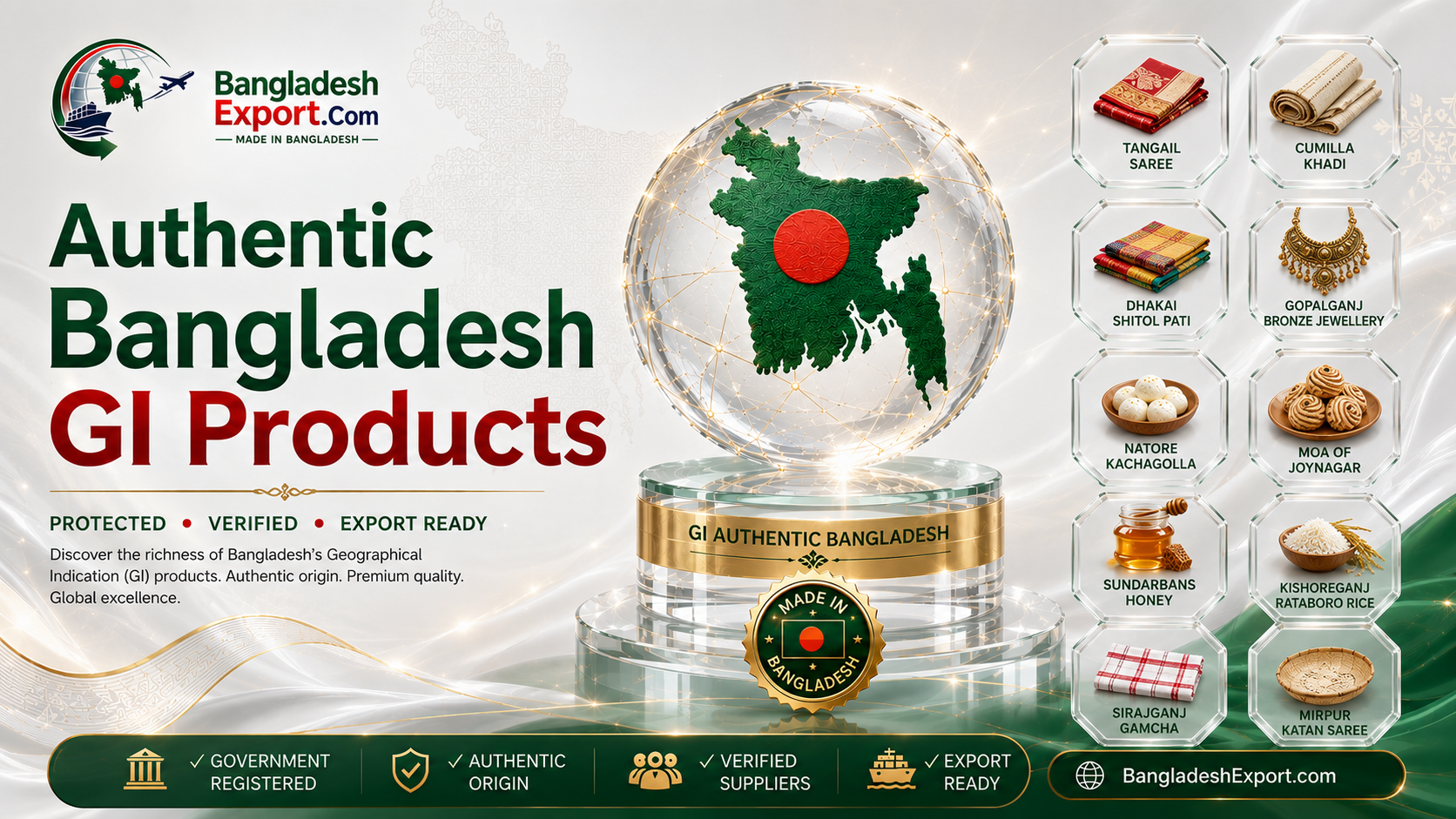
Every Bengali man owns at least one — the gamcha. This traditional handwoven cotton towel is as essential to daily life in rural Bangladesh as rice and water. Used as a towel, a scarf, a head covering, a makeshift bag, a sleeping sheet, and even a ceremonial gift, the gamcha is one of the most ubiquitous textile products in Bangladeshi culture. The "Gamcha of Sirajganj," registered as a Bangladesh GI product in 2024, represents the premium end of this everyday product — woven in the Sirajganj district of northern Bangladesh using traditional handloom techniques that produce a distinctive checkered pattern, soft hand-feel, and exceptional durability. For buyers in the sustainable-textile, fair-trade, and ethnic-goods segments, Sirajganj Gamcha offers a genuinely authentic, high-volume, low-cost Bangladeshi handloom product with mass-market accessibility.
This guide is for international textile importers, sustainable-fashion brands, fair-trade retailers, and ethnic-goods distributors sourcing authentic Gamcha of Sirajganj directly from verified weavers. We cover the gamcha's cultural significance, the 2024 GI registration, the Sirajganj production region, weaving technique, quality grading, export markets, HS codes, packaging, authenticity verification, certifications, and direct sourcing from verified textile suppliers on BangladeshExport.com.
📜 Cultural Significance and Historical Roots
Buyers can verify the official list of Bangladesh's registered Geographical Indication (GI) products through the Bangladesh Trade Portal: bangladeshtradeportal.gov.bd — GI Products Page
The word "gamcha" derives from the Bengali "ga mochho" — literally meaning "to wipe the body." This etymological root reveals the gamcha's primary identity as a functional body-drying textile, but over the centuries it has grown into a far richer cultural artifact. The handloom weaving tradition in the Sirajganj region dates back at least 200 years, with some oral histories tracing organized gamcha production to the early 19th century when the British colonial administration formalized jute and cotton trading along the Jamuna river corridor. Sirajganj, situated on the eastern banks of the Jamuna, developed a strong handloom weaving tradition due to the convergence of three factors: reliable supply of cotton yarn from local spinning mills in Pabna and Bogura, a large traditional weaver community predominantly from the Hindu Tanti and Muslim Julaha castes, and easy river-borne access to the Kolkata textile market.
The Sirajganj gamcha became known across Bengal for its distinctive tight checkered weave, soft but durable texture, and the characteristic combination of red-and-white or blue-and-white color patterns. The red-and-white variant, in particular, carries cultural symbolism — the red (aar shada) represents vitality and auspiciousness, while the white checks symbolize purity. In rural households, a fresh gamcha is traditionally presented to a groom before his wedding, to a son leaving for higher studies or hajj pilgrimage, and to honored guests as a mark of respect. During the Bengali New Year (Pohela Boishakh) celebrations, men across Bangladesh drape gamchas around the neck or shoulders as a visible marker of cultural identity, and political and cultural leaders have adopted the gamcha as a symbol of rural Bangladeshi pride.
The 2024 GI registration — part of DPDT's historic wave of Bangladesh GI protections — formally recognized the "Gamcha of Sirajganj" name and tied it legally to the Sirajganj production region and traditional handloom method. This registration protects the weaver community of Sirajganj from cheap power-loom imitations that have flooded the market since the 1990s, and gives international buyers legal recourse against counterfeit product. See also our complete 60-product GI list and our Tangail Saree guide (a related Bangladeshi GI handloom textile from the same broader region), as well as our Katan Saree of Mirpur guide for a comparison of Bangladeshi handloom premium textiles.
🏛️ GI Registration and Production Region
The Gamcha of Sirajganj was registered by the Department of Patents, Designs and Trademarks (DPDT) under the Ministry of Industries in 2024, alongside other Bangladeshi handloom and agricultural GI products. The GI registration specifically protects the name "Sirajganj Gamcha" or "Gamcha of Sirajganj" for cotton gamchas produced within the geographical boundaries of Sirajganj district using traditional pit-loom handloom techniques. The protected production region covers the entire Sirajganj district, including the major weaving clusters of Sirajganj Sadar, Ullahpara, Raiganj, Kamarkhanda, Belkuchi, Chowlihash, and Tarash upazilas. Of these, Ullahpara and Belkuchi account for the largest concentration of working pit looms, with an estimated 12,000–15,000 active weaver households across the district.
Buyers should request a GI registration certificate from the supplier and verify the production location — the GI protection does not extend to gamchas produced in Pabna, Bogura, Natore, or other neighboring districts even when those products look visually similar. Verification follows the methodology in our GI verification guide, which covers the four-stage verification process: documentary (GI certificate, cooperative membership), physical (weave inspection, handloom irregularity test), geographical (production address verification), and institutional (Bangladesh Handloom Board certification).
🧶 Weaving Technique, Loom Setup, and Production Workflow
The authentic Sirajganj Gamcha is produced on a traditional pit loom (khatiya loom) — a wooden frame loom where the weaver sits in a shallow pit with the loom frame above the lap. This loom type has remained essentially unchanged for over 150 years and produces the characteristic handloom irregularities that distinguish the Sirajganj product from power-loom alternatives. The complete production workflow involves eight stages: (1) yarn procurement — typically 60s or 80s count cotton yarn from local spinning mills or imported from India; (2) yarn dyeing — vat dyes for the red or blue color, with the white yarn left undyed; (3) drying and conditioning — yarn is dried in shaded courtyards to preserve color fastness; (4) warping — winding the warp yarn onto the beam in the correct sequence to create the checkered pattern; (5) drafting — threading warp yarns through heddles and reed, the most skilled step; (6) weaving — the actual pit-loom operation, typically 8–12 hours per gamcha; (7) cutting and finishing — removing the gamcha from the loom, knotting fringe ends, and inspecting for defects; (8) washing and pressing — final softening and folding for retail.
The checkered pattern is created by alternating blocks of colored and white warp and weft yarns in a fixed sequence. The traditional Sirajganj check uses a 6×6 or 8×8 yarn block, producing checks of approximately 1.5–2.0 cm. The decorative border (par) at both ends is created by introducing a different weft pattern for the first and last 5–8 cm of the gamcha, often with a zigzag or diamond motif. A skilled weaver can complete one standard-size gamcha (1.8 × 0.9 m, 60s yarn) in approximately 8 hours of pit-loom work, while a premium-grade double-border piece (2.0 × 1.0 m, 80s yarn) requires 12–14 hours. Weavers typically work 8–10 hours per day and produce 5–6 gamchas per week, with household income supplemented by other family members who handle warping, fringe-knotting, and finishing.
📊 Quality Grading and Specifications
| Grade | Yarn Count | Weave Style | Dimensions | Weight (g) | Production Time | Retail Range (USD) |
|---|---|---|---|---|---|---|
| A Premium | 80s fine cotton | Tight checkered, double-border, hand-knotted fringe | 2.0 × 1.0 m | 220–250 | 12–14 hrs/piece | 5–12 |
| A Standard | 60s standard cotton | Standard checkered, single border | 1.8 × 0.9 m | 170–200 | 8–10 hrs/piece | 2–5 |
| B Grade | 40s coarse cotton | Simple checkered, no border | 1.5 × 0.8 m | 140–160 | 5–6 hrs/piece | 1–2 |
| Export Grade | 80s combed cotton | Tight checkered, color-fast vat dye, double-border | 2.0 × 1.0 m | 240–260 | 14–16 hrs/piece | 8–15 |
Authentic Sirajganj Gamcha has six distinguishing physical characteristics: (1) tight checkered weave with 6×6 or 8×8 yarn blocks; (2) soft but durable cotton hand-feel that improves with washing; (3) decorative border (par) at both ends with zigzag or diamond motif; (4) good absorbency — the gamcha's primary function is as a towel, so the weave density is calibrated to absorb moisture quickly; (5) slight handloom irregularities visible in warp tension and weft beating, which distinguish it from power-loom product; (6) hand-knotted fringe at both ends (premium grades) or simple hem (standard and B grades). Color fastness for export grade is rated at minimum 4 on the ISO 105-A02 gray scale after 10 home washes. The full production time is 1–2 days per piece on a traditional pit loom, with annual household output averaging 250–300 pieces per weaver.
🌍 Export Markets and Buyer Segments
- Middle East (UAE, Saudi Arabia, Qatar, Kuwait, Oman): Largest diaspora market — Bangladeshi expatriates buy gamchas for personal use and as gifts sent home. Retail USD 2–8 per piece in Bangladeshi grocery stores; A-grade gamchas command USD 5–12 in premium South Asian specialty stores in Dubai, Abu Dhabi, Doha, and Riyadh. Annual estimated demand: 8–10 million pieces.
- EU & UK (UK, Germany, France, Netherlands, Italy): Sustainable-fashion and fair-trade retail segment. Brands like People Tree, Gossypium, and small fair-trade boutiques source gamchas as fair-trade cotton towels, scarves, and yoga accessories. Retail EUR 4–12 per piece. EU buyers increasingly require GOTS organic certification for the cotton yarn.
- USA & Canada: Diaspora (New York, Toronto, Detroit, Los Angeles) + sustainable-fashion segment. Retail USD 3–10 per piece in Bangladeshi grocery stores; USD 8–20 per piece in yoga and wellness boutiques that position the gamcha as a "yoga towel" or "travel towel."
- India: Cultural affinity market — the gamcha is also a traditional textile in Indian states like West Bengal, Bihar, Uttar Pradesh, and Odisha. Cross-border informal trade is significant. Retail INR 50–300 per piece in border markets. Note that India has its own gamcha GI registrations (e.g., Fulia Jamdani, Assam Gamosa), so Sirajganj Gamcha competes primarily on price and authenticity.
- Australia, Japan, South Korea: Niche sustainable-fashion and ethnic-textile segments. Lower volume (50,000–200,000 pieces/year combined) but premium pricing — AUD 12–25, JPY 1,200–2,500, KRW 15,000–30,000 per piece.
- Southeast Asia (Malaysia, Singapore): Muslim-majority markets with cultural affinity and halal tourism demand. Retail MYR 10–30 / SGD 5–12 per piece.
🏷️ HS Codes and Customs Classification
| HS Code | Description | Typical Use |
|---|---|---|
| 62114200 | Women's or girls' garments of cotton, nes | Finished gamcha classified as cotton garment |
| 52081100 | Unbleached plain woven cotton fabric | Gamcha fabric sold by meter (for re-export re-cutting) |
| 63026000 | Toilet linen and kitchen linen of cotton terry | When classified as cotton towel (some markets) |
| 63025900 | Other table linen of cotton (nes) | When classified as cotton household linen |
Most Bangladesh Customs entries for gamcha exports use HS 62114200 or 63026000 depending on the destination market's classification convention. Buyers should consult their customs broker and request that the supplier declare the HS code that best matches the destination country's tariff schedule to avoid misclassification penalties. The Export Promotion Bureau of Bangladesh (EPB) maintains a tariff-line export statistics database that buyers can consult to verify recent export values per HS code.
📦 Packaging, Shipping, and Documentation
Packaging varies by buyer segment and grade. For premium and export grade, individual folding with acid-free tissue paper and a cotton drawstring bag (often printed with the supplier's logo and GI identification) is standard. For standard and B grades, bulk bales of 50–100 pieces are pressed and wrapped in jute hessian, with each bale weighing approximately 18–22 kg. Sea freight via Chittagong (Chattogram) port is viable for bulk orders above 5,000 pieces, with transit time to EU ports 25–32 days, to US East Coast 28–35 days, and to Middle East ports 14–18 days. Air freight is used for samples (10–50 pieces) and small urgent orders (up to 1,000 pieces), with transit time 3–7 days to most destinations.
Required export documentation includes: (1) Commercial Invoice with HS code, unit price, and total value; (2) Packing List with bale counts and weights; (3) Certificate of Origin issued by the Sirajganj Chamber of Commerce & Industry or the Bangladesh Chamber of Industries; (4) DPDT GI Registration certificate copy (the supplier's own copy); (5) Bangladesh Handloom Board certification (confirms handloom production, not power-loom); (6) Phytosanitary certificate (not typically required for cotton textile, but some buyers request); (7) GOTS organic cotton certification (if claimed); (8) Fair Trade certification (if claimed, from WFTO or Fair Trade USA). See our export documentation guide for the complete document checklist and a step-by-step workflow.
✅ Authenticity Verification — Seven-Point Checklist
To verify that a gamcha marketed as "Sirajganj Gamcha" is authentic, perform the following seven-point inspection:
- Weave inspection: Tight checkered weave with 6×6 or 8×8 yarn blocks; visible handloom irregularities in warp tension and weft beating (slight unevenness is normal and authentic — perfectly even weave indicates power-loom production).
- Border inspection: Decorative border (par) at both ends with zigzag or diamond motif; border is woven integrally with the body, not sewn on afterward.
- Hand-feel test: Soft cotton hand-feel that improves with washing; stiff or waxy feel indicates sizing treatment common in power-loom product.
- Absorbency test: Drop 5 ml of water on the gamcha — authentic Sirajganj Gamcha absorbs within 3–5 seconds; prolonged pooling indicates synthetic blend or sizing.
- Color pattern: Traditional red-and-white or blue-and-white pattern with color-fast vat dyes; rub-test the colored yarn against white cotton — significant color transfer indicates poor dye quality.
- DPDT GI registration: Supplier provides a copy of the DPDT GI registration certificate; for bulk orders, request the cooperative's GI usage authorization letter.
- Sirajganj production documentation: Bangladesh Handloom Board certification confirming production at a Sirajganj address; cooperative membership card for the weaver; cross-verify production address through the Sirajganj Chamber of Commerce.
🏛️ Certifications and Institutional Support
Beyond the GI registration, multiple institutional certifications support the Sirajganj Gamcha supply chain. The Bangladesh Handloom Board (BHB), under the Ministry of Textiles and Jute, issues weaver ID cards and provides subsidized yarn through the National Yarn Bank — buyers can request the supplier's BHB registration number to verify legitimate handloom status. The Bangladesh Small and Cottage Industries Corporation (BSCIC) registers gamcha weaving cooperatives and provides working capital loans — many Ullahpara and Belkuchi weaving clusters are organized as BSCIC cooperatives. For organic cotton claims, the Global Organic Textile Standard (GOTS) certification is required by most EU buyers; some Sirajganj suppliers now offer GOTS-certified organic cotton gamchas at a 25–35% premium. For fair-trade claims, the World Fair Trade Organization (WFTO) membership or Fair Trade USA certification is the recognized standard.
Institutional support for export comes from three agencies: the Export Promotion Bureau (EPB) provides market intelligence and trade-fair participation subsidies; the Bangladesh Handloom Board provides design development and quality control training; and the Bangladesh Garment Manufacturers and Exporters Association (BGMEA) — though primarily focused on readymade garments — has expanded its handloom subcommittee to support gamcha and other handloom textile exports. Buyers seeking institutional supplier referrals can contact the Sirajganj Chamber of Commerce & Industry directly or browse the broader Bangladesh exporters' association directory on BangladeshExport.com.
🤝 Sourcing Verified Gamcha Weavers — Five-Step Process
- Browse verified textile suppliers: Start with our 1,180 verified Textiles & Fabrics suppliers — filter by district (Sirajganj) and subcategory (Handloom / Towel / Cotton Textile) to shortlist 10–15 suppliers.
- Post a free RFQ: Submit a Request for Quotation specifying "Gamcha of Sirajganj" with grade (A Premium / A Standard / B / Export Grade), color pattern (red-white or blue-white), quantity, dimensions, packaging, and destination port. Verified suppliers respond within 24–72 hours.
- Check credentials: For each shortlisted supplier, verify (a) Bangladesh Handloom Board registration, (b) BSCIC cooperative membership (if applicable), (c) DPDT GI registration copy, (d) Sirajganj Chamber of Commerce membership, (e) GOTS or Fair Trade certification (if claimed), and (f) EPB export track record.
- Order samples: Request 10–50 pieces (mixed grades if possible) before placing a bulk order. Pay for samples via L/C or escrow. Evaluate samples against the seven-point authenticity checklist above. Visit the weaving cluster in person if the bulk order exceeds USD 50,000.
- Finalize directly: For orders over USD 5,000, use an irrevocable L/C at sight from a top-50 international bank; for smaller orders, advance payment with 50% deposit and 50% against shipping documents is standard. BangladeshExport.com does not charge commission — buyers transact directly with suppliers.
If you are a Sirajganj gamcha weaver or weaving cooperative: register as a supplier on BangladeshExport.com (free). The platform is the only government-aligned export marketplace focused exclusively on Bangladesh-origin products and connects you directly with verified international buyers without intermediary margins.
🚀 Source Authentic Sirajganj Gamcha — Free RFQ
Post a free RFQ for authentic Gamcha of Sirajganj from verified weavers. Specify grade, color, quantity, and destination — verified suppliers respond within 24–72 hours. No commission, no middleman, direct supplier contact.
🚀 Post a Free RFQ → 🔍 Browse 1,180 Verified Textile Suppliers🎯 Conclusion
The Gamcha of Sirajganj is Bangladesh's most accessible GI textile — an everyday product with cultural ubiquity, handloom authenticity, and a price point that makes it viable for mass-market retail. For buyers seeking an entry-level Bangladeshi handloom product with GI legal protection, Sirajganj Gamcha is the ideal starting point. Its combination of low unit cost (USD 1–15 across grades), proven cultural demand across South Asian diaspora markets, growing acceptance in sustainable-fashion and fair-trade segments, and robust institutional support from the Bangladesh Handloom Board makes it a low-risk, high-volume sourcing decision. BangladeshExport.com makes sourcing free and transparent — start with a free RFQ today and connect directly with verified weaver cooperatives in Ullahpara, Belkuchi, and Sirajganj Sadar.
For the complete catalog of 60+ Bangladesh GI products, see our complete GI products list. For related Bangladeshi GI handloom textiles, see our Tangail Saree guide, Khadi of Comilla guide, Katan Saree of Mirpur guide, and Lungi guide (a related everyday handloom textile). For broader context on Bangladesh handloom export trends, see our 2026 global demand analysis. For step-by-step verification methodology, see our GI verification guide.
❓ Frequently Asked Questions
What makes Gamcha of Sirajganj a GI product?
Gamcha of Sirajganj was registered as a Bangladesh GI product by DPDT in 2024. The registration protects the name "Sirajganj Gamcha" for the traditional handwoven cotton towel produced in Sirajganj district using pit-loom handloom techniques with the characteristic checkered pattern and decorative border. The GI registration legally distinguishes authentic Sirajganj Gamcha from power-loom imitations and from gamchas produced in other Bangladeshi districts.
How is a gamcha different from a regular towel?
Three main differences. First, material: gamcha is woven cotton (not terry cloth); it is thinner, lighter, and more breathable. Second, pattern: gamcha has a distinctive checkered weave with decorative borders — regular towels are plain terry. Third, versatility: gamcha is used as towel, scarf, head covering, bag, and sleeping sheet — a multi-purpose textile that regular towels are not designed for. The gamcha's tighter, flatter weave also dries faster than terry cloth, which is essential in humid Bangladeshi climates.
What is the HS code for gamcha exports?
Gamcha uses HS codes 62114200 (cotton garments, nes — for finished gamcha), 52081100 (unbleached cotton fabric — for gamcha fabric by meter), or 63026000 (cotton toilet linen — when classified as towel). Most Bangladesh Customs entries use 62114200 or 63026000 depending on destination market convention.
How do I verify that a gamcha is authentic Sirajganj Gamcha?
Use the seven-point checklist: (1) tight checkered weave with handloom irregularities; (2) decorative border (par) at both ends; (3) soft cotton hand-feel; (4) good absorbency (3–5 second water drop test); (5) traditional red-white or blue-white color pattern with color-fast vat dyes; (6) DPDT GI registration certificate; (7) Sirajganj production documentation (Bangladesh Handloom Board certification, cooperative membership).
What is the MOQ for gamcha?
Typical MOQ is 100–1,000 pieces for first-time buyers. For trial orders, weavers may accept 10–50 pieces. Bulk B-grade orders can reach MOQs of 500–5,000 pieces with significant unit-price discounts. Sea freight becomes viable above 5,000 pieces; air freight is preferred for samples and orders below 1,000 pieces.
What is the production capacity of Sirajganj weavers?
Sirajganj district has an estimated 12,000–15,000 active weaver households, primarily in Ullahpara and Belkuchi upazilas. A skilled weaver produces 5–6 gamchas per week, or 250–300 per year. Total district annual production is estimated at 3.5–4.5 million pieces, of which approximately 1.5–2.0 million are exported (formal and informal channels combined).
Can I source organic or fair-trade certified gamcha?
Yes — a growing number of Sirajganj suppliers offer GOTS-certified organic cotton gamchas (typically 25–35% price premium) and WFTO or Fair Trade USA certified fair-trade gamchas (15–25% premium). State this requirement clearly in your RFQ and request certification documentation as part of the supplier shortlisting process.
Where can I find verified gamcha suppliers?
BangladeshExport.com hosts 1,180 verified Textiles & Fabrics suppliers. Post a free RFQ specifying "Gamcha of Sirajganj" with your grade, color, quantity, and destination — verified weavers and cooperatives will respond within 24–72 hours.