Bangladesh GI Products: Complete Guide for Global Buyers (2026)
Bangladesh's 60+ registered GI products — the complete 2026 guide for global buyers. Verified manufacturers, sourcing process, export potential, free RFQ system.
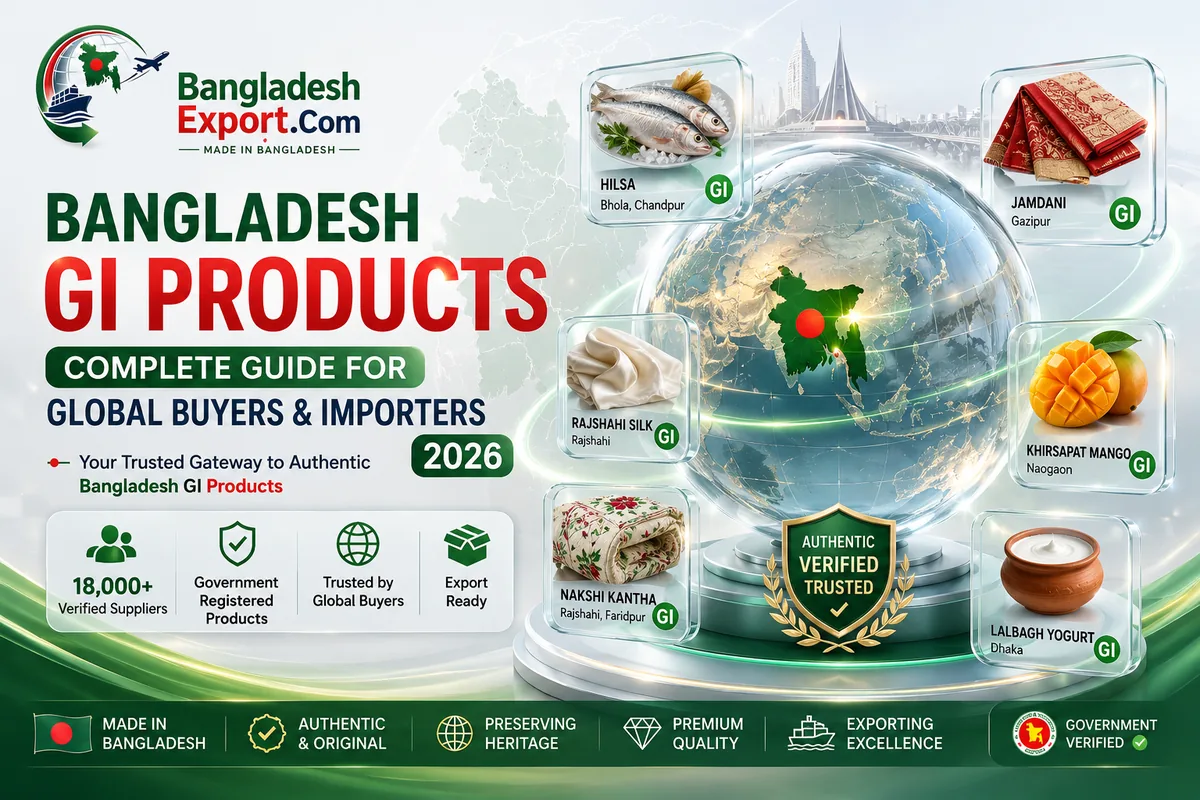
Bangladesh has quietly become one of South Asia's most exciting sourcing destinations for buyers who want authenticity, heritage and verified quality — not just cheap volume. The country's Geographical Indication (GI) registry, administered by the Department of Patents, Designs and Trade Marks (DPDT), now covers more than 60 registered products ranging from the world-famous Jamdani saree to Padma river Hilsa, Khirsapat mango and Sundarbans honey. For a global buyer, importer or sourcing agency, understanding which Bangladeshi GI products exist, how they are verified, and how to source them directly from registered manufacturers is no longer optional — it is the difference between buying a generic commodity and buying a story-backed premium product.
This 2026 guide is the definitive resource on Bangladesh GI products for international buyers. It explains what GI protection means under WTO/TRIPS, lists every registered Bangladeshi GI product by category, ranks them by export potential, and shows you exactly how to verify authenticity and source directly from verified manufacturers on BangladeshExport.com — completely free for buyers.
📚 What Is a Geographical Indication (GI) Product?
Buyers can verify the official list of Bangladesh's registered Geographical Indication (GI) products through the Bangladesh Trade Portal maintained by the Government of Bangladesh. Refer to the official GI products page for the latest registrations and updates:
bangladeshtradeportal.gov.bd — GI Products Page
A Geographical Indication (GI) is a sign used on products that have a specific geographical origin and possess qualities, reputation or characteristics essentially attributable to that origin. In simple terms: a GI tag tells the world that "this product can only authentically come from this specific place, made by these specific people, using these specific methods." Champagne must come from the Champagne region of France. Parmigiano-Reggiano must come from Parma, Italy. Darjeeling tea must come from Darjeeling, India. The same legal principle now protects Jamdani from Narayanganj, Hilsa from the Padma-Meghna river system, and Khirsapat mango from Chapainawabganj.
Internationally, GI protection is grounded in the World Trade Organization's TRIPS Agreement (Trade-Related Aspects of Intellectual Property Rights, 1994), which requires all 164 WTO member states to provide legal protection for geographical indications. Bangladesh enacted its own Geographical Indication of Goods (Registration and Protection) Act 2013, and the DPDT began registering products under this law in 2016, with Jamdani saree becoming the country's first GI-registered product.
For buyers and importers, the practical implication is significant: a GI-registered product cannot legally be sold under that name unless it actually originates from the registered region and is made using the registered method. This means a "Jamdani saree" sold without authentic Narayanganj-origin documentation is, legally, not a Jamdani saree — and customs authorities in WTO member states can seize counterfeit shipments under TRIPS enforcement provisions.
🎯 Why Bangladesh GI Products Matter for Global Importers
For a global importer, GI products matter for four concrete commercial reasons that go well beyond the romantic idea of "heritage sourcing."
First, authenticity commands a premium. A genuine GI-tagged Jamdani saree retails in European boutiques at 3–5× the price of a non-GI imitation, because the buyer is paying for verifiable provenance. The same premium applies to GI Hilsa in Middle Eastern markets, GI Khirsapat mango in the EU, and GI Muslin in Japanese luxury textile markets. Importers who source authenticated GI products can defend higher retail prices with documentation — and consumers are increasingly willing to pay that premium.
Second, buyer confidence is structurally higher. A GI registration is a government-issued intellectual property right, not a marketing claim. When you tell your retail customer "this is a registered GI product of Bangladesh, certificate number XYZ issued by DPDT," you are making a legally verifiable claim — not a brand assertion. This shifts the trust conversation.
Third, cultural heritage creates a marketing story. Modern consumers — particularly Millennials and Gen Z in the EU, USA and Japan — increasingly buy stories, not just products. A Nakshi Kantha quilt embroidered by artisan women in Jamalpur using a centuries-old technique is a far stronger marketing narrative than "a quilt from Bangladesh." The GI tag is the legal proof that the story is true.
Fourth, differentiation from competing suppliers. India, Pakistan, Sri Lanka, Vietnam and Cambodia all compete with Bangladesh in textiles, agriculture and food. But Bangladesh's GI registry includes products that no other country can claim — Muslin of Dhaka, Hilsa of the Padma, Khirsapat of Chapainawabganj. These are uniquely Bangladeshi assets, and they cannot be replicated elsewhere.
Key insight: Bangladesh's GI registry as of July 2026 contains more than 60 registered products — but most international buyers can name only one (Jamdani). The commercial opportunity lies in the other 59.
📊 Bangladesh GI Products — Overview (2026)
As of July 2026, Bangladesh has registered more than 60 products under the Geographical Indication of Goods (Registration and Protection) Act 2013. The registrar is the Department of Patents, Designs and Trade Marks (DPDT), under the Ministry of Industries. The complete and current list of registered products is published on the Bangladesh Trade Portal GI Products page, maintained by the Ministry of Commerce.
The registration timeline shows steady acceleration: Jamdani in 2016, Hilsa and Rajshahi Silk in 2017, Khirsapat Mango and Shotoronji in 2018, Kalijira Rice in 2019, Dhakai Muslin in 2020, and a major wave of registrations in 2024 that added more than 40 new products including Tangail Saree, Khadi of Comilla, Nakshi Kantha of Jamalpur, Bogurar Doi, and dozens of regional fruits, sweets and handicrafts. The 2024 wave was the largest single-year GI expansion in Bangladesh's history.
For buyers, this rapid expansion means two things: first, the catalog of authenticatable Bangladeshi products is now large enough to support a serious "Bangladesh GI" sourcing strategy across multiple categories; second, because many of these registrations are new, supply chains are still maturing — early-moving importers can lock in supplier relationships before competitors discover these products.
🏷️ Major Categories of Bangladesh GI Products
The 60+ registered Bangladeshi GI products span five major categories. Each category has its own buyer profile, sourcing pattern and export logistics considerations.
🧵 Textiles — 12 registered products
The flagship category. Includes Jamdani Shari (the original 2016 registration), Dhakai Muslin, Rajshahi Silk, Tangail Saree, Khadi of Comilla, Monipuri Saree of Sylhet, Katan Saree of Mirpur, Gamcha of Sirajganj, Bed Sheet of Kumarkhali, Lungi of Sirajganj, and the Dhakai Phuti Karpas cotton that authentic Muslin requires. Textiles are the highest-export-potential GI category because they are non-perishable, high-value-per-kilogram, and have established buyer markets in the EU, USA, UK, Japan and the Middle East.
🪡 Handicrafts — 6 registered products
Includes Nakshi Kantha of Jamalpur (the iconic embroidered quilt), Shital-Pati (a traditional woven mat), Shotoronji of Rangpur (handwoven floor rug), Sadamati of Bijoypur (a traditional clay craft), Chhanamukhi of Brahmanbaria, and bronze jewelry of Gopalganj. Handicrafts appeal to fair-trade buyers, luxury home-decor retailers, and boutique gift markets. Order quantities are typically smaller than textiles, but margins are higher.
🍽️ Food — 32 registered products
The largest category by count. Includes Hilsa fish (the second Bangladeshi GI, registered 2017), six varieties of mango (Khirsapat, Ashwina, Fazli, Langra, Haribhanga, Nak Fazli), iconic sweets (Bogurar Doi, Kachagolla of Natore, Porabari Chomchom, Rasmalai of Cumilla, Muktagacha Monda), fruits (Pineapple of Madhupur, Jackfruit of Gazipur, Litchi of Magura and Dinajpur, Banana varieties), and confectionery (Tiler Khaja of Kushtia, Jessore Molasses). Food is high-volume but requires careful cold-chain logistics for perishables; sweets and confectionery are shelf-stable and easier to export.
🌾 Agriculture — 5 registered products
Includes four premium rice varieties (Kalijira, Kataribhog of Dinajpur, Tulshi-Mala of Sherpur, Rata Boro of Kishoreganj) and Sweet Betel Leaf of Rajshahi. Premium aromatic rice has strong demand in Middle Eastern and South Asian diaspora markets. Betel leaf has niche demand in Indian and Southeast Asian markets.
🌿 Natural Products — 5 registered products
Includes Honey of Sundarbans (wild honey harvested from the world's largest mangrove forest), Agar and Agar Attar of Moulvibazar (premium aromatic wood and essential oil used in Middle Eastern perfumery), Black Bengal Goat (a heritage livestock breed), and Jute of Faridpur (the original "golden fiber" of Bangladesh). Natural products command the highest average export potential (4.4 stars out of 5) because they include several luxury/perfumery inputs with strong international demand.
⭐ Top Bangladesh GI Products with Export Potential
Not all 60+ GI products have the same commercial appeal. The following table ranks the top 10 by export potential for international buyers in 2026, based on international demand signals, perishability, premium positioning, and existing export volume data from the Export Promotion Bureau (EPB).
| Product | Region | Primary Buyer Market | Export Potential |
|---|---|---|---|
| Jamdani Saree 🧵 | Narayanganj | USA, UK, Canada | ★★★★★ |
| Ilish (Hilsa) 🐟 | Padma-Meghna river | Middle East, UK, USA | ★★★★★ |
| Khirsapat Mango 🥭 | Chapainawabganj | EU, Middle East | ★★★★★ |
| Rajshahi Silk 🧵 | Rajshahi | Europe, USA, Japan | ★★★★★ |
| Tangail Saree 🧵 | Tangail | UK, India, USA | ★★★★★ |
| Nakshi Kantha 🪡 | Jamalpur | Europe, Japan, USA | ★★★★★ |
| Dhakai Muslin 🧵 | Dhaka | EU luxury, Japan | ★★★★★ |
| Agar Attar 🌿 | Moulvibazar | Middle East (perfumery) | ★★★★★ |
| Sundarbans Honey 🍯 | Sundarbans | EU, USA, Japan | ★★★★☆ |
| Bogurar Doi (Yogurt) 🍶 | Bogura | Middle East (diaspora) | ★★★★☆ |
For a complete list of all 60+ registered GI products with districts, GI registration years and export-potential ratings, see our companion guide: Bangladesh GI Products List (2026): 60+ Verified Items for Global Buyers.
✅ How Buyers Can Verify Bangladesh GI Products
Verification is the single most important step in GI sourcing — and it is the step that most first-time buyers skip, to their eventual regret. The Bangladeshi GI market, like every GI market globally, has counterfeit products. A "Jamdani" sold in a tourist shop without DPDT documentation is almost certainly a power-loom imitation. A "Hilsa" imported from Myanmar is legally not Hilsa under Bangladeshi GI protection.
Verification follows a four-layer framework:
- Layer 1 — Government GI registration: Confirm the product appears on the official Bangladesh Trade Portal GI Products page. If a product is not on this list, it is not a registered Bangladeshi GI product — regardless of what the supplier claims.
- Layer 2 — Manufacturer GI certificate: The manufacturer should hold a GI registration certificate issued by DPDT, with a registration number traceable on the DPDT portal. Ask the supplier for the certificate number and verify it independently.
- Layer 3 — Exporter licence verification: The exporter should hold valid association memberships (BGMEA for garments, BKMEA for knitwear, EPB registration for general exports, CBCCTG bonded licence for bonded warehouse operations). These are publicly verifiable on the respective association websites and on BangladeshExport.com supplier profiles.
- Layer 4 — BangladeshExport.com multi-source cross-verification: Our platform cross-checks supplier claims against BGMEA, BKMEA, EPB, BayXBengal and CBCCTG databases. Suppliers who pass this cross-verification display a "Verified" badge on their profile — meaning at least two independent data sources confirm the supplier's stated memberships and licences.
For a complete walkthrough of the verification process — including the exact questions to ask suppliers, red flags to watch for, and how to read a GI certificate — see our dedicated guide: How to Verify Bangladesh GI Products Before Importing.
🚀 Source GI Products from Verified Manufacturers — Free
Post a free Request for Quotation (RFQ) on BangladeshExport.com and let verified GI manufacturers compete for your order. No middlemen, no commission, no fees for buyers. Specify the product, quantity, target price and destination — verified suppliers respond directly.
🚀 Post a Free RFQ → 🔍 Browse Verified Suppliers🤝 How BangladeshExport.com Helps You Source GI Products
BangladeshExport.com is Bangladesh's largest B2B supplier discovery platform — and our explicit mission is to be the first stop for every global buyer researching Bangladeshi exports. Our value proposition for GI sourcing is built on four pillars.
1. Verified supplier directory. Our supplier database contains more than 7,900 active Bangladeshi exporters, cross-referenced against BGMEA (4,271 members), BKMEA (2,781 members), EPB (5,910 registered exporters) and CBCCTG (1,733 bonded warehouse licensees). When you see a supplier marked "Verified" on our platform, it means at least two independent government or association sources confirm the supplier's stated memberships, licences and operational status. This multi-source verification is not a marketing claim — it is a structured data pipeline.
2. Free RFQ system. Buyers post Requests for Quotation at no cost. Specify the GI product you want (e.g. "Jamdani saree, cotton-mixed, 100 units, FOB Dhaka"), and verified suppliers respond with quotes within 24–72 hours. You compare prices, MOQs, lead times and supplier ratings in one dashboard — no middleman markups, no commissions, no buyer-side fees. Post a free RFQ now.
3. Direct factory connection. Once you shortlist a supplier, you communicate directly with them via our in-platform messaging system — no platform intermediary. You can request samples, arrange factory audits, negotiate terms and finalize contracts directly. We do not take a cut of any deal.
4. Multi-source verification data on every supplier profile. Each supplier profile on BangladeshExport.com displays the supplier's BGMEA membership number (if applicable), BKMEA membership number, EPB registration number, CBCCTG bonded licence number, DIFE labour licence, and any certifications (WRAP, BSCI, OEKO-TEX, GOTS, etc). This is the same data the supplier would show you in a private conversation — but pre-verified and visible before you make contact. See an example on our supplier directory.
For suppliers, listing a GI product on BangladeshExport.com is also free. If you are a Bangladeshi GI manufacturer holding a DPDT registration certificate, register as a supplier and select "GI Products" as your category — your products will be discoverable by the global buyers visiting this blog.
🌍 Why Bangladesh GI Products Are Gaining Global Attention
The global market for authentic, story-backed, region-specific products is growing faster than the overall B2B trade market — and Bangladesh is uniquely positioned to capture a disproportionate share of this growth. Three forces are driving this:
First, EU and US consumer shift toward provenance. Post-pandemic research by McKinsey, Bain and Deloitte consistently shows that 65–75% of affluent consumers in the EU, USA and Japan now consider "where a product comes from" as a top-three purchase factor — up from 35% in 2015. This shift directly benefits GI products, which legally encode provenance.
Second, Middle Eastern and diaspora demand. The Bangladeshi diaspora in Saudi Arabia, UAE, Qatar, Oman, Kuwait, the UK and the USA represents a built-in market of more than 13 million people who actively seek authentic Bangladeshi products for cultural, religious and familial reasons. Hilsa exports to the Middle East peak during Ramadan; Jamdani and Nakshi Kantha sales peak during Eid and wedding seasons.
Third, revival of nearly-extinct heritage crafts. Dhakai Muslin, woven from the indigenous Phuti Karpas cotton, was nearly extinct by the 1990s. A government-and-private revival project has now brought it back into commercial production, with GI registration granted in 2020. Japanese and European luxury textile buyers have shown strong interest. For a deeper analysis of why Bangladesh GI products are becoming globally popular — including regional demand breakdowns and growth forecasts — see our companion guide: Why Bangladesh GI Products Are Globally Popular (2026).
🎯 Conclusion — Your Next Step
Bangladesh's GI registry has matured from a single-product listing in 2016 (Jamdani) to a 60+ product portfolio in 2026 spanning textiles, handicrafts, food, agriculture and natural products. For global buyers, importers and sourcing agencies, this is no longer a niche opportunity — it is a serious commercial category with verifiable authenticity, government-backed legal protection and a maturing supplier base.
The buyers who will win in this market are the ones who move early, verify rigorously, and build direct supplier relationships before competitors discover these products. BangladeshExport.com exists to make that process free, transparent and verifiable for you.
Three ways to start today:
- 🚀 Post a free RFQ — tell us which GI product you want, and verified suppliers will respond within 24–72 hours.
- 🔍 Browse verified GI suppliers — see the manufacturers and exporters already registered on our platform.
- 📝 Register as a buyer — free account unlocks saved supplier shortlists, RFQ tracking, and direct supplier messaging.
For Bangladeshi GI manufacturers reading this: register as a supplier and select "GI Products" as your category. Listing is free, and our team will verify your DPDT certificate and association memberships at no cost.
❓ Frequently Asked Questions
What is a Geographical Indication (GI) product?
A Geographical Indication is a legal sign used on products that have a specific geographical origin and possess qualities, reputation or characteristics essentially attributable to that origin. In Bangladesh, GI registration is granted by the Department of Patents, Designs and Trade Marks (DPDT) under the Geographical Indication of Goods (Registration and Protection) Act 2013. Once registered, only products genuinely originating from the registered region and made using the registered method can legally carry the GI name.
How many GI products are registered in Bangladesh in 2026?
As of July 2026, Bangladesh has registered more than 60 GI products. The complete and current list is maintained on the Bangladesh Trade Portal GI Products page by the Ministry of Commerce. Major categories include textiles (12 products), food (32 products), handicrafts (6 products), agriculture (5 products) and natural products (5 products).
Can I import Bangladesh GI products directly as a foreign buyer?
Yes. Global buyers can import Bangladesh GI products directly from verified manufacturers through BangladeshExport.com. The process is: (1) post a free RFQ specifying the product, quantity and target price; (2) receive quotes from verified suppliers within 24–72 hours; (3) shortlist suppliers and request samples; (4) negotiate terms directly with the supplier via in-platform messaging; (5) finalize the contract and arrange shipment. There are no buyer-side fees at any step.
How do I verify that a Bangladesh GI product is authentic?
Verify via four layers: (1) confirm the product appears on the official Bangladesh Trade Portal GI list; (2) check that the manufacturer holds a DPDT-issued GI registration certificate with a traceable registration number; (3) verify the supplier's BGMEA/BKMEA/EPB/CBCCTG memberships; (4) prefer suppliers marked "Verified" on BangladeshExport.com, which means our platform has cross-checked the supplier against multiple independent data sources. See our detailed verification guide for the full process.
Which countries import the most Bangladesh GI products?
The Middle East (Saudi Arabia, UAE, Qatar, Oman, Kuwait) is the largest market for Hilsa, Bogurar Doi and other food products, driven by the 13-million-strong Bangladeshi diaspora in the region. The EU (especially Germany, France, the Netherlands and the UK) leads in textile GI products like Jamdani, Muslin and Nakshi Kantha. The USA and Canada are growing markets for both textiles and handicrafts. Japan is an emerging market for Rajshahi Silk and premium Muslin, driven by Japanese appreciation for traditional craft.
Is BangladeshExport.com free for buyers?
Yes. BangladeshExport.com is completely free for buyers — searching suppliers, posting RFQs, messaging suppliers, accessing all blog content including this guide, and tracking your RFQs in the dashboard. We monetise through optional supplier memberships (suppliers pay for premium visibility features) and through advertising — never through buyer fees. You can register as a buyer here at no cost.
How are GI products different from regular Bangladeshi export products?
A regular Bangladeshi export product (e.g. a standard woven shirt from a Dhaka factory) is a commodity — any factory with similar capability can produce an equivalent. A GI product (e.g. Jamdani) is legally protected — only manufacturers in the registered region using the registered method can sell it under that name. This means GI products command premium pricing, have stronger marketing stories, and offer buyers legal protection against counterfeits. The trade-off is that GI product supply is limited to specific regions and traditional methods.