Patkheer of Munshiganj: Bangladesh Heritage GI Sweet — Buyer's Guide (2026)
Patkheer of Munshiganj — Bangladesh's 2024 GI kheer-based layered sweet. 250-year tradition, 4-6 hour slow milk reduction, 16-64 layers per piece, cardamom-nutmeg aromatic. HS 21069090, 7-point authenticity, 435 verified food suppliers.
The Patkheer of Munshiganj — registered as a Bangladesh GI product in 2024 — is one of Bangladesh's most distinctive traditional sweets, an artisan confectionery made from condensed milk, sugar, and a unique blend of aromatic spices that has been crafted by the sweet-maker families of Munshiganj for over two centuries. The name "Patkheer" comes from the Bengali words "pat" (meaning "leaf" or "thin layer") and "kheer" (meaning "thickened milk confection"), referring to the sweet's distinctive thin, layered, paper-like texture that shatters delicately when bitten. Unlike the more common Bengali chhana-based sweets (such as rosogolla, chomchom, or rasmalai), Patkheer is a kheer-based confection — made by slowly reducing full-fat cow milk for hours until it thickens into a dense, fudge-like consistency, then flavored with cardamom, nutmeg, and a small amount of rice flour or arrowroot as a binder.
This guide is for international diaspora grocers, ethnic-food distributors, premium sweet retailers, and HORECA buyers sourcing authentic Patkheer of Munshiganj. We cover the sweet's history, the 2024 GI registration, the Munshiganj production region, the traditional kheer-making technique, quality characteristics, export markets, HS codes, packaging and cold-chain logistics, authenticity verification, certifications, and direct sourcing from verified food suppliers on BangladeshExport.com.
📜 History and the Munshiganj Sweet-Making Heritage
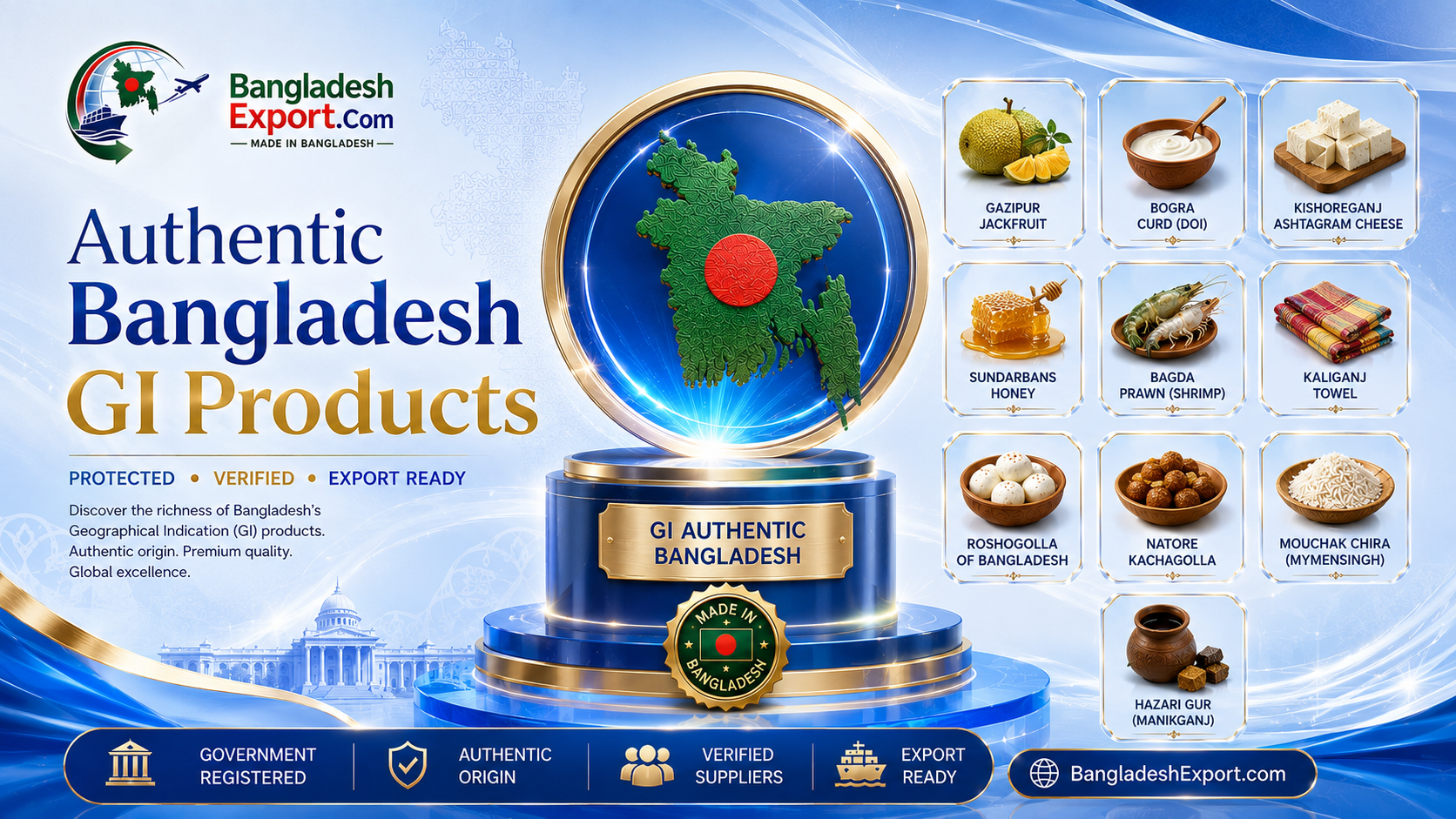
Buyers can verify the official list of Bangladesh's registered Geographical Indication (GI) products through the Bangladesh Trade Portal: bangladeshtradeportal.gov.bd — GI Products Page
Munshiganj district, situated just south of Dhaka along the confluence of the Padma, Meghna, and Dhaleshwari rivers, has been a renowned sweet-making region for over 250 years. The district's specific agro-climatic conditions — the fertile alluvial soil of the Padma floodplain that supports abundant dairy production from indigenous Bengal cow breeds, the year-round availability of high-quality milk, and the river-trade connectivity that historically linked Munshiganj to the major Bengali markets of Dhaka, Narayanganj, and Kolkata — created an ideal environment for the development of a sophisticated sweet-making tradition. Munshiganj's confectioner community, primarily the Pal, Das, and Modak families of Munshiganj Sadar, Sreenagar, and Lauhajang upazilas, developed several distinctive sweet varieties over the centuries, of which Patkheer is the most iconic and the only one to have received GI registration to date.
The Patkheer tradition traces back approximately 200–250 years, with oral histories from Munshiganj's sweet-maker families attributing the recipe's development to the late Mughal period or the early British colonial era. The sweet was reportedly created as a way to preserve surplus milk during the high-production winter season (November–February, when cows fed on new grass produced the richest milk) — by slowly reducing the milk for hours and adding sugar as a preservative, the sweet-maker families could extend the milk's shelf life from 1–2 days to 1–2 weeks without refrigeration. The distinctive thin-layered texture was reportedly an accidental discovery — a batch of over-reduced kheer was spread thin on a metal tray to cool faster, and the resulting layered, brittle texture was so appealing that it became the standard form. The recipe was refined over generations, with the addition of cardamom, nutmeg, and a small amount of rice flour or arrowroot to stabilize the layered structure.
By the 19th century, Patkheer had become Munshiganj's signature sweet, served at weddings, religious festivals (both Hindu and Muslim), and as a premium gift item. The sweet's reputation spread across Bengal through the river-trade network, with Munshiganj Patkheer becoming a recognized regional specialty that travelers would seek out at the Munshiganj river-port markets. The 2024 GI registration protected the "Patkheer of Munshiganj" name and tied it legally to the Munshiganj production region. The registration was supported by the Bangladesh Sweet Manufacturers' Association, the Munshiganj Sweet Manufacturers' Cooperative, and the Munshiganj Chamber of Commerce & Industry. See our complete 60+ product GI list and our guides to other Bangladeshi GI sweets: Porabari Chomchom, Rasmalai of Cumilla, Rosogolla of Gopalganj, Chanar Payesh of Sherpur, Kachagolla of Natore, Balish Misti of Netrokona, and Tiler Khaja of Kushtia.
🏛️ GI Registration and the Munshiganj Production Region
Patkheer of Munshiganj was registered by the Department of Patents, Designs and Trademarks (DPDT) under the Ministry of Industries in 2024. The GI registration protects the name "Patkheer of Munshiganj" or "Munshiganj Patkheer" for the traditional kheer-based layered sweet produced in Munshiganj district using the centuries-old slow-reduction and layering technique with full-fat cow milk, sugar, cardamom, nutmeg, and rice flour or arrowroot binder. The protected production region covers the entire Munshiganj district, with the major production clusters in Munshiganj Sadar, Sreenagar, Lauhajang, Sirajdikhan, Tongibari, and Gazaria upazilas. Munshiganj Sadar and Sreenagar together account for approximately 70% of the district's Patkheer production, with an estimated 25–35 commercial sweet-makers operating in these two upazilas.
Buyers should request a GI registration certificate from the supplier and verify the production location — the GI protection does not extend to kheer-based sweets produced in Dhaka, Narayanganj, Manikganj, or other neighboring districts even when those products use the "Patkheer" name. Verification follows the methodology in our GI verification guide.
🥛 Production Technique — The Slow-Reduction Method
The authentic Patkheer is produced using a traditional, multi-stage technique that requires 6–10 hours of careful attention from a skilled sweet-maker (moira). The complete production workflow involves seven stages:
Stage 1 — Milk sourcing and preparation: Fresh whole cow milk (4–5% fat content, sourced from Munshiganj's indigenous Bengal cow breeds — particularly the Red Chittagong and Non-descript Deshi cattle) is collected daily from household herds in the early morning. The milk is filtered through muslin cloth to remove impurities and is used within 4 hours of milking. Approximately 8–10 liters of fresh milk are required to produce 1 kg of Patkheer — the high milk-to-product ratio (8:1) is the main driver of the sweet's premium pricing.
Stage 2 — Slow reduction (the defining step): The filtered milk is poured into a heavy-bottomed copper or stainless steel pan (katai) and brought to a slow simmer (80–85°C) over a wood-fired or gas-fired stove. The milk is stirred continuously with a long-handled wooden spatula to prevent scorching on the pan bottom, and the simmering continues for 4–6 hours until the milk has reduced to approximately one-eighth of its original volume (8–10 liters of milk becomes 1.0–1.2 liters of thick kheer). During this slow reduction, the milk sugars (lactose) caramelize slightly, developing the characteristic pale-golden color and rich, nutty-caramel flavor of authentic Patkheer. The slow reduction is the most critical and time-consuming step — rushing it (using higher heat) produces a burnt-flavor product, while extending it too long produces a dry, crumbly texture.
Stage 3 — Sweetener and spice addition: When the kheer has reached the correct consistency (it should coat the back of a spoon thickly and hold a clear trail when a finger is drawn through it), cane sugar is added at a ratio of approximately 350–400g of sugar per kg of finished kheer. The sugar is stirred in until fully dissolved, then freshly ground green cardamom powder (3–5g per kg) and freshly grated nutmeg (1–2g per kg) are added for the characteristic aromatic flavor profile. The spiced kheer is simmered for another 15–20 minutes to allow the flavors to infuse.
Stage 4 — Binder addition: A slurry of rice flour or arrowroot powder (20–30g per kg of kheer, mixed with a small amount of cold water) is stirred into the spiced kheer. The binder helps stabilize the layered structure during the subsequent spreading and cooling stages. The mixture is simmered for another 5–10 minutes until the binder is fully cooked and the kheer has a thick, glossy, pourable consistency.
Stage 5 — Spreading and layering (the distinctive technique): The hot kheer is poured onto a large flat oiled metal tray (thala) and spread thin (3–5 mm thick) using a flat wooden spatula. The tray is left to cool for 15–20 minutes until the kheer has set into a thin, pliable sheet. The sheet is then carefully lifted, folded back on itself (creating a 2-layer sheet), and spread again. This fold-and-spread process is repeated 4–6 times, creating a multi-layered sheet with 16–64 layers. The layering gives Patkheer its distinctive paper-like, flaky texture.
Stage 6 — Cutting and shaping: The multi-layered sheet is cut into rectangular pieces (8×4 cm, 15–20g per piece) or diamond shapes (4×4 cm, 10–15g per piece) using a sharp knife or rotary cutter. The pieces are gently separated and arranged on a tray for final cooling.
Stage 7 — Packaging: The cooled Patkheer pieces are immediately packaged in airtight containers to prevent moisture absorption (which would make the layers sticky and lose their flaky texture). For retail, individual pieces are wrapped in food-grade wax paper within cardboard boxes (250g, 500g, 1kg). For export, vacuum-sealed packaging with desiccant packets is standard.
A batch of Patkheer (typically 5–10 kg) takes 6–10 hours from start to finish, with the slow-reduction phase being the most time-intensive. A skilled Munshiganj moira can produce 15–25 kg per day. The sweet has a refrigerated shelf life of 10–14 days without preservatives, extended to 3–4 weeks with permitted preservatives and vacuum-sealed packaging.
📊 Quality Characteristics and Grading
| Grade | Color | Texture | Layer Count | Flavor | Retail Range (USD/kg) |
|---|---|---|---|---|---|
| A Premium (Traditional) | Pale golden, uniform | Thin layers, flaky, melts in mouth | 32–64 layers per piece | Rich caramel, cardamom-nutmeg aromatic | 10–18 |
| A Standard | Pale golden | Multi-layered, flaky | 16–32 layers per piece | Caramel, mild spice | 6–10 |
| B Grade | Lighter color | Fewer layers, denser | 8–16 layers per piece | Sweet, light spice | 3–6 |
| Export Grade (Vacuum-packed) | Pale golden, uniform | Thin layers, vacuum-sealed | 32+ layers per piece | Rich caramel, balanced spice | 12–20 |
Authentic Munshiganj Patkheer has six distinguishing physical characteristics: (1) pale golden color (from the slow caramelization of milk sugars during the 4–6 hour reduction); (2) thin, multi-layered, paper-like texture that shatters delicately when bitten (the defining characteristic — single-layer dense texture indicates non-traditional production); (3) flaky, melt-in-the-mouth consistency that dissolves on the tongue; (4) rich, nutty-caramel flavor from the slow-reduced milk, balanced with the aromatic warmth of cardamom and nutmeg; (5) clean sweet finish without bitterness or burnt aftertaste; (6) thin rectangular or diamond shape (8×4 cm or 4×4 cm, 10–20g per piece). The sweet is best consumed within 7–10 days of production for optimal flavor and texture.
🌍 Export Markets and Buyer Segments
- Middle East (UAE, Saudi Arabia, Qatar, Kuwait, Oman): Diaspora demand — Bangladeshi expatriates (over 4 million workers) buy Patkheer for personal consumption and as gifts during Eid festivals and the Bengali New Year. Retail USD 10–18/kg in Bangladeshi grocery stores in Dubai, Abu Dhabi, Doha, Riyadh. Peak demand during Ramadan and the two Eid festivals. Annual estimated demand: 300–600 metric tons.
- EU & UK (UK, Germany, France, Netherlands, Italy): Premium ethnic-food and artisan-confectionery retail. Bangladeshi diaspora in Birmingham, Tower Hamlets (London), Manchester are core buyers. Premium retailers position Patkheer as a "discovered traditional" artisan sweet. Retail EUR 12–20/kg. EU buyers require full HACCP certification and BSTI certification.
- USA & Canada: Diaspora demand in New York (Jackson Heights), Detroit (Hamtramck), Toronto (East End), Los Angeles. Air freight essential due to short shelf life. Retail USD 12–22/kg in Bangladeshi grocery stores; USD 18–28/kg in premium ethnic-food and artisan-confectionery retailers.
- India (especially West Bengal): Cultural affinity market — kheer-based sweets are also a Bengali Indian tradition (with the "Joynagarer Moya" of South 24 Parganas being a related variety). Cross-border formal and informal trade. Retail INR 600–1,200/kg in border markets.
- Australia, New Zealand: Niche diaspora and artisan-confectionery market. Retail AUD 22–38 / NZD 24–42/kg. Strict dairy-import requirements.
- Southeast Asia (Malaysia, Singapore): Diaspora demand — Bangladeshi workers and expatriates. Retail MYR 45–80 / SGD 15–28/kg.
🏷️ HS Codes and Customs Classification
| HS Code | Description | Typical Use |
|---|---|---|
| 21069090 | Other food preparations not elsewhere specified | Primary classification for Patkheer (kheer-based layered sweet) |
| 21069020 | Food preparations containing mawa (dairy-based sweets) | Alternative classification (when mawa is added as ingredient) |
| 04022900 | Milk and cream, concentrated or sweetened, nes | When classified as concentrated milk product |
| 21069099 | Food preparations, nes | Generic food preparation classification |
Most Bangladesh Customs entries for Patkheer exports use HS 21069090 (other food preparations nes). Buyers should consult their customs broker and verify destination market dairy-import requirements.
📦 Packaging, Cold Chain, and Shipping
Patkheer is a moderately perishable dairy-based confectionery — refrigerated shelf life is 10–14 days without preservatives, 3–4 weeks with permitted preservatives and vacuum-sealed packaging. Standard packaging: individual pieces wrapped in food-grade wax paper within cardboard boxes (250g, 500g, 1kg per box). For premium retail, vacuum-sealed plastic pouches with branded labeling and traceability code are standard. For HORECA bulk, 2kg or 5kg food-grade plastic containers with airtight lids are used. Cold chain: 4–8°C throughout transit and storage — Patkheer should never be frozen (freezing damages the layered structure and causes the milk fats to separate), and should never be stored above 10°C for more than 6 hours. Relative humidity 60–70% (lower than typical dairy sweets) to prevent the layered texture from becoming sticky.
Shipping options: (1) Air freight — essential for premium fresh Patkheer, transit time 1–3 days to most destinations, cost USD 3.0–6.0/kg; (2) Sea freight in refrigerated containers — 14–18 day transit to Middle East (viable only for vacuum-packed export grade with preservative stabilization), not recommended for EU/UK/USA due to shelf-life constraints. Required documentation includes: Health Certificate (Department of Livestock Services), Phytosanitary Certificate (for any plant-derived ingredients — cardamom, nutmeg, rice flour), Certificate of Origin (Munshiganj Chamber of Commerce & Industry), DPDT GI registration certificate copy, BSTI certification under BDS 1705 (Dairy-based products standard), HACCP / BRC certification (for EU/UK buyers), Halal certification (for Middle East buyers). See our export documentation guide for the complete document checklist.
✅ Authenticity Verification — Seven-Point Checklist
To verify that a sweet marketed as "Patkheer of Munshiganj" is authentic, perform the following seven-point inspection:
- Texture inspection: Thin, multi-layered, paper-like texture that shatters delicately when bitten — the defining characteristic. Single-layer dense texture indicates non-traditional production.
- Layer count inspection: Authentic Patkheer has 16–64 layers per piece (visible when the piece is broken cross-section); fewer than 8 layers indicates shortcut production or non-traditional method.
- Color inspection: Pale golden color from the slow caramelization of milk sugars (4–6 hour reduction); pure white color indicates insufficient reduction; dark brown indicates over-cooking or scorching.
- Flavor inspection: Rich, nutty-caramel flavor from slow-reduced milk, balanced with the aromatic warmth of cardamom and nutmeg; clean sweet finish without bitterness or burnt aftertaste. Absence of caramel notes indicates insufficient reduction (modern shortcut production).
- Aroma inspection: Distinctive cardamom-nutmeg aroma with a milky-sweet undertone; absence of spice aroma indicates non-traditional recipe or shortcut production.
- DPDT GI registration: Supplier provides a copy of the DPDT GI registration certificate for "Patkheer of Munshiganj"; for bulk orders, request the producer's GI usage authorization letter.
- Munshiganj production documentation: BSTI certification under BDS 1705, Department of Livestock Services dairy-processing licence, Munshiganj Chamber of Commerce membership, and traceability code linking to the producing facility in Munshiganj district.
🏛️ Certifications and Institutional Support
The Patkheer supply chain is supported by multiple institutional certifications and agencies. The Bangladesh Standards and Testing Institution (BSTI), under the Ministry of Industries, issues product certification under BDS 1705 (Dairy-based products standard). The Department of Livestock Services (DLS), under the Ministry of Fisheries and Livestock, issues dairy-processing licenses and health certificates for export. The Bangladesh Food Safety Authority (BFSA) provides regulatory oversight. The Bangladesh Council of Scientific and Industrial Research (BCSIR) provides technical support for traditional dairy-product preservation. For EU export, full HACCP certification is required; the British Retail Consortium (BRC) Global Standard for Food Safety is required by major UK retailers. For Middle East export, Halal certification from a recognized Halal authority is required — Patkheer is naturally Halal-compliant as it contains no animal-derived ingredients except dairy. For organic claims, EU Organic, USDA NOP, or equivalent certification applies. The Bangladesh Sweet Manufacturers' Association and the Munshiganj Sweet Manufacturers' Cooperative provide industry coordination.
Institutional support for export comes from the Export Promotion Bureau (EPB) for market intelligence and trade-fair participation; the Munshiganj Sweet Manufacturers' Cooperative for production-side coordination; and the Ministry of Agriculture's Department of Agricultural Marketing for export-oriented production subsidies. Buyers seeking institutional supplier referrals can contact the Munshiganj Chamber of Commerce & Industry directly or browse the broader Bangladesh exporters' association directory on BangladeshExport.com.
🤝 Sourcing Verified Patkheer Manufacturers — Five-Step Process
- Browse verified food suppliers: Start with our 435 verified Food & Beverage suppliers — filter by district (Munshiganj) and subcategory (Sweets / Confectionery / Dairy) to shortlist 5–10 suppliers.
- Post a free RFQ: Submit a Request for Quotation specifying "Patkheer of Munshiganj" with grade (A Premium Traditional / A Standard / B / Export Vacuum-packed), quantity, packaging (retail box, HORECA bulk, vacuum-sealed), destination port, and required certifications (BSTI, HACCP, BRC, Halal). Verified suppliers respond within 24–72 hours.
- Check credentials: For each shortlisted supplier, verify (a) BSTI certification under BDS 1705, (b) BFSA registration, (c) Department of Livestock Services dairy-processing licence, (d) DPDT GI registration copy, (e) Munshiganj Chamber of Commerce membership, (f) HACCP / BRC / Halal certification (if claimed), (g) EPB export track record.
- Order a trial shipment: Request 10–50 kg trial shipment by air freight. Pay via L/C or escrow. Evaluate against the seven-point authenticity checklist and conduct lab testing (moisture content, fat content, microbial load) at an ISO 17025-accredited laboratory. Visit the production facility in Munshiganj in person if bulk order exceeds USD 30,000.
- Finalize directly: For orders over USD 3,000, use irrevocable L/C at sight from a top-50 international bank; for smaller orders, advance payment with 50% deposit and 50% against shipping documents is standard. BangladeshExport.com does not charge commission.
If you are a Munshiganj Patkheer manufacturer: register as a supplier on BangladeshExport.com (free). The platform connects you directly with verified international buyers without intermediary margins.
🚀 Source Authentic Munshiganj Patkheer — Free RFQ
Post a free RFQ for authentic Patkheer of Munshiganj. Specify grade, packaging, quantity, and destination. Year-round production with peak output during winter festival season (November–February). Verified suppliers respond within 24–72 hours.
🚀 Post a Free RFQ → 🔍 Browse 435 Verified Food & Beverage Suppliers🎯 Conclusion
Patkheer of Munshiganj is one of Bangladesh's most distinctive traditional GI sweets — the 250-year-old slow-reduction technique, the multi-layered paper-like texture (16–64 layers per piece), the rich caramel flavor from 4–6 hours of milk reduction, and the cardamom-nutmeg aromatic profile create a product that modern shortcut production cannot replicate. For buyers serving diaspora, premium-ethnic-food, or artisan-confectionery segments, authentic Munshiganj Patkheer offers a defensible premium position with growing demand among consumers seeking traditional and artisan dairy confectionery. The chilled cold-chain requirements (4–8°C, 10–14 day shelf life without preservatives, 3–4 weeks with vacuum packing) and the labor-intensive production (6–10 hours per batch) make Patkheer a high-margin specialty product rather than a mass-market sweet. BangladeshExport.com makes sourcing free and transparent — start with a free RFQ today.
For the complete catalog of 60+ Bangladesh GI products, see our complete GI products list. For other Bangladeshi GI sweets, see our Porabari Chomchom guide, Rasmalai of Cumilla guide, Rosogolla of Gopalganj guide, Chanar Payesh of Sherpur guide, Kachagolla of Natore guide, Balish Misti of Netrokona guide, Tiler Khaja of Kushtia guide, and Sandesh of Jamurki guide. For the latest newly added GI products (registrations 61–65), see our Bangladesh Newly Added GI Products (2026) guide. For broader context on Bangladesh food-export trends, see our 2026 global demand analysis. For step-by-step verification methodology, see our GI verification guide.
❓ Frequently Asked Questions
What makes Patkheer of Munshiganj a GI product?
Patkheer of Munshiganj was registered as a Bangladesh GI product by DPDT in 2024. The registration protects the name for the traditional kheer-based layered sweet produced in Munshiganj district using the centuries-old slow-reduction (4–6 hours) and multi-layering technique with full-fat cow milk, sugar, cardamom, nutmeg, and rice flour or arrowroot binder. The Munshiganj terroir — particularly the fertile Padma floodplain that supports rich dairy production from indigenous Bengal cow breeds — and the 250-year-old sweet-making tradition combine to produce a sweet with distinctive layered texture, caramel flavor, and aromatic spice profile that shortcut production cannot replicate. The GI registration legally distinguishes authentic Munshiganj Patkheer from kheer-based sweets produced in other districts.
How is Patkheer different from other Bengali kheer-based sweets?
Three main differences. First, texture: Patkheer has a thin, multi-layered, paper-like texture (16–64 layers per piece) that shatters delicately when bitten — most other kheer sweets (such as kalakand or milk cake) have a dense, fudge-like texture without layers. Second, production technique: Patkheer requires the slow reduction of milk for 4–6 hours (8–10 liters of milk produces 1 kg of Patkheer), followed by a unique fold-and-spread layering process; other kheer sweets skip the layering step. Third, flavor: Patkheer has a rich, nutty-caramel flavor from the slow caramelization of milk sugars, balanced with cardamom and nutmeg — most other kheer sweets have a simpler sweet-milk flavor without the caramel notes.
What is the HS code for Patkheer exports?
Patkheer uses HS codes 21069090 (other food preparations not elsewhere specified — primary classification), 21069020 (food preparations containing mawa), 04022900 (concentrated milk product), or 21069099 (food preparations, nes). Most Bangladesh Customs entries use 21069090.
How do I verify that Patkheer is authentic Munshiganj origin?
Use the seven-point checklist: (1) thin multi-layered paper-like texture that shatters when bitten; (2) 16–64 layers per piece visible in cross-section; (3) pale golden color from slow caramelization; (4) rich caramel flavor with cardamom-nutmeg aroma, clean finish; (5) distinctive spice aroma; (6) DPDT GI registration certificate; (7) Munshiganj production documentation (BSTI under BDS 1705, DLS license, Munshiganj Chamber membership, traceability code).
What is the MOQ for Patkheer?
Typical MOQ is 20–100 kg for first-time buyers (1–4 master cartons). Trial shipments of 10–20 kg are available. Bulk festival-season orders (Eid, Durga Puja, Pohela Boishakh) can reach 300–1,500 kg per shipment via dedicated air freight charter. Air freight is essential for all export shipments due to the relatively short shelf life (10–14 days refrigerated without preservatives, 3–4 weeks with vacuum-sealed packaging).
What is the shelf life of Patkheer and how should it be stored?
Refrigerated shelf life is 10–14 days without preservatives, 3–4 weeks with permitted preservatives and vacuum-sealed packaging. Patkheer must never be frozen (freezing damages the layered structure and causes milk fats to separate) and must never be stored above 10°C for more than 6 hours. Maintain 60–70% relative humidity (lower than typical dairy sweets) to prevent the layered texture from becoming sticky. For optimal flavor and texture, consume within 7–10 days of production.
Where can I find verified Patkheer suppliers?
BangladeshExport.com hosts 435 verified Food & Beverage suppliers. Post a free RFQ specifying "Patkheer of Munshiganj" with your grade, quantity, packaging, and destination — verified Munshiganj-district manufacturers will respond within 24–72 hours.