Khirsapat Mango: Bangladesh's Premium GI Mango — Complete Buyer's Guide (2026)
Khirsapat Mango — Bangladesh's third GI product (2018), premium Chapainawabganj mango. Complete buyer's guide: history, GI registration, fiberless flesh quality, export markets, HS codes (08045031/39), May-July harvest, cold-chain logistics, authenticity verification.
Khirsapat Mango — also known locally as "Himsagar" — is Bangladesh's premium mango variety and the country's third Geographical Indication (GI) registered product, granted GI status by DPDT in 2018. Grown exclusively in the Chapainawabganj district of northern Bangladesh, Khirsapat is renowned for its fiberless flesh, intense aroma, and high sugar content (often 18–22° Brix). During the May–July harvest season, fresh Khirsapat mangoes are air-freighted to Middle Eastern, EU and UK markets where they retail at premium gourmet prices — USD 6–15 per kg for fresh fruit, USD 25–40 per kg for gift-grade premium packs. For international buyers, Khirsapat represents one of the highest-margin GI food sourcing opportunities from Bangladesh, but the seasonal window is short and supply is limited by the small geographic growing region.
This guide is the complete buyer's reference for international importers, gourmet retailers, diaspora grocers, and food wholesalers sourcing authentic Chapainawabganj Khirsapat mangoes. It covers the history of the variety, the 2018 GI registration, the Chapainawabbanjan terroir, quality grading, harvest season logistics, HS codes, packaging and cold-chain requirements, authenticity verification against Indian "Himsagar" look-alikes, and direct sourcing from verified agriculture exporters on BangladeshExport.com.
📜 History & Origin of Khirsapat Mango
Buyers can verify the official list of Bangladesh's registered Geographical Indication (GI) products through the Bangladesh Trade Portal maintained by the Government of Bangladesh. Refer to the official GI products page for the latest registrations and updates:
bangladeshtradeportal.gov.bd — GI Products Page
The Khirsapat mango variety traces its origins to the royal mango orchards of Maharaja Sutangshu Kumar Acharya Bahadur of Mymensingh, who established a mango orchard at Kansat in present-day Chapainawabganj around 200 years ago. The Khirsapat variety was cultivated in that garden alongside other excellent varieties, and over time it became the signature mango of the Chapainawabganj region. The unique combination of the region's alluvial soil (deposited by the Padma and Mahananda rivers), the long hot dry season, and the skilled farming practices of local mango growers produced a fruit with characteristics that cannot be replicated elsewhere — even when the same variety is grown in other districts of Bangladesh or across the border in West Bengal, India.
The variety's alternative name "Himsagar" (literally "ice ocean," referring to its creamy pale-yellow flesh) is shared with a similar Indian-grown mango from West Bengal and Murshidabad. This naming overlap was a primary motivation for the 2018 GI registration: it legally distinguishes the Bangladesh-origin Khirsapat from Indian-origin Himsagar, giving Bangladesh exporters enforceable rights to the Khirsapat name in WTO member states. The GI registration also documented and protected the traditional Chapainawabganj growing methods, ensuring that industrial-scale mango production cannot legally market itself as Khirsapat.
Chapainawabganj today produces an estimated 200,000–250,000 metric tons of mangoes annually across all varieties, with Khirsapat representing approximately 25–30% of that total. The district is recognized as the "mango capital" of Bangladesh, and the annual Chapainawabganj Mango Fair (held in June) is a major cultural and commercial event.
🏛️ GI Registration Details & Region of Origin
Khirsapat Mango was registered as Bangladesh's third GI product in 2018 by DPDT under the Geographical Indication of Goods (Registration and Protection) Act 2013. The registered region of origin is Chapainawabganj district in northern Bangladesh — specifically the upazilas of Chapainawabganj Sadar, Shibganj, Gomastapur, Nachole, and Bholahat. Only mangoes grown in these specific upazilas, of the Khirsapat variety, using traditional Chapainawabganj cultivation methods, can legally be sold as "Khirsapat" under GI protection.
The legal implication for buyers is significant: a mango sold as "Khirsapat" or "Chapainawabganj Khirsapat" in any WTO member state must genuinely originate from the registered region. Mangoes grown in other districts of Bangladesh (Rajshahi, Naogaon, Meherpur), Indian-origin "Himsagar" from West Bengal, or any other variety marketed under the Khirsapat name are legally counterfeit. Importers who source verified Chapainawabganj-origin Khirsapat have legal protection against these counterfeits in their destination markets.
The 2018 GI registration was the result of a coordinated effort by the Chapainawabganj mango grower community, the Department of Agricultural Extension (DAE), and the Bangladesh Mango Foundation. For buyers, authenticity is verifiable through: (1) DPDT GI registration certificate from the exporter, (2) DAE-issued origin certificate naming Chapainawabganj as the growing district, (3) harvest-season documentation (Khirsapat is harvested May–July; outside this window is suspect), and (4) BangladeshExport.com multi-source supplier verification. See our 4-layer GI verification framework for the complete process.
🥭 Quality Characteristics & Unique Selling Points
Khirsapat's premium market position is built on five distinct quality characteristics that differentiate it from other South Asian mango varieties.
Fiberless flesh: Unlike many Asian mango varieties (including Bangladeshi Langra and Indian Alphonso), Khirsapat has essentially no fibers in its flesh. The fruit can be sliced cleanly and eaten with a spoon — a key selling point for premium retail and dessert applications. The fiberless texture also makes it ideal for pulp, puree, and juice processing.
High sugar content: Khirsapat typically measures 18–22° Brix (sugar concentration), placing it among the sweetest mango varieties globally. By comparison, Alphonso measures 16–18° Brix and Tommy Atkins (the dominant US supermarket variety) measures 11–14° Brix. This high sugar content gives Khirsapat its intense, honey-like sweetness.
Intense aroma: The fruit's aroma is distinctive and powerful — a complex blend of tropical fruit, citrus, and floral notes. This aroma is what most strongly differentiates Khirsapat from Indian Himsagar in blind taste tests, and it is the primary reason Khirsapat commands a premium in Middle Eastern and EU markets where aromatic fruits are particularly valued.
Thin pit and high flesh-to-weight ratio: The Khirsapat pit (seed) is thin and small relative to the fruit size, giving a flesh-to-weight ratio of 70–75% — meaning buyers get more edible fruit per kilogram than with many competing varieties. This is particularly important for processed-mango buyers (pulp, juice, dried mango) where yield is a key cost factor.
Creamy pale-yellow flesh color: The flesh color is a distinctive creamy pale yellow — different from the deep orange of Alphonso or the bright yellow of Langra. This color holds well in processing and is preferred by premium juice and pulp buyers who want a "natural cream" rather than artificial orange product.
Quality grading for export is by fruit weight and visual perfection. Grade A Premium (350–500 g, unblemished skin) retails at the highest price points. Grade A Standard (250–350 g) is the workhorse export grade. Grade B (200–250 g or minor skin blemishes) is used for processing and diaspora-market value retail. Cull fruit (under 200 g or significant blemishes) goes to pulp processing.
🌍 Main Export Markets & Buyer Industries
Khirsapat export demand is concentrated in markets with significant South Asian diaspora and in EU premium-fruit retail channels. The short May–July harvest season creates annual demand spikes that importers must plan around.
| Market | Buyer Profile | Typical Use | Price Range (USD/kg) |
|---|---|---|---|
| Saudi Arabia, UAE, Qatar, Kuwait | Diaspora grocers + premium fruit retailers | Fresh fruit, gift packs, Ramadan demand | 6–15 |
| United Kingdom | Bangladeshi-British grocers + gourmet retailers | Fresh fruit, premium gift packs | 8–18 |
| European Union | Premium fruit importers + ethnic retailers | Fresh fruit, gourmet retail | 10–25 |
| USA & Canada | Bangladeshi-American diaspora + ethnic grocers | Fresh fruit (air-freight only, APHIS-regulated) | 12–28 |
| India (informal) | Bengali community in West Bengal | Fresh fruit, cultural affinity | 3–8 |
| Processed fruit buyers (global) | Juice, pulp, dried mango manufacturers | Industrial ingredient | 1.5–4 |
The Middle East is the largest volume market driven by the 13-million-strong Bangladeshi diaspora and Ramadan demand peaks. The EU and UK command the highest per-kg prices for fresh fruit, driven by gourmet retail positioning. The US/Canada market is regulated by APHIS (USDA Animal and Plant Health Inspection Service) irradiation requirements that add cost but enable air-freight import. Processed-fruit buyers represent a high-volume, lower-margin segment where Khirsapat's fiberless high-yield characteristics give it a competitive edge over lower-quality industrial mango varieties.
🏷️ HS Codes & Customs Classification
Bangladesh uses the 8-digit HS code system. Khirsapat mangoes are classified under the 0804 chapter (dates, figs, pineapples, avocados, guavas, mangoes, and mangosteens). Our DB contains the two relevant mango HS codes:
| HS Code | Description | Typical Use |
|---|---|---|
| 08045031 | Mangoes, fresh or dried, not wrapped/canned (bulk) | Bulk air-freight to wholesale importers |
| 08045039 | Mangoes, fresh or dried, nes (wrapped/canned up to 2.5 kg) | Premium retail packs, gift boxes |
Most Khirsapat fresh fruit exports use HS 08045031 (bulk air-freight cartons of 5 kg). Premium retail gift packs (2 kg boxes with individually-wrapped mangoes) use HS 08045039. Processed Khirsapat (pulp, puree, dried slices) uses different HS codes under chapter 20 (preparations of fruit) — confirm the correct code with your exporter based on the specific processed format. Always verify the HS code with your destination-country customs broker, as classification can affect import duty, phytosanitary inspection requirements, and preferential-treatment eligibility. For full HS code lookup, see our HS code directory.
📦 Packaging, Cold Chain & Shipping
Khirsapat is a climacteric fruit — it continues to ripen after harvest — which makes packaging, cold-chain, and shipping logistics critical to delivering premium-quality fruit to international markets. A 4–7 day delay in cold-chain handling can transform Grade A Premium into overripe cull.
Harvest and pre-cooling: Mangoes are hand-picked at the mature-green stage (with a small portion of stem attached to prevent latex staining) and immediately pre-cooled to 10–12°C within 4 hours of harvest. Pre-cooling arrests respiration and extends shelf life. Skip pre-cooling and shelf life drops from 21 days to 7 days.
Export packaging formats:
- Bulk cartons (5 kg): Single-layer corrugated carton with each mango wrapped in tissue paper and nestled in foam net sleeves. 8–12 mangoes per carton depending on fruit size. Standard format for Middle Eastern and EU wholesale importers. Most common Khirsapat export format.
- Premium gift packs (2 kg): Gift-grade carton with 4–6 large mangoes (400–500 g each) individually wrapped in tissue + foam net + custom-printed outer sleeve. Used for high-end EU and Middle Eastern retail. Carries the GI logo and brand of the grower/exporter.
- Cluster packs (3 kg): Mid-tier format with 6–10 mangoes per carton, used for UK and US diaspora retail. Combines premium packaging with manageable per-carton pricing.
Refrigerated transport: Khirsapat must be maintained at 10–13°C throughout transit. Lower than 10°C causes chilling injury (skin blackening); higher than 13°C accelerates ripening and bruising. Air freight is standard for all Khirsapat exports (3–7 day transit) due to the short shelf life. Sea freight is generally not viable for fresh Khirsapat — the 20+ day transit time exceeds shelf life even under controlled-atmosphere conditions.
Required export documentation: Phytosanitary Certificate (DAE-issued), Certificate of Origin (Chamber of Commerce or DAE confirming Chapainawabganj origin), GI registration certificate copy (DPDT-issued), packing list with carton counts and net weight, and the commercial invoice with HS code 08045031 or 08045039. For US-bound shipments, additional APHIS irradiation certification is required. See our export documentation guide for the full process.
✅ How to Identify Authentic Khirsapat Mango
Counterfeit Khirsapat is a significant problem — Indian-origin Himsagar, mangoes from other Bangladeshi districts (Rajshahi, Naogaon), and even unrelated varieties are routinely sold under the Khirsapat name in diaspora markets. Use this verification checklist:
- Origin documentation: The exporter must provide a DAE-issued origin certificate naming Chapainawabganj district as the growing region. No Chapainawabganj origin documentation = high fraud risk.
- GI registration certificate: The exporter must hold a valid DPDT GI registration for Khirsapat Mango. Request the registration number and verify independently.
- Harvest season declaration: Authentic Khirsapat is harvested May–July. Fresh Khirsapat exported outside this window is suspect (likely cold-storage fruit of reduced quality, or substitute variety).
- Fruit appearance: Khirsapat is medium-sized (250–500 g), oval-shaped, with yellow-orange skin when ripe and a distinctive thin pit. Round mangoes, very large mangoes, or mangoes with prominent "beak" shapes are not Khirsapat.
- Flesh color and texture: Authentic Khirsapat flesh is creamy pale yellow with no fibers. Orange-fleshed, fibrous, or stringy mangoes are not Khirsapat.
- Aroma test: A ripe Khirsapat has an intense, sweet, complex aroma even before cutting. No aroma or a generic "fruity" smell suggests immature harvest or wrong variety.
- Export packaging labeling: Each carton must show the exporter name, harvest date, origin district (Chapainawabganj), net weight, and "Product of Bangladesh" origin marking. Generic labeling with no origin district is a fraud signal.
For the full four-layer verification framework — including how BangladeshExport.com cross-checks agro exporters against multiple government databases — see our GI verification guide.
🤝 Where to Source Verified Khirsapat Exporters
BangladeshExport.com hosts verified Bangladeshi agriculture and food exporters across multiple categories. To source authentic Khirsapat directly from verified Chapainawabganj exporters:
- Browse verified agriculture suppliers: View 709 verified Agriculture & Agro suppliers — this category includes mango growers, agro-processors, and fresh-fruit exporters. Also browse 435 verified Food & Beverage suppliers for processed mango products (pulp, juice, dried).
- Post a free RFQ: Submit a Request for Quotation specifying "Khirsapat Mango" with grade (A Premium / A Standard), quantity, target price, harvest-season preference, packaging format, and destination country. Verified suppliers respond within 24–72 hours.
- Check exporter credentials: On each supplier profile, verify EPB registration, DAE licensing, Agro-Processors Association membership, and the DPDT GI registration certificate. Suppliers with the "Verified" badge have been cross-checked against at least two independent data sources.
- Order a trial shipment first: For new supplier relationships, order 200–500 kg as a trial during the May–July harvest season. Inspect fruit quality, packaging, cold-chain handling, and documentation accuracy before committing to multi-ton orders.
- Finalize directly with the exporter: Communicate via in-platform messaging, negotiate payment terms (L/C recommended for first orders), arrange pre-shipment inspection. BangladeshExport.com takes no commission on any deal.
For Bangladeshi mango growers and exporters reading this: register as a supplier on BangladeshExport.com (free), select "Agriculture & Agro" as your category, and upload your DPDT GI registration certificate and DAE grower licence. Our verification team will validate your documents at no cost.
Relevant industry associations supporting Bangladesh agro exporters include the Agro-Products Business Promotion Council and the broader Bangladesh exporters' association directory.
🚀 Source Authentic Khirsapat Mango — Free RFQ
Post a free Request for Quotation on BangladeshExport.com for authentic Chapainawabganj Khirsapat mangoes. Specify grade, quantity, harvest-season preference, packaging format, and destination — verified suppliers respond within 24–72 hours. Plan orders 4–6 weeks before the May–July harvest season for best availability.
🚀 Post a Free RFQ → 🔍 Browse 709 Verified Agriculture Suppliers🎯 Conclusion
Khirsapat Mango is Bangladesh's highest-potential GI fruit product — legally protected, internationally distinctive, and supported by a dedicated grower community in Chapainawabganj. For global buyers, the May–July harvest window creates a focused annual sourcing opportunity with strong premium-retail demand across the Middle East, EU, UK, and North American diaspora markets. The combination of fiberless flesh, high sugar content, intense aroma, and verified Chapainawabganj origin makes Khirsapat a defensible premium product that can compete directly with Indian Alphonso in international gourmet retail.
The buyers who succeed with Khirsapat long-term are those who source directly from verified Chapainawabganj growers, plan their orders around the May–July harvest, document the GI origin chain rigorously, and build multi-year supplier relationships that secure priority allocation during the short season. BangladeshExport.com makes that process free, transparent, and built on multi-source verification — start with a free RFQ today, or browse our verified agriculture supplier directory.
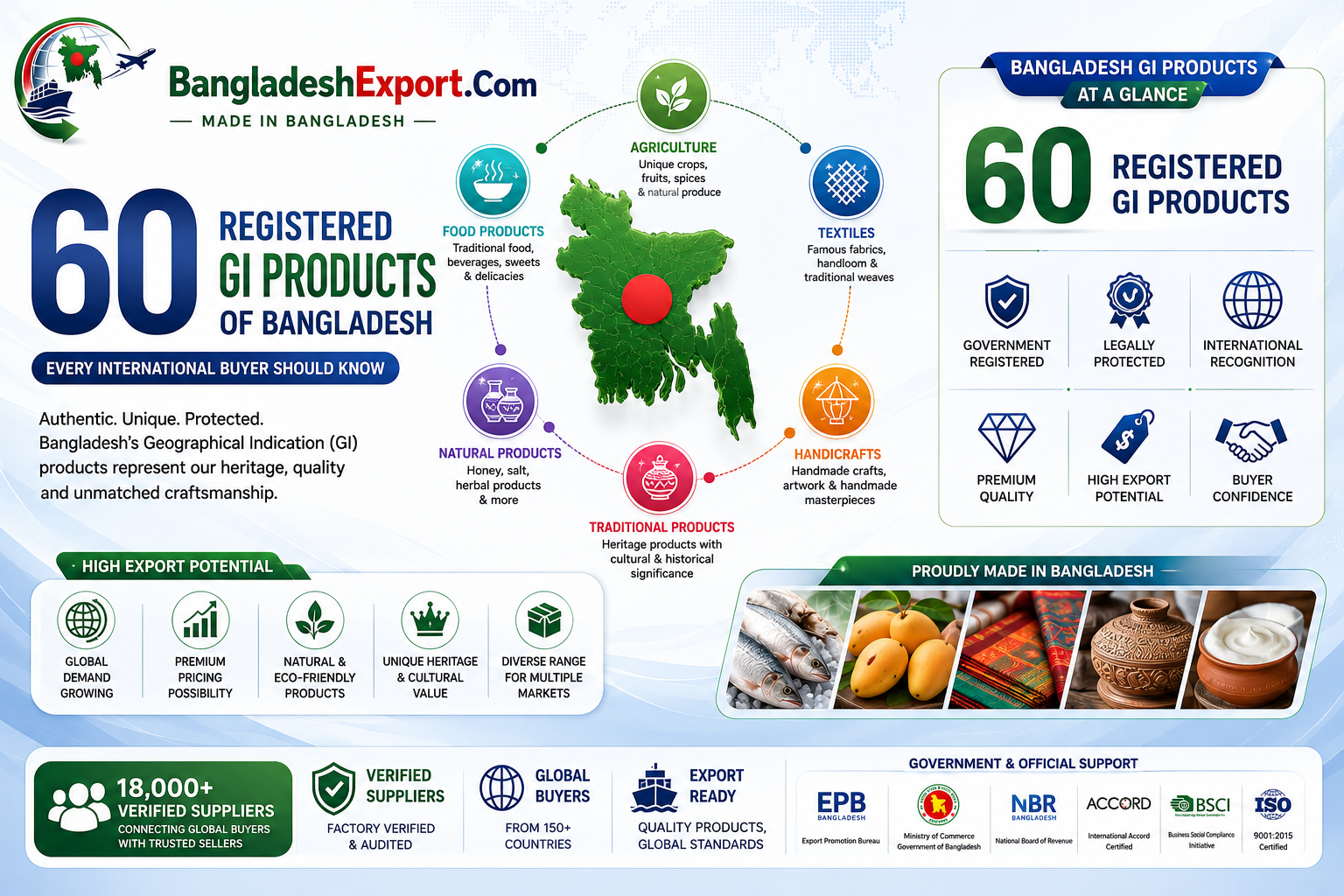
For the complete catalog of 60+ Bangladesh GI products, see our full GI products list. For the broader context on Bangladesh GI product export trends, see our 2026 global demand analysis.
❓ Frequently Asked Questions
What makes Khirsapat Mango a GI product?
Khirsapat Mango was registered as Bangladesh's third GI product in 2018 by DPDT. The GI registration legally protects the "Khirsapat" name for mangoes grown in Chapainawabganj district using traditional cultivation methods. The registration was motivated in part by the need to distinguish Bangladesh-origin Khirsapat from Indian-origin "Himsagar" mangoes that share the alternative name. Only Chapainawabganj-grown mangoes of the Khirsapat variety can legally carry the name in WTO member states.
When is the Khirsapat mango harvest season?
The Khirsapat harvest season runs from May to July each year, with peak volume and quality in June. The short harvest window creates annual demand spikes in diaspora markets — particularly during Ramadan (which often falls in March–April, requiring cold storage of late-season fruit) and the Eid holidays. Buyers should plan orders 4–6 weeks before harvest for best availability and to secure priority allocation with verified growers.
How is Khirsapat different from Indian Himsagar mango?
Khirsapat (Bangladesh) and Himsagar (India) share the alternative name and varietal origin but are legally distinct GI products. Khirsapat is grown in the Chapainawabganj district of Bangladesh, while Himsagar is grown in West Bengal and Murshidabad districts of India. The Chapainawabganj terroir — alluvial Padma-Mahananda soil, longer dry season, local farming practices — produces a fruit with measurably different aroma, sweetness (18–22° Brix vs. Indian Himsagar's 16–18° Brix typically), and texture. GI registration legally enforces this distinction in WTO member states.
What is the HS code for Khirsapat mango exports?
Khirsapat mangoes are classified under two HS codes in the Bangladesh 8-digit system: 08045031 (mangoes, fresh or dried, not wrapped/canned — used for bulk 5 kg cartons) and 08045039 (mangoes, fresh or dried, nes — used for premium 2 kg gift packs with individually-wrapped fruit). Processed Khirsapat (pulp, puree, dried slices) uses different HS codes under chapter 20.
Can Khirsapat mangoes be shipped by sea freight?
Generally no for fresh fruit. Khirsapat has a 21-day shelf life under optimal 10–13°C cold-chain conditions, but sea freight from Chattogram to EU or US ports takes 20–35 days — exceeding the shelf life even under controlled-atmosphere containers. Air freight (3–7 day transit) is the standard for all fresh Khirsapat exports. Sea freight is viable only for processed Khirsapat (pulp, puree, frozen chunks) which has longer shelf life.
How do I verify that Khirsapat mangoes are authentic?
Verify via: (1) DAE-issued origin certificate naming Chapainawabganj district; (2) exporter's DPDT GI registration certificate; (3) harvest season declaration (authentic fresh Khirsapat is harvested May–July); (4) fruit appearance (oval, 250–500 g, yellow-orange skin when ripe); (5) flesh color and texture (creamy pale yellow, fiberless); (6) intense aroma even before cutting; (7) export carton labeling with exporter name, harvest date, and "Product of Bangladesh" origin. The full verification checklist is in the section above.
How many verified mango suppliers are on BangladeshExport.com?
BangladeshExport.com hosts 709 verified Agriculture & Agro suppliers (including mango growers and exporters) plus 435 verified Food & Beverage suppliers (including processed-fruit exporters). Not all are Khirsapat-specific, but you can post a free RFQ specifying "Khirsapat Mango" with your grade and quantity requirements, and verified Chapainawabganj-capable suppliers will respond within 24–72 hours.