Kataribhog Rice of Dinajpur: Bangladesh Aromatic GI Rice — Buyer's Guide (2026)
Kataribhog Rice of Dinajpur — Bangladesh's 2024 GI aromatic rice, slender 5.5-6.5mm grains with complex popcorn-toasted-floral aroma. Buyer's guide: 200-year Dinajpur tradition, BRRI DNA authentication, HS 10063019/91, 2AP concentration test, 709 verified agriculture suppliers.
If you ask a Bengali chef to name Bangladesh's finest aromatic rice varieties, Kataribhog of Dinajpur will be near the top of the list — alongside Kalijira and Chinigura. Registered as a Bangladesh GI product in 2024, Kataribhog is a premium short-to-medium-grain aromatic rice grown in the Dinajpur district of northern Bangladesh, prized for its distinctive fragrance (described as a mix of popcorn, toasted rice, and subtle floral notes), its slender grain shape, and the prized characteristic that the cooked rice remains fluffy and separate. The variety has been cultivated in the Dinajpur region for over 200 years using traditional low-input methods, and annual production is limited to roughly 15,000–25,000 metric tons — a tiny fraction of Bangladesh's total rice output. For international buyers in the gourmet-food, premium-restaurant, and South Asian diaspora segments, Kataribhog is one of the highest-margin GI agricultural products available from Bangladesh.
This guide is for international gourmet-food importers, diaspora grocers, premium-restaurant suppliers, and ethnic-food distributors sourcing authentic Bangladesh-origin Kataribhog Rice directly from verified Dinajpur growers and rice mill exporters. We'll cover the variety's history, the 2024 GI registration, the Dinajpur production region, agronomic characteristics, quality grading, export markets, HS codes, packaging and shipping, the critical authenticity verification (Kataribhog is frequently adulterated with cheaper aromatic rice), and direct sourcing from verified agriculture suppliers on BangladeshExport.com.
📜 The Kataribhog Heritage of Dinajpur
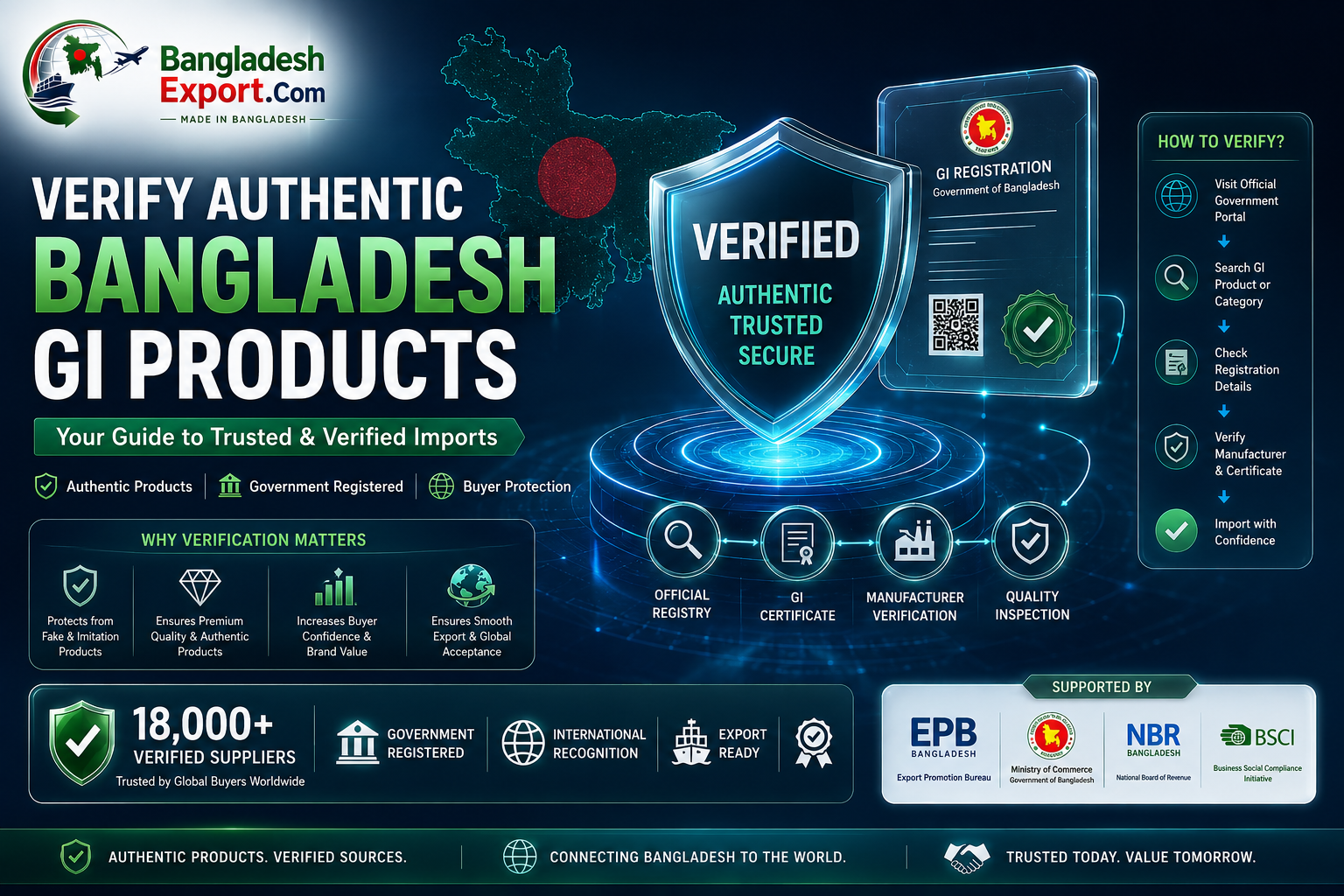
Buyers can verify the official list of Bangladesh's registered Geographical Indication (GI) products through the Bangladesh Trade Portal maintained by the Government of Bangladesh. Refer to the official GI products page for the latest registrations and updates:
bangladeshtradeportal.gov.bd — GI Products Page
The name "Kataribhog" comes from the Bengali words "katari" (meaning knife or blade — referring to the rice grain's slender, blade-like shape) and "bhog" (meaning pleasure or offering — suggesting the rice was historically considered special enough for ceremonial and offering purposes). The variety has been cultivated in the Dinajpur region for at least 200 years, with oral histories from local farming families tracing its cultivation back to the early 19th century. Dinajpur's specific agro-climatic conditions — the well-drained loamy soil of the Barind tract, the moderate dry-season temperatures, and the relatively low humidity compared to southern Bangladesh — created the conditions where Kataribhog developed its distinctive aromatic and textural characteristics.
Like Kalijira, Kataribhog was nearly lost during the Green Revolution push for high-yielding varieties (HYVs) in the 1960s–80s. The variety's relatively low yield (1.8–2.8 tons per hectare, compared to 4–6 tons for HYVs) made it economically unattractive for many farmers, and by the 1990s Kataribhog cultivation had declined to a few thousand hectares maintained primarily by traditional farming families in the Dinajpur, Thakurgaon, and Panchagarh districts. The revival came in the 2000s as consumer demand for aromatic and heritage rice varieties grew — both domestically (middle-class urban consumers seeking premium rice for special occasions) and internationally (diaspora markets and gourmet-food retail).
The Bangladesh Rice Research Institute (BRRI) and Bangladesh Agricultural Development Corporation (BADC) supported the revival through seed preservation, variety purification, extension services, and market-link programs. By the early 2020s, Kataribhog cultivation had recovered to 8,000–12,000 hectares across the greater Dinajpur region, with annual production of 15,000–25,000 metric tons. The 2024 GI registration — part of the historic 2024 wave — gave the variety formal legal recognition and protected the "Kataribhog Rice of Dinajpur" name internationally, distinguishing it from Indian "Katarni" rice (a related but different variety from Bihar) and from other aromatic rice varieties marketed under similar names.
🏛️ GI Registration & the Dinajpur Production Region
Kataribhog Rice of Dinajpur was registered as a Bangladesh GI product in 2024 by DPDT. The registered production region is Dinajpur district in northern Bangladesh — with the Dinajpur Sadar, Birampur, Ghoraghat, Hakimpur, Nawabganj, Birganj, Bochaganj, Biral, Kaharole, Khansama, and Parbatipur upazilas as the primary cultivation areas. The GI registration covers the Kataribhog variety (a specific traditional landrace) grown in the registered Dinajpur region using traditional cultivation methods.
The legal implication for buyers is significant. Rice sold as "Kataribhog Rice of Dinajpur" in any WTO member state must genuinely be the Kataribhog variety grown in Dinajpur district. Indian "Katarni" rice from Bihar (a different though related variety), other aromatic rices from other Bangladeshi districts, blended or adulterated rice, and any lower-quality rice marketed under the Kataribhog name cannot legally carry the GI-protected designation. Importers who source verified Dinajpur-origin Kataribhog have legal protection against these counterfeits in their destination markets under TRIPS enforcement provisions.
Verification follows the standard four-layer framework we describe in our GI verification guide: DPDT registration certificate, BRRI variety authentication, BSTI quality certification, and BangladeshExport.com multi-source supplier verification. For broader context, see our complete 60-product GI list and our Kalijira Rice guide — Bangladesh's other GI aromatic rice variety.
🌾 Agronomic Characteristics & Cultivation
Kataribhog's premium market position is rooted in its distinctive agronomic characteristics and traditional cultivation methods. Here's what makes it different from commodity rice:
Grain characteristics: Kataribhog grains are slender and medium-length — typically 5.5–6.5mm long and 1.8–2.2mm wide, with a length-to-width ratio of around 3:1. The raw grains are white with a slight translucent quality. When cooked, the grains expand longitudinally (lengthwise) more than widthwise — producing the characteristic long, slender cooked grain that distinguishes Kataribhog from short-grain varieties. The cooked grain has a glossy appearance and a delicate fluffy texture.
Aromatic profile: Kataribhog's aroma is the key selling point. The raw rice has a subtle fragrance that intensifies dramatically during cooking — filling the kitchen with a complex aroma described as a blend of popcorn, toasted nuts, and a mild floral note. The primary aromatic compound is 2-acetyl-1-pyrroline (2AP), the same molecule responsible for Basmati's aroma — but Kataribhog has its own distinctive concentration and balance of secondary aromatic compounds that produce the unique fragrance. The aroma is most pronounced in freshly harvested rice (within 6 months of harvest) and diminishes with prolonged storage.
Traditional cultivation: Kataribhog is typically grown as an Aman (monsoon-season) crop, transplanted in July–August and harvested in November–December. Some farmers also grow it as a Rabi (dry-season) crop under irrigation, transplanted in January–February and harvested in April–May. The variety is cultivated using traditional low-input methods — minimal synthetic fertilizer (the variety has poor response to high fertilizer application, which can actually reduce aroma), no pesticides (the variety has reasonable natural pest resistance), and rain-fed irrigation for the Aman crop. This traditional low-input cultivation produces rice with measurably different flavor and aroma profiles than intensively-farmed HYV rice.
Yield and scarcity: Kataribhog yields 1.8–2.8 tons per hectare — roughly one-third to one-half of modern HYV yields. Combined with the limited cultivation area (8,000–12,000 hectares), this produces an annual harvest of 15,000–25,000 metric tons — a tiny fraction of Bangladesh's total rice production (35+ million metric tons). This structural scarcity is the foundation of Kataribhog's premium pricing.
Cooking quality: Cooked Kataribhog has a fluffy, separate-grain texture with a slight firmness that holds up well in biryani, polao, and other rice dishes where grain texture matters. The rice absorbs flavors well without becoming mushy. Cooking ratio is typically 1 part rice to 1.5–1.75 parts water, with 12–15 minutes cooking time. The cooked rice retains its aroma for 30–60 minutes after cooking.
📊 Quality Grading — What to Specify in Your RFQ
Kataribhog quality is graded by grain uniformity, aroma intensity, milling quality, and absence of broken grains. The grading directly affects both production cost and retail price.
| Grade | Grain Uniformity | Broken Grains | Aroma Intensity | Retail Range (USD/kg) |
|---|---|---|---|---|
| A Premium (Export) | >95% uniform | <2% broken | Strong, distinctive | 7–12 |
| A Standard | >90% uniform | <5% broken | Strong | 4–7 |
| B Grade | >85% uniform | <10% broken | Standard | 2.5–4 |
| C Grade (Broken) | Mixed | >10% broken | Standard | 1.2–2.5 |
Authentic premium Kataribhog Rice has these measurable quality markers: grain length 5.5–6.5mm, moisture content below 13%, 2-acetyl-1-pyrroline (2AP) concentration above 0.4 ppm, and broken-grain percentage below 2% for A Premium grade. The 2AP concentration is the technical aromatic marker — premium Kataribhog typically tests at 0.4–0.8 ppm, while standard aromatic rices test at 0.2–0.4 ppm.
🌍 Where the Demand Is — Export Markets
Kataribhog export demand is concentrated in markets with significant South Asian diaspora and in gourmet-food retail. The premium pricing positions Kataribhog above commodity rice but in the same tier as Kalijira and premium Basmati.
- Middle East (Saudi Arabia, UAE, Qatar, Oman): Largest volume market driven by the 13-million-strong Bangladeshi diaspora. Premium Kataribhog is used for biryani, polao, and festive rice dishes during Ramadan, Eid, and weddings. Retail USD 4–9 per kg.
- European Union (UK, Germany, France): Premium gourmet retail plus diaspora demand. British-Bangladeshi community in London (Brick Lane area) drives significant UK demand. Gourmet retailers position Kataribhog as a "heritage rice" alternative to Basmati. Retail EUR 8–14 per kg.
- USA and Canada: Bangladeshi-American diaspora plus gourmet-food retail. Premium Indian and Bangladeshi grocery stores in New York, New Jersey, Toronto stock Kataribhog. Retail USD 8–14 per kg.
- Australia, Singapore, Malaysia: Growing diaspora and premium-food retail demand. Retail USD 6–11 per kg.
- India (West Bengal, Assam): Cultural affinity market — Bengali cuisine values aromatic rice varieties. Retail INR 90–200 per kg.
- Premium restaurant buyers (global): High-end South Asian restaurants, fusion-cuisine chefs, and hotel buffet buyers source A Premium Kataribhog for biryani, polao, and specialty rice dishes. Wholesale USD 4–8 per kg.
For buyers building gourmet-food or sustainable-sourcing portfolios, Kataribhog offers a compelling combination: traditional landrace variety, low-input cultivation, distinctive aromatic profile, GI legal protection, and a heritage narrative that competing rice varieties cannot replicate. The variety is also well-suited for premium baby food and specialty rice-product manufacturing due to its soft texture and natural aroma.
🏷️ HS Codes & Customs Classification
Bangladesh uses the 8-digit HS code system. Kataribhog Rice uses the same chapter 10 (cereals) rice HS codes as Kalijira Rice. Our DB contains the relevant codes:
| HS Code | Description | Typical Use |
|---|---|---|
| 10063019 | Semi-milled or wholly milled rice, nes (wrapped/canned up to 2.5 kg) | Premium retail packs (500g, 1kg vacuum-sealed pouches) |
| 10063091 | Semi-milled or wholly milled rice, nes (excl. wrapped/canned up to 2.5 kg) | Bulk cartons (5kg, 10kg, 25kg) for wholesale importers |
| 10062000 | Husked (brown) rice | Brown Kataribhog (less common but available for health-food buyers) |
HS 10063019 (milled rice, wrapped/canned up to 2.5 kg) is the standard classification for premium retail packs — the most common Kataribhog export format. HS 10063091 covers bulk milled-rice exports. Brown Kataribhog (husked but not milled) uses HS 10062000 and appeals to health-food buyers seeking whole-grain rice. Always confirm the HS code with your destination-country customs broker, as some countries apply specific tariff quotas or preferential treatment to aromatic rice. See our HS code directory for full tariff details.
📦 Packaging & Shipping
Kataribhog is a shelf-stable agricultural product with straightforward packaging and shipping requirements — but premium-grade packaging is essential to preserve grain quality and aromatic integrity.
- Premium retail packs (500g, 1kg): Vacuum-sealed food-grade plastic pouches within printed cardboard cartons. Vacuum sealing preserves the aromatic compounds that would otherwise dissipate over time. Each carton carries the exporter's label with DPDT GI registration number, harvest season, BSTI quality certification mark, BRRI variety authentication, and "Product of Bangladesh" origin marking.
- Bulk packs (5kg, 10kg, 25kg): Woven polypropylene (PP) bags with inner polyethylene (PE) liner for moisture protection. Used for wholesale importers and diaspora grocers who repack under their own brand.
- Storage protection: Milled rice should be stored in cool, dry conditions (below 25°C, below 65% relative humidity) to prevent moisture absorption, insect infestation, and aroma loss. Prolonged storage above 30°C accelerates aroma degradation.
- Shipping mode: Sea freight (20–35 days) is viable for all Kataribhog exports — the rice's shelf stability (12+ months under proper storage) makes sea freight cost-effective. Air freight is reserved for urgent sample shipments or very high-value master-grade lots.
- Required export documentation: Certificate of Origin (Dinajpur Chamber of Commerce), DPDT GI registration certificate copy, BSTI quality certification, BRRI variety authentication, phytosanitary certificate (DAE-issued), packing list, commercial invoice. See our export documentation guide.
✅ Spotting Adulteration — Kataribhog Authenticity Checklist
Kataribhog is frequently adulterated — common frauds include blending with cheaper aromatic rice (to extend volume while maintaining some aroma), substitution with Indian Katarni or other aromatic rices (which are similar but legally distinct), and even artificial aroma treatment of commodity rice. Use this checklist:
- Grain size and shape: Authentic Kataribhog grains are 5.5–6.5mm long and 1.8–2.2mm wide, with a length-to-width ratio of around 3:1. Significantly shorter or wider grains suggest blending with non-Kataribhog rice.
- Aroma test (raw): Authentic raw Kataribhog has a subtle but distinctive aroma — a mild popcorn-toasted-nut scent. No aroma suggests wrong variety or aged past peak. Chemical-artificial aroma suggests adulteration.
- Aroma test (cooked): Authentic cooked Kataribhog fills the kitchen with a strong popcorn-nut aroma within the first 5 minutes of cooking. The aroma is most pronounced for 30–60 minutes after cooking and dissipates with reheating. Artificial aroma additives tend to smell chemical and do not dissipate the same way.
- Cooking texture: Authentic cooked Kataribhog has separate, fluffy, slightly firm grains — never sticky or mushy. The grains expand longitudinally (lengthwise) when cooked, producing long slender grains.
- 2AP concentration test: For premium-grade verification, request 2-acetyl-1-pyrroline (2AP) concentration testing from an independent laboratory. Premium Kataribhog tests at 0.4–0.8 ppm. Significantly lower 2AP suggests blending or wrong variety.
- BRRI DNA variety authentication: For the strongest technical verification, request BRRI DNA-based variety authentication. This confirms the rice is genuine Kataribhog landrace, not a related variety.
- DPDT GI registration certificate: The exporter must hold a valid DPDT GI registration for Kataribhog Rice of Dinajpur. Request the registration number and verify independently.
- Production region documentation: Confirm the rice was grown in Dinajpur district. A "Kataribhog" exporter with rice grown in another district is suspect.
For the full four-layer verification framework — including how BangladeshExport.com cross-checks rice exporters against BRRI, BADC, BSTI, and EPB registries — see our GI verification guide.
🤝 Sourcing Verified Kataribhog Exporters
BangladeshExport.com hosts verified Bangladeshi agriculture and rice mill exporters. Here's the practical sourcing workflow:
- Browse verified agriculture suppliers: View 709 verified Agriculture & Agro suppliers — includes rice growers, rice mill operators, and agro-exporters. Look for the "Verified" badge.
- Post a free RFQ: Submit a Request for Quotation specifying "Kataribhog Rice of Dinajpur" with grade (A Premium / A Standard / B), packaging format (500g retail / 1kg retail / 5kg bulk / 25kg bulk), quantity, target price, and destination country. Verified suppliers respond within 24–72 hours.
- Check exporter credentials: On each supplier profile, verify EPB registration, BRRI variety authentication, BSTI quality certification, and DPDT GI registration. For premium orders, request BRRI DNA authentication and 2AP concentration testing.
- Order a small trial shipment first: For new supplier relationships, order 100–500 kg as a trial shipment. Conduct grain-size inspection, aroma evaluation, and cooking test before placing a multi-ton bulk order.
- Finalize directly with the exporter: Communicate via in-platform messaging, negotiate payment terms (L/C recommended for first orders over USD 10,000), arrange pre-shipment quality inspection. BangladeshExport.com takes no commission on any deal.
If you're a Dinajpur Kataribhog rice grower, mill operator, or exporter reading this: register as a supplier on BangladeshExport.com (free), select "Agriculture & Agro" as your category, and upload your DPDT GI registration certificate, BRRI variety authentication, and BSTI quality certification. Our verification team will validate your documents at no cost.
Relevant industry support includes the Dinajpur Chamber of Commerce & Industry (the GI production-region chamber), the Dinajpur District Rice Mill Owners Group, and the broader Bangladesh exporters' association directory.
🚀 Source Authentic Kataribhog Rice — Free RFQ
Post a free Request for Quotation on BangladeshExport.com for authentic Dinajpur-origin Kataribhog Rice from verified growers and rice mill exporters. Specify grade (A Premium / A Standard / B), packaging format, quantity, and destination — verified suppliers respond within 24–72 hours. Sea freight viable for bulk orders. No middlemen, no commission, completely free for buyers.
🚀 Post a Free RFQ → 🔍 Browse 709 Verified Agriculture Suppliers🎯 Conclusion — Why Kataribhog Is Worth Sourcing
Kataribhog Rice of Dinajpur is a genuinely distinctive premium aromatic rice — a heritage landrace variety with 200+ years of cultivation history in the specific agro-climatic conditions of northern Bangladesh, a complex aromatic profile that competing varieties cannot replicate, and a 2024 GI registration that legally protects the name internationally. For buyers serving gourmet-food, premium-restaurant, or South Asian diaspora retail segments, authentic Dinajpur Kataribhog offers a defensible premium position with a story that commodity rice varieties simply don't have.
The buyers who succeed with Kataribhog are the ones who source directly from verified Dinajpur growers, document the BRRI and GI provenance rigorously, conduct physical authenticity testing (especially the 2AP concentration test for premium grades), and build multi-year relationships that secure priority allocation of the limited annual harvest. BangladeshExport.com makes that process free, transparent, and built on multi-source verification — start with a free RFQ today, or browse our verified agriculture supplier directory.
For the complete catalog of 60+ Bangladesh GI products, see our complete GI products list. For Bangladesh's other GI aromatic rice, see our Kalijira Rice guide. For broader context on Bangladesh GI product export trends, see our 2026 global demand analysis.
❓ Frequently Asked Questions
What makes Kataribhog Rice of Dinajpur a GI product?
Kataribhog Rice of Dinajpur was registered as a Bangladesh GI product by DPDT in 2024. The registration legally protects the "Kataribhog Rice of Dinajpur" name for the Kataribhog traditional landrace variety grown in Dinajpur district using traditional cultivation methods. The registration distinguishes Dinajpur Kataribhog from Indian "Katarni" rice (a related but different variety from Bihar), from other aromatic rices, and from any adulterated or blended rice marketed under the Kataribhog name.
How is Kataribhog different from Kalijira Rice?
Both are Bangladeshi GI aromatic rices but they are distinct varieties with different characteristics. Kalijira (registered 2019, nationwide GI) has tiny 4–5mm grains (one of the smallest commercial rice varieties), a delicate popcorn-nut aroma, and yields 1.5–2.5 tons/hectare. Kataribhog (registered 2024, Dinajpur-specific GI) has slender medium-length 5.5–6.5mm grains, a stronger complex aroma (popcorn + toasted nuts + floral notes), and yields 1.8–2.8 tons/hectare. Kataribhog has higher 2AP concentration (0.4–0.8 ppm vs. Kalijira's 0.3–0.5 ppm) and a more pronounced cooked aroma.
How is Kataribhog different from Basmati rice?
Three main differences. First, grain length: Basmati grains are 7–8mm long (very long), while Kataribhog grains are 5.5–6.5mm (medium-long). Second, aroma: Basmati has a nutty-popcorn aroma from 2AP; Kataribhog has a more complex popcorn-toasted-floral aroma from a different balance of aromatic compounds. Third, cooking texture: Basmati cooks to separate fluffy long grains; Kataribhog cooks to separate fluffy slender grains with a slightly softer texture. Both are suitable for biryani and polao, but Kataribhog has a distinctive character that Basmati cannot replicate.
What is the HS code for Kataribhog Rice exports?
Kataribhog Rice uses the same HS codes as Kalijira Rice: 10063019 (milled rice retail, wrapped/canned up to 2.5 kg), 10063091 (milled rice bulk, excl. wrapped/canned up to 2.5 kg), and 10062000 (husked brown rice). Some destination countries apply specific tariff quotas or preferential treatment to aromatic rice — confirm with your customs broker.
How do I verify that Kataribhog Rice is authentic?
Eight-point checklist: (1) grain size 5.5–6.5mm long with 3:1 length-to-width ratio; (2) raw aroma — distinctive subtle popcorn-nut scent; (3) cooked aroma fills kitchen within 5 minutes, dissipates with reheating; (4) cooking texture — separate, fluffy, slightly firm grains that expand longitudinally; (5) 2AP concentration test — premium Kataribhog tests at 0.4–0.8 ppm; (6) BRRI DNA variety authentication; (7) DPDT GI registration certificate; (8) production region documentation (Dinajpur district). Full checklist is in the section above.
How many verified Kataribhog suppliers are on BangladeshExport.com?
BangladeshExport.com hosts 709 verified Agriculture & Agro suppliers. Not all are Kataribhog specialists — given the variety's limited cultivation (8,000–12,000 hectares in the greater Dinajpur region), only a subset of verified rice exporters handle authentic Kataribhog. Post a free RFQ specifying "Kataribhog Rice of Dinajpur" with your grade and quantity requirements, and verified Kataribhog-capable suppliers will respond within 24–72 hours.
What is the minimum order quantity (MOQ) for Kataribhog Rice?
Typical MOQ is 500–2,000 kg for bulk orders (5kg or 25kg bags). For first-time buyers, exporters may accept a 100–500 kg trial shipment at a slightly higher per-kg price. Premium retail-pack orders (500g or 1kg vacuum-sealed pouches) typically have MOQs of 1,000–5,000 pouches. Bulk orders of 10+ tons typically have 4–8 week lead time including milling, packaging, and shipping arrangement. Sea freight is the standard shipping mode for bulk orders.