Katan Saree of Mirpur: Bangladesh Heritage GI Textile — Buyer's Guide (2026)
Katan Saree of Mirpur — Bangladesh's 2024 GI silk textile, silk warp+weft for double-sided lustrous sheen. Buyer's guide: ceremonial wear, HS 62114900/62114200, 7-point authenticity, 1,180 textile suppliers.
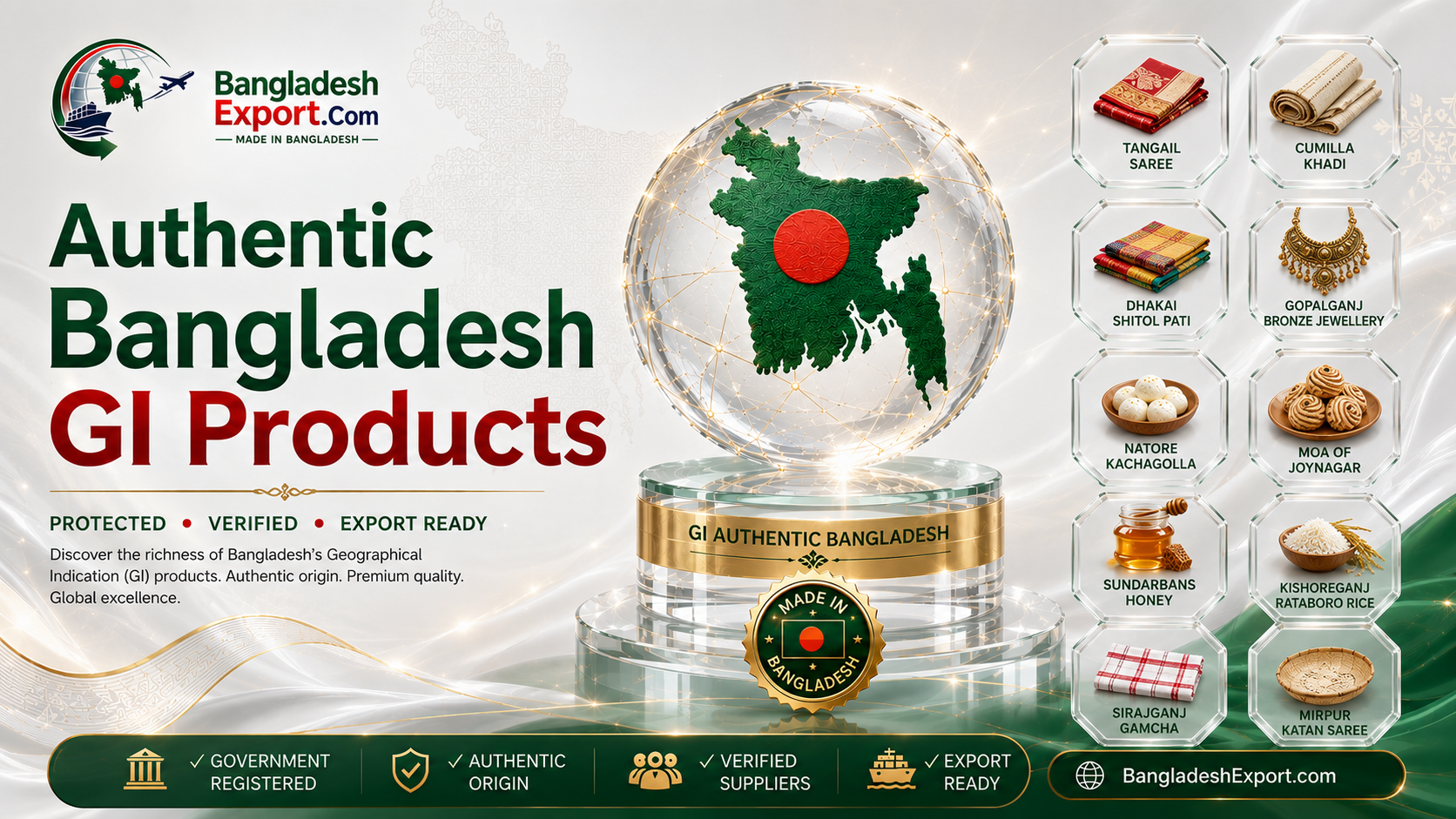
Katan Saree of Mirpur — registered as a Bangladesh GI product in 2024 — is a premium handwoven saree from the Mirpur area of Dhaka that has been produced for over 200 years. The word "Katan" refers to a specific weaving technique where both the warp and weft are silk, producing a fabric with a distinctive lustrous sheen on both sides — a characteristic that immediately distinguishes Katan from cotton sarees (like Tangail — see our Tangail Saree guide) or half-silk sarees (where only the warp is silk). Unlike the more famous Jamdani (which features supplementary-weft motifs woven into the body — see our Jamdani guide), Katan Sarees are characterized by their solid-color or striped body with elaborate woven borders and anchal (pallu) designs. For buyers in the premium-textile, ethnic-wear, and diaspora-gift segments, authentic Mirpur Katan Sarees offer a distinctively luxurious product that sits between Jamdani's intricate motifs and Tangail's everyday handloom in the premium spectrum.
This guide is for international textile buyers, ethnic-wear retailers, diaspora gift suppliers, premium-fashion brands, and wedding-couture buyers sourcing authentic Katan Saree of Mirpur. We'll cover the saree's history, the 2024 GI registration, the Katan weaving technique, quality characteristics and grading, export markets, HS codes, packaging and shipping, authenticity verification, and direct sourcing from verified textile suppliers on BangladeshExport.com.
📜 History & the Mirpur Weaving Tradition
Buyers can verify the official list of Bangladesh's registered Geographical Indication (GI) products through the Bangladesh Trade Portal: bangladeshtradeportal.gov.bd — GI Products Page
Mirpur, now a bustling urban area of Dhaka, was historically a weaving center that produced premium silk and half-silk sarees for the Dhaka aristocracy. The Katan technique — using silk for both warp and weft — produces a heavier, more lustrous fabric than cotton sarees, and the technique was historically associated with wedding and ceremonial wear for wealthy Bengali families. The Mirpur weaving community developed the Katan technique alongside the more famous Jamdani, but while Jamdani focused on intricate supplementary-weft motifs, Katan focused on the luxurious quality of the silk fabric itself — solid colors, elaborate borders, and rich drape. The 2024 GI registration protected the "Katan Saree of Mirpur" name. See our complete 60-product GI list and our guides to Jamdani Saree, Rajshahi Silk, and Tangail Saree for related Bangladeshi GI textiles.
🏛️ GI Registration & Production Region
Katan Saree of Mirpur was registered by DPDT in 2024. The production region is Mirpur, Dhaka. Verification follows our GI verification guide.
🧶 The Katan Weaving Technique
The Katan technique uses silk yarn for both warp (lengthwise threads) and weft (crosswise threads), producing a fabric with lustrous sheen on both sides. This differs from half-silk sarees (where cotton weft is used, producing sheen on only one side) and cotton sarees (where both warp and weft are cotton, producing no sheen). The silk yarn is typically sourced from Rajshahi (see our Rajshahi Silk guide) or imported from China/India. Traditional Katan sarees are woven on pit looms with elaborate supplementary-weft borders (par) and anchal (pallu) designs — geometric, floral, or peacock motifs woven in gold zari thread. Production time: 5–14 days per piece.
📊 Quality Grading
| Grade | Material | Weave | Border | Retail Range (USD) |
|---|---|---|---|---|
| A Premium (Pure Silk) | 100% silk warp + weft | Full Katan, tight weave | Gold zari border, intricate | 200–600 |
| A Standard (Half-Silk) | Silk warp + cotton weft | Standard Katan | Standard border | 80–200 |
| B Grade | Synthetic blend | Katan-style | Simple border | 30–80 |
🌍 Export Markets
- Middle East: Diaspora wedding/ceremonial demand. Retail USD 100–500.
- USA & Canada: Diaspora gift + ethnic-wear. Retail USD 100–500.
- EU & UK: Premium ethnic-wear boutiques. Retail EUR 80–400.
- India: Cultural affinity. Retail INR 5,000–25,000.
🏷️ HS Codes
| HS Code | Description |
|---|---|
| 62114900 | Women's garments of other textiles (silk Katan sarees) |
| 62114200 | Women's garments of cotton (half-silk Katan) |
📦 Packaging & Shipping
Individual saree folded with acid-free tissue paper in rigid cardboard box. Air freight for premium; sea freight for bulk. Documentation: Certificate of Origin (Dhaka Chamber), DPDT GI registration, Bangladesh Handloom Board certification. See our export documentation guide.
✅ Authenticity Verification
Seven-point checklist: (1) lustrous sheen on both sides (Katan signature — silk in both warp and weft); (2) elaborate woven border and anchal; (3) substantial weight (600–900g for pure silk); (4) silk hand-feel (warm, fluid drape); (5) handloom irregularities; (6) DPDT GI registration; (7) Mirpur (Dhaka) production documentation.
🤝 Sourcing Verified Katan Saree Weavers
- Browse verified textile suppliers: View 1,180 verified Textiles & Fabrics suppliers.
- Post a free RFQ: Submit a Request for Quotation specifying "Katan Saree of Mirpur" with grade, material, quantity, and destination.
- Check credentials: Verify Bangladesh Handloom Board registration, DPDT GI registration.
- Order samples: 5–10 pieces trial.
- Finalize directly: L/C for orders over USD 3,000. No commission.
For Mirpur Katan Saree weavers: register as a supplier on BangladeshExport.com (free). Relevant industry support: Dhaka Chamber of Commerce & Industry and the broader Bangladesh exporters' association directory.
🚀 Source Authentic Mirpur Katan Sarees — Free RFQ
Post a free RFQ for authentic Katan Saree of Mirpur from verified weavers. Specify grade, material, quantity, and destination.
🚀 Post a Free RFQ → 🔍 Browse 1,180 Verified Textile Suppliers🎯 Conclusion
Katan Saree of Mirpur is Bangladesh's premium silk-weave GI textile — the lustrous double-silk fabric, elaborate borders, and ceremonial positioning make it a luxury product distinct from both Jamdani (motif-focused) and Tangail (everyday handloom). For buyers serving premium ethnic-wear or diaspora-gift segments, authentic Mirpur Katan offers a defensible luxury position. BangladeshExport.com makes sourcing free and transparent — start with a free RFQ today.
For the complete catalog of 60+ Bangladesh GI products, see our complete GI products list. For related Dhaka-region GI textiles, see our Jamdani Saree guide and Dhakai Muslin guide. For broader context, see our 2026 global demand analysis.
❓ Frequently Asked Questions
What makes Katan Saree of Mirpur a GI product?
Katan Saree of Mirpur was registered as a Bangladesh GI product by DPDT in 2024. The registration protects the name for silk sarees woven in the Katan technique (silk in both warp and weft) in the Mirpur area of Dhaka using traditional handloom methods.
How is Katan different from Jamdani?
Katan uses silk for both warp and weft, producing a lustrous solid-color or striped fabric with elaborate borders. Jamdani uses cotton with supplementary-weft motifs woven into the body. Katan is heavier, more lustrous, and positioned as ceremonial/wedding wear; Jamdani is lighter, motif-focused, and positioned as heritage craft wear.
What is the HS code for Katan Saree exports?
Katan Sarees use HS code 62114900 (women's garments of other textiles — silk Katan) or 62114200 (women's cotton garments — half-silk Katan).
How do I verify that a Katan Saree is authentic?
Seven-point checklist: (1) lustrous sheen on both sides; (2) elaborate woven border and anchal; (3) substantial weight 600–900g; (4) silk hand-feel; (5) handloom irregularities; (6) DPDT GI registration; (7) Mirpur production documentation.
What is the MOQ for Katan Sarees?
Typical MOQ is 10–50 pieces. For first-time buyers, weavers may accept 2–5 piece samples. Premium pure-silk pieces have MOQs of 5–20 pieces. Lead time 2–6 weeks.
Where can I find verified Katan Saree suppliers?
BangladeshExport.com hosts 1,180 verified Textiles & Fabrics suppliers. Post a free RFQ specifying "Katan Saree of Mirpur" and verified weavers will respond within 24–72 hours.