Retaining Multilateral Trade Regimes: WTO Report 2026 Analysis
Column examines WTO World Trade Report 2026 finding that multilateral trade system erosion could cost global GDP 6.9-10%, with LDCs bearing disproportionate losses; Bangladesh's LDC graduation context
🌏 Almost eight decades ago, the world's leading nations agreed to create rules and regulations to govern international trade. That's why 23 nations signed the General Agreement on Tariffs and Trade (GATT) on 30 October 1947 as contracting parties. Over its 47 years (1948-1994), GATT went through a series of trade negotiations to expand tariff concessions and address non-tariff issues. The key outcome of the Uruguay Round was the establishment of the World Trade Organization (WTO) in 1995.
📊 More than three decades after the establishment of the WTO, many of its promises and expectations remain unfulfilled. WTO members failed to reach consensus on various issues, including farm subsidies, industrial tariffs, services diversification, and intellectual property rights, under the Doha Round negotiations. As a result, the round was ultimately abandoned. The multilateral trade regime, governed by WTO-oriented rules, now stands at a critical juncture.
📜 World Trade Report 2026: A Critical Juncture
Against this backdrop, the WTO released its World Trade Report 2026 last week in Geneva. Titled 'A critical juncture for the world trading system,' the focus of the latest trade report is a timely one. Its core argument is that the world trading system is at a critical juncture not because cooperation among countries has ceased to matter, but because cooperation must now work under much more demanding conditions. In other words, two tasks remain: preserve the order of the multilateral trading system and modernise it to address emerging challenges.
The report categorically acknowledged that, although the multilateral trading system has delivered substantial gains by significantly reducing barriers to and costs of trade, not all economies have shared equally in these gains. Take the example of Bangladesh. Being a least developed country (LDC), Bangladesh has enjoyed some preferential market access facilities, but its share of global trade remains modest.
💰 Cost Of Erosion: 6.9-10% GDP Loss
An interesting observation of the report is that the WTO is a victim of its own success. Trade expansion, along with declining barriers and deeper interdependence, increased cooperation among nations but also intensified the complexity of managing it. What to do then? Many now believe that multilateralism has reached its last lap and its future is gloomy. The WTO report, however, strongly opposed this proposition, arguing that allowing the system to erode would entail high global economic costs.
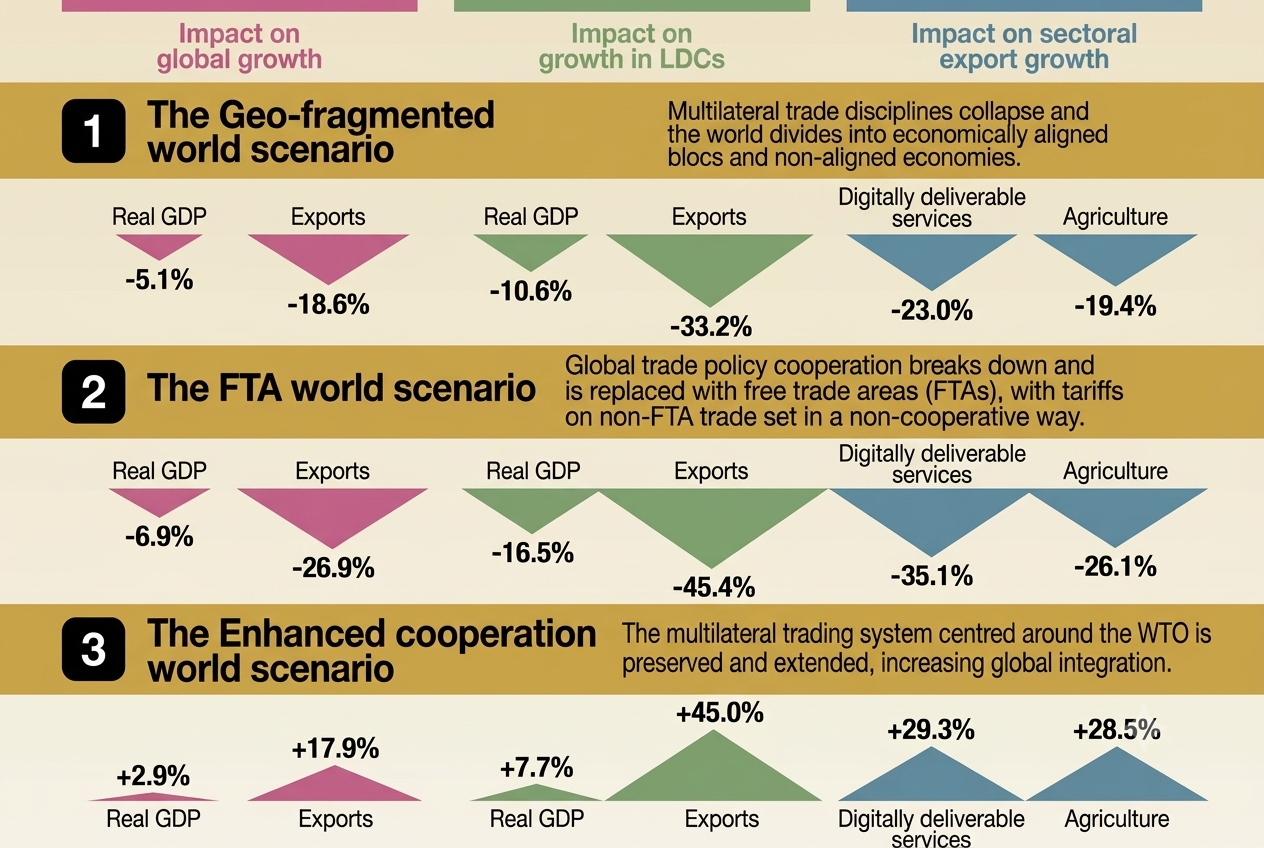
- 📊 Global GDP loss (geo-fragmented scenario): 5.1%
- 📊 Global GDP loss (FTA world scenario): 6.9%
- 📊 Global output loss (inaction): up to 10%
- 📊 LDC GDP loss (geo-fragmented): 10.6%
- 📊 LDC GDP loss (FTA world): 16.5%
- 📊 High-income GDP loss: 2.9% (geo-fragmented)
🌏 Bangladesh's LDC Graduation Context
For Bangladesh, the report's findings carry particular significance as the country approaches LDC graduation. Bangladesh is the largest merchandise exporter among LDCs, accounting for approximately 17 per cent of total LDC exports. The country's RMG sector — which accounts for over 84% of merchandise exports — depends heavily on rules-based market access to EU and US markets. If the multilateral system erodes and market access becomes contingent on bilateral power dynamics rather than agreed rules, Bangladesh's trade position would be significantly compromised.
The report's finding that LDCs face disproportionate losses — 10.6% GDP decline in a geo-fragmented scenario versus 2.9% for high-income economies — underscores the structural vulnerability that makes multilateral trade governance particularly important for developing countries. The 16.5% LDC GDP loss in an 'FTA world' scenario — where multilateral cooperation is replaced by unstructured FTA networks — represents a potentially catastrophic economic outcome for the world's poorest countries.
🤝 What Comes Next: Preserve And Modernise
The WTO report's core message — that the world must both preserve the existing multilateral order and modernise it to address emerging challenges — provides the framework for Bangladesh's engagement with the multilateral trade agenda. As a country preparing to graduate from LDC status, Bangladesh has a direct interest in ensuring that the post-LDC trading environment is governed by predictable, rules-based multilateral disciplines rather than ad hoc bilateral arrangements that favour larger economies.
The coming months will reveal whether the WTO report's warnings catalyse meaningful reform momentum — or whether the geopolitical forces driving trade fragmentation overwhelm the multilateral system. For Bangladesh, the difference between a functioning WTO and a fragmented trade world is the difference between manageable post-graduation transition and potentially catastrophic export revenue loss. The stakes could not be higher.
This news was originally published by The Financial Express. For the full original report, please visit: https://thefinancialexpress.com.bd/columns/retaining-multilateral-trade-regimes
📬 Get Bangladesh Trade News in your inbox
Weekly digest of export industry news, policy updates, and market analysis.
📰 Related Stories