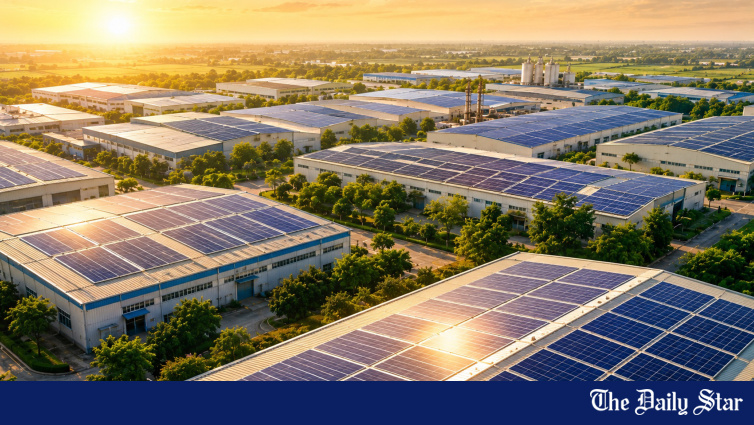
PRAN-RFL and Walton Go Big on Solar Equipment Manufacturing Amid Energy Crisis
PRAN-RFL investing $5M in two solar inverter plants (Palash + Habiganj); Walton setting up inverter + lithium-ion battery plant in Chandra, Gazipur. Both aim to build end-to-end domestic solar supply chain and target 100% solar power for own operations.

☀ Dhaka, Bangladesh — Two of Bangladesh’s largest conglomerates — PRAN-RFL Group and Walton Group — are going big on solar equipment manufacturing amid the ongoing energy crisis, aiming to reduce import dependency and build an end-to-end domestic solar power supply chain.
📊 Simultaneously, the two groups plan to invest in small, medium, and large-scale solar power projects nationwide under a capex model — supplying equipment while providing operation and maintenance services to public and private sector clients.
👥 PM Tarique Rahman Urged Investment
📊 According to officials from the Prime Minister’s Office and both conglomerates, the projects gathered momentum following a 1 August meeting with private-sector entrepreneurs, where Prime Minister Tarique Rahman urged businesses to invest heavily in renewable energy.
🏭 PRAN-RFL: $5 Million Investment in Two Inverter Plants
📊 Kamal Kamruzzaman, Marketing Director at PRAN-RFL Group, stated that work has commenced on a $1 million solar inverter manufacturing plant at Palash in Narsingdi.
💬 “The plant is expected to begin production within three to four months, with a capacity to manufacture up to 1,000 inverters monthly in the 1kW-5kW range alongside storage batteries,” Kamruzzaman said.
📊 He added that PRAN-RFL plans to establish a second inverter facility in Habiganj with an investment of approximately $4 million.
📊 PRAN-RFL solar investment to date:
- 💰 Tk 100 crore invested in solar energy so far
- ☀ 40MW generation capacity currently
- 📈 Target: 100MW by end of 2026
- 📈 Target: 100% solar power for PRAN-RFL by FY28 (250MW demand)
💬 “We have aligned our investments to meet 100% of PRAN-RFL Group’s electricity demand from solar power by FY28,” Kamruzzaman noted. Once local production begins, PRAN-RFL intends to expand its installation and maintenance services for third-party commercial and residential clients, as well as compete for government projects through public tenders.
🏭 Walton: Inverter + Lithium-Ion Battery Plants
📊 Walton has commenced setup of a solar inverter manufacturing plant at Chandra, Gazipur. It has also completed a lithium-ion battery plant, which is slated to begin commercial production within a month, according to Md Nazmul Islam, Executive Director and Head of Electrical and Renewable Energy at Walton Group.
📊 Walton currently imports ARC inverters from China as an original equipment manufacturer (OEM), branding them locally.
📊 In a written response, Walton confirmed that setting up local lithium-ion battery, solar inverter, and solar panel production facilities is designed to:
- 🏢 Build domestic resilience
- 🌿 Lower carbon emissions
- 👥 Generate industrial employment
📊 Bangladesh Solar Inverter Import Market
📊 Bangladesh currently has no local solar inverter production. Most inverters are imported from:
- 🇨🇳 China
- 🇯🇵 Japan
- 🇮🇳 India
💰 Annual imports worth around $15 million. According to the NBR, Bangladesh imported 429.4 tonnes of solar inverters between December and May.
🔌 How Solar Power Systems Work
📊 In a solar power system:
- ☀ Photovoltaic cells in solar panels convert sunlight into direct current (DC) electricity
- 🔌 Inverter converts DC into alternating current (AC) — powers household appliances and feeds surplus to national grid
- 🔋 Lithium-ion batteries store electricity for use when sunlight is unavailable
💰 Government Duty Concessions
📊 To encourage local manufacturing, the government has reduced duties on imported raw materials for inverters, batteries and solar panels to 1%. By contrast, commercial imports face much higher duties:
- 💰 Inverters: ~28% duty
- 💰 Solar panels: ~63% duty
- 💰 Batteries: ~29% duty
📊 This significant duty differential creates a strong competitive advantage for local manufacturers.
📈 Government Solar Targets
📊 The government has set targets for solar power generation:
- 📈 4,000MW by end of 2026
- 📈 10,000MW by 2030
📊 It has also announced a net-metering system under which solar power producers can sell surplus electricity to the national grid at Tk 10.50 per unit, including an additional profit incentive.
💰 End-to-End Service Model
📊 Walton and PRAN-RFL plan to offer end-to-end support to individuals and businesses interested in installing solar power systems:
- 💰 Customer finances investment
- 🏭 Companies install plants
- 🔧 Companies provide maintenance if contracted
- 📊 Customers can also self-maintain
- 🏛 Government project competition through public tenders
🌏 Strategic Context: Bangladesh Renewable Energy Push
📊 For Bangladesh’s renewable energy sector, the PRAN-RFL and Walton investments represent a significant milestone:
- 🏢 First domestic solar inverter production — ending import dependence
- 🔋 First lithium-ion battery plant — domestic storage capacity
- 💰 $5M+ investment by PRAN-RFL — in two inverter plants
- 💰 Walton inverter + battery plants — complete supply chain
- 📈 100% solar target by FY28 — for PRAN-RFL Group
- 📊 End-to-end service model — installation + maintenance
✅ For Bangladesh’s broader industrial diversification strategy, the entry of major conglomerates into solar equipment manufacturing signals that the renewable energy sector is maturing from an import-dependent niche to a domestically-capable industry. With government duty concessions, net-metering incentives, and ambitious solar targets, the PRAN-RFL and Walton investments could catalyse a broader wave of domestic renewable energy manufacturing — reducing import dependency, creating jobs, and supporting Bangladesh’s energy security goals.
🌏 For the export community — particularly RMG and textile manufacturers facing energy cost pressures — the domestic production of solar inverters and batteries could make rooftop solar more accessible and affordable. With PRAN-RFL targeting 100% solar power by FY28 and Walton building complete supply chain capability, Bangladesh’s industrial sector may be on the cusp of a significant renewable energy adoption wave — one that could reduce energy costs, improve sustainability compliance for EU buyers, and contribute to the country’s climate commitments.
This news was originally published by The Business Standard. For the full original report, please visit: https://www.tbsnews.net/economy/energy/pran-rfl-walton-go-big-solar-equipment-manufacturing-amid-energy-crisis-1536411
Related on BangladeshExport
📬 Get Bangladesh Trade News in your inbox
Weekly digest of export industry news, policy updates, and market analysis.
📰 Related Stories