PM Tarique Rahman Tells NBR Stop Raising Tax Load on Existing Taxpayers, Expand Scope
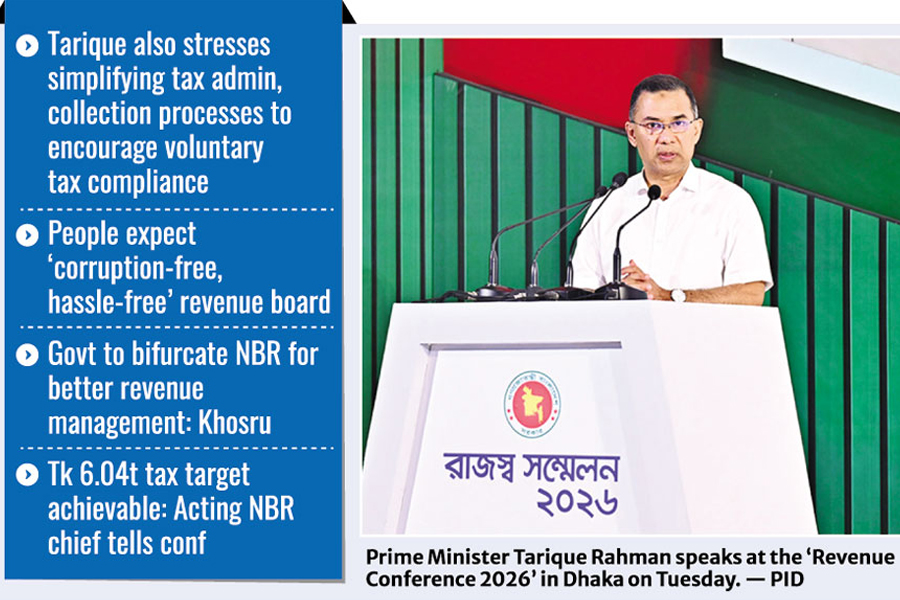
Dhaka, August 18, 2026 — Prime Minister Tarique Rahman on Tuesday directed the National Board of Revenue (NBR) to cease repeatedly increasing the tax burden on existing taxpayers and instead identify eligible taxpayers who remain outside the tax net — delivering numerous directions to the revenue board at the "Revenue Conference 2026" organised by NBR at the Bangladesh-China Friendship Conference Centre in Dhaka. The prime minister's remarks mark a significant shift in Bangladesh's tax policy direction, with explicit emphasis on net expansion rather than rate increases.
📊 Key Announcements from Revenue Conference 2026
- 👥 Stop raising tax load on existing taxpayers — PM Tarique Rahman's directive
- 🔍 Identify eligible taxpayers outside the tax net — expand scope
- 💻 Digital, modern, data-driven tax administration — the only alternative for net expansion
- 📜 Simplify tax administration and collection — encourage voluntary compliance
- 🛡 No obstacles to businesses on VAT collection — PM's instruction to NBR
- 🤝 "Corruption-free and hassle-free NBR" — people's expectation
- 🏛 NBR separation into two divisions — announced by Finance Minister Amir Khosru
- 💰 Tk 6.04 trillion — FY27 tax revenue target (achievable, per NBR)
- 📈 12% — YoY revenue growth mobilised in FY26
👥 Why Net Expansion Matters
Bangladesh has one of the lowest tax-to-GDP ratios in the world — roughly 7–8 percent, compared to an average of 15–18 percent for lower-middle-income countries. The country's tax base is also extremely narrow: out of a population of 170 million, only about 4–5 million file income tax returns — and even fewer (roughly 1.5–2 million) actually pay tax. This narrow base forces the NBR to repeatedly extract more from the existing compliant taxpayers — typically through higher rates, withdrawal of exemptions, and broader withholding tax coverage — rather than expanding the net to capture the millions of eligible taxpayers who remain outside the system.
PM Tarique Rahman's directive to stop raising the load on existing taxpayers and instead expand the scope is therefore a fundamental shift in approach. It acknowledges that the existing tax base has been squeezed to near its limit — with diminishing returns and growing political backlash from compliant taxpayers who feel penalised for their compliance. The new approach requires the NBR to:
- 🔍 Identify non-filers with taxable income — using bank transaction data, property records, vehicle registrations, and other digital footprints
- 💻 Build a digital, modern, data-driven tax administration — that can detect and pursue eligible non-filers efficiently
- 📜 Simplify tax administration and collection — reducing the compliance burden for new taxpayers entering the net
- 🤝 Encourage voluntary compliance — through incentives, simplification, and trust-building, rather than punitive enforcement
🏛 NBR Separation into Two Divisions
Finance and Planning Minister Amir Khosru Mahmud Chowdhury told the revenue conference that the government has decided to separate the NBR into two divisions for better management of revenue mobilisation. This structural reform has been under discussion for some time — with the broader goal of separating policy-making (tax policy formulation) from administration (tax collection and enforcement). The separation is intended to:
- 🏛 Improve governance — clearer accountability and reduced scope for conflict of interest
- 📊 Specialise functions — policy division focuses on long-term strategy, administration focuses on operational efficiency
- 🛡 Reduce political interference — by depoliticising tax administration
- 🌐 Align with international practice — many countries (UK, Australia, Canada) separate policy from administration
- 🤝 Strengthen autonomy — giving the administrative arm operational independence
However, the separation has been controversial within the NBR itself. Customs Commissioner Dr Nahida Faridy, in an opinion-exchange session, urged the prime minister to consider reinstating officials who faced suspension and disciplinary action following protests over the NBR-separation issue — noting that despite assurances from NBR high-ups that no such action would be taken, some officials had subsequently faced punishment. Responding, PM Tarique Rahman said he would look into the issue, but noted that strikes or work stoppages in an institution as important as the NBR are a matter of deep concern.
💰 Revenue Targets and Performance
Acting NBR Chairman Ahsan Habib told the conference that the Tk 6.04 trillion tax revenue target for FY27 is achievable through intensified efforts. He reported that:
- 📈 12% YoY revenue growth — mobilised in FY26
- 📈 Higher revenue in the last quarter of FY26 — suggesting momentum going into FY27
- 💰 Tk 6.04 trillion — FY27 target (achievable)
- 🤝 "New spirit" under current government — per Dr Rashed Al Titumir, PM's Finance Adviser
For Bangladesh's fiscal position, the Tk 6.04 trillion target represents a meaningful step up from FY26's actual collection — which, if the 12 percent growth figure is applied, would imply FY26 collection of roughly Tk 5.4 trillion. Achieving Tk 6.04 trillion would require roughly 12 percent growth again in FY27 — not unprecedented, but contingent on continued economic recovery, effective enforcement, and successful net expansion.
📜 VAT Collection: No Obstacles to Business
The prime minister instructed the NBR not to create obstacles for businesses and trade in realising value-added tax (VAT). This is a significant directive — VAT administration in Bangladesh has historically been a source of friction between businesses and the revenue authority, with disputes over VAT assessment, withholding, and refund processes. The PM's directive signals that the government wants VAT to be collected efficiently without becoming a compliance burden that discourages business activity.
"People expect a corruption-free and hassle-free NBR," the prime minister told the conference. He noted that a modern tax administration should not only focus on collecting higher amounts of tax but also encourage people to pay taxes voluntarily. This voluntary-compliance-first approach is a significant departure from the enforcement-heavy model that has historically dominated NBR's culture — and aligns with international best practice in tax administration reform.
👥 Conference Participants and Proposals
The Revenue Conference 2026 brought together senior NBR officials across income tax, customs, and VAT wings:
- 📜 Dr Nahida Faridy, Customs Commissioner — urged PM to reinstate officials suspended over NBR-separation protests
- 👥 Shakila Farzana, Additional Commissioner (Customs and VAT) — proposed increasing budgetary allocations for NBR to expedite activities and mobilise higher revenues
- 💼 Jafor Imam, Income Tax First Secretary — highlighted the need for tax officials to receive training in advanced technologies to trace money flows in the digital era
- 🤝 Dr Rashed Al Titumir, PM's Finance Adviser — credited NBR's "new spirit" under current government
At the close of the conference, the prime minister visited different stalls showcasing service-delivery processes in income tax, customs, and VAT — signalling personal engagement with the operational aspects of the NBR's modernisation agenda.
🌐 Strategic Significance for Bangladesh's Economy
For Bangladesh's broader economy, the PM's directive on tax net expansion is one of the most consequential policy signals of the BNP government's first six months in office. The country's fiscal capacity — the government's ability to fund its operating expenditure and public investment programme from domestic revenue — has been a binding constraint on economic policy for years. The TBS review published on 18 August noted that the government cannot meet its expenditure from revenue earnings, forcing it to borrow more from the financial sector — crowding out private credit and limiting the fiscal space for trade-enabling infrastructure investment.
The PM's directive implies several specific implications:
- 💰 Fiscal consolidation — expanding the tax net would increase revenue without raising rates, supporting fiscal sustainability
- 🤝 Investor confidence — a predictable, broad-based tax system is more attractive to investors than narrow, high-rate taxation
- 💼 Business environment — stopping further tax load increases on existing taxpayers eases compliance burden for compliant businesses
- 🌐 Post-LDC fiscal readiness — LDC graduation will phase out certain fiscal flexibilities, making domestic revenue mobilisation a strategic priority
- 💰 Foreign exchange independence — stronger domestic revenue reduces reliance on foreign borrowing and development partner financing
For Finance Minister Amir Khosru Mahmud Chowdhury's broader reform agenda, the prime minister's directive provides critical political backing for the NBR separation and modernisation programme — giving the Finance Ministry the mandate needed to push through structural reforms that have been pending for years. The challenge now is implementation: whether the NBR can deliver on the Tk 6.04 trillion FY27 target, whether the separation into two divisions can be executed without operational disruption, and whether the net expansion effort can identify and bring into the formal tax system the millions of eligible taxpayers who have remained outside it. The next 12 months will reveal whether the prime minister's directive translates into measurable fiscal improvement — or becomes another high-quality policy commitment whose implementation fails to match the announcement.
This news was originally published by The Financial Express. For the full original report, please visit: https://thefinancialexpress.com.bd/economy/stop-raising-tax-load-on-existing-taxpayers-expand-scope
Related on BangladeshExport
📬 Get Bangladesh Trade News in your inbox
Weekly digest of export industry news, policy updates, and market analysis.
📰 Related Stories