DESCO Swings To Profit In FY26 As It Cuts System Loss, Reduces Foreign Exchange Losses
Dhaka Electric Supply Company reports Tk 401.54 million profit in FY26 vs Tk 1.25 billion loss in FY25, driven by reduced system loss to 5.47%, higher FDR income, and lower forex losses.
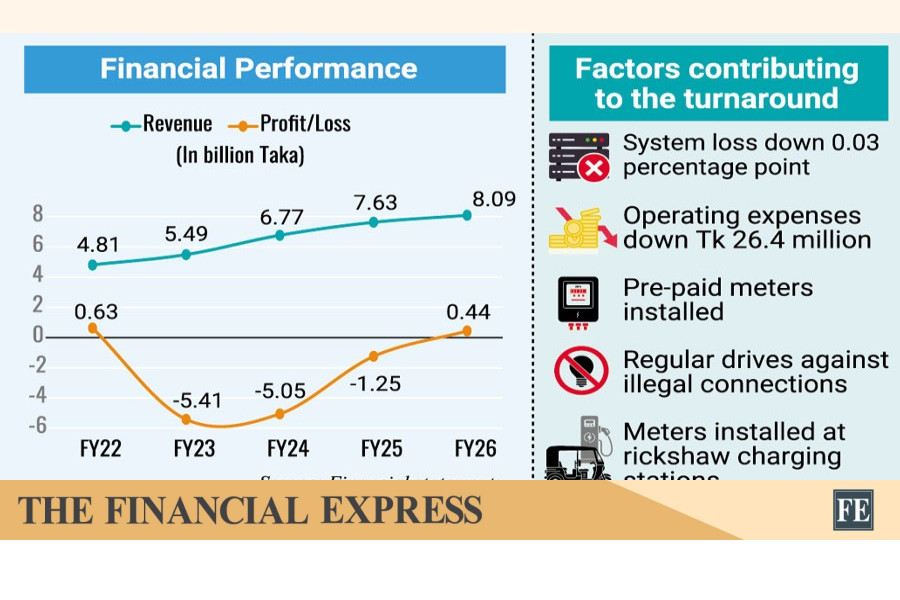
🔌 Dhaka Electric Supply Company (DESCO) achieved a significant financial turnaround in FY26, returning to profit after experiencing substantial losses over the previous three financial years. It reported a profit of Tk 401.54 million in FY26, as opposed to a loss of Tk 1.25 billion in FY25, backed by a reduction in system loss and an increase in income from fixed deposit receipts (FDRs). Also, foreign exchange losses fell significantly in FY26 compared to the previous year, driving up earnings.
📊 According to company officials, DESCO''s system losses were cut to 5.47 per cent in FY26 from 5.5 per cent in the previous year. The installation of prepaid meters helped reduce losses by 0.03 percentage points. "After years of losses, what we mainly did was we slashed costs. We cut back on administrative and operating expenses. The main impact was on exchange losses—foreign exchange losses. We reduced those," said DESCO''s Managing Director Brig. Gen. Shameem Ahmed.
🏛 Cost reduction strategy
DESCO''s turnaround strategy focused on cost reduction, system loss improvement, and foreign exchange loss management. The company cut back on administrative and operating expenses — addressing inefficiencies that had built up during its years of losses. The reduction in system loss, though modest in percentage terms (from 5.5% to 5.47%), represents meaningful progress in addressing one of the structural challenges facing Bangladesh''s power distribution utilities.
System loss — the gap between electricity purchased and electricity billed to consumers — is a critical performance indicator for power distribution companies. It reflects a combination of technical losses (from transmission and distribution inefficiencies) and non-technical losses (from theft, meter tampering, and billing errors). Reducing system loss improves both the financial performance and the operational efficiency of distribution utilities.
👥 Prepaid meter rollout
The installation of prepaid meters has been a key driver of DESCO''s system loss reduction. Prepaid meters require consumers to pay for electricity before using it — eliminating the risk of unpaid bills and reducing the incentive for meter tampering. The technology also provides more accurate consumption data, supporting better demand forecasting and operational planning.
Bangladesh has been rolling out prepaid meters across its power distribution network in recent years, with DESCO, the Dhaka Electric Supply Company, leading the deployment. The technology represents a significant modernisation of the country''s power distribution infrastructure — and one that is delivering tangible benefits in terms of reduced losses, improved cash flow, and better customer service.
💰 Foreign exchange loss management
The reduction in foreign exchange losses was a particularly important driver of DESCO''s turnaround. As a power distribution company that purchases electricity (some of which is generated from imported fuel), DESCO is exposed to foreign exchange risk through its power purchase costs. When the Bangladeshi taka depreciates against the US dollar, the local currency cost of purchasing dollar-denominated electricity rises — creating foreign exchange losses.
Bangladesh has experienced significant taka depreciation in recent years, putting pressure on companies like DESCO that have dollar-denominated cost structures. The company''s success in reducing foreign exchange losses in FY26 likely reflects a combination of better foreign exchange management, hedging strategies, and possibly some stabilisation of the taka during the year.
🌏 Looking ahead
For DESCO, the return to profit after three years of losses is a significant milestone. The company''s turnaround strategy — focused on cost reduction, system loss improvement, and foreign exchange management — provides a model for other Bangladeshi power distribution utilities facing similar challenges.
The coming years will show whether DESCO can sustain its profitability and continue to improve its operational performance. The ongoing rollout of prepaid meters, continued focus on system loss reduction, and effective foreign exchange management should support further financial improvement. For Bangladesh''s broader power sector, DESCO''s turnaround demonstrates that even structurally challenged utilities can be returned to profitability through focused management and strategic investment.
This news was originally published by The Financial Express. For the full original report, please visit: https://thefinancialexpress.com.bd/stock/desco-swings-to-profit-as-it-cuts-leakage-secures-foreign-exchange-gain
📬 Get Bangladesh Trade News in your inbox
Weekly digest of export industry news, policy updates, and market analysis.
📰 Related Stories