BGMEA and GRI Sign Strategic Partnership to Advance Sustainability Reporting in Bangladesh Apparel
Multi-year ITSB Initiative will strengthen capacity for impact-based reporting using GRI Standards; 300+ stakeholders already engaged in May and July 2026 sessions
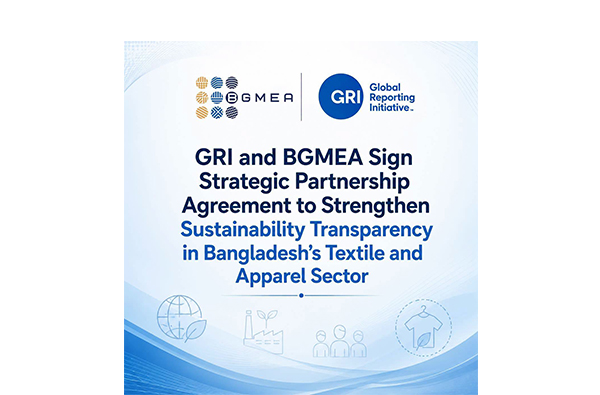
Dhaka, July 24, 2026 — The Bangladesh Garment Manufacturers and Exporters Association (BGMEA) and the Global Reporting Initiative (GRI) have signed a Strategic Partnership Agreement to advance the Improving Transparency for Sustainable Business (ITSB) Initiative in Bangladesh's textile and apparel sector. The formal signing marks a significant step in institutionalising a collaboration that began in 2025 between the two organisations. 🤝
📋 The partnership will strengthen the capacity of businesses and wider stakeholders to identify, manage, and report their most significant sustainability impacts using the GRI Standards — complementing evolving investor-focused sustainability disclosure requirements with information on organisations' impacts on the economy, environment, and people.
🎯 Why This Matters — Bangladesh Apparel at an ESG Crossroads
The partnership comes at a critical time for Bangladesh's apparel sector. With international buyers, investors, regulators, and consumers increasingly demanding credible sustainability disclosures, Bangladeshi manufacturers face growing pressure to demonstrate transparent, comparable, and decision-useful sustainability reporting. 🌍
📈 For a sector deeply connected to international markets and value chains, credible sustainability reporting can help businesses respond to:
- 🛒 Buyers — Who increasingly require ESG data as a condition of sourcing
- 💰 Investors — Who use sustainability disclosures for risk assessment
- 🏛️ Regulators — In export markets introducing mandatory ESG disclosure rules
- 👥 Workers and communities — Who deserve transparency on social impacts
- 📊 Wider stakeholders — Including NGOs, media, and the public
📚 What the ITSB Initiative Will Deliver
The collaboration will include a comprehensive programme of activities designed to build capacity and drive adoption of the GRI Standards across Bangladesh's textile and apparel sector:
- 💬 Online and in-person dialogues — Stakeholder consultations on sector priorities
- 🎓 Trainings — Practical capacity-building on GRI Standards application
- 🌐 Webinars — Knowledge-sharing sessions with global experts
- 🏫 Workshops — Hands-on sessions for sustainability practitioners
- 📋 Consultations — Structured feedback into GRI's standard-setting work
- 📊 Surveys — Sector-wide data collection on sustainability practices
🔄 The initiative will go beyond a single thematic focus and progressively address sector-relevant environmental, social, and economic impacts aligned with the GRI Standards.
🔗 Alignment with GRI's Global Standard-Setting Work
The ITSB Initiative is aligned with GRI's ongoing standard-setting work, ensuring that Bangladesh's sectoral experience directly informs global sustainability reporting standards:
- 👕 GRI Textile and Apparel Sector Standard — A dedicated sector standard under development
- 👥 Labour Topics project — Addressing workforce-related disclosures
- 💰 Economic Impact Topics project — Addressing economic value distribution
🏛️ Through consultations and structured stakeholder engagement, Bangladeshi organisations will have the opportunity to share sectoral priorities, practical realities, and feedback with the Global Sustainability Standards Board (GSSB) — GRI's independent standard-setting body.
🎓 SusNex — Training and Outreach Partner
The Sustainability Nexus (SusNex) will serve as ITSB's Training and Outreach Partner in Bangladesh, supporting the development and delivery of:
- 🎓 Nationally contextualised trainings — Tailored to Bangladesh's regulatory and business environment
- 🏫 Workshops — Practical sessions for factory managers and sustainability officers
- 🌐 Webinars — Online knowledge-sharing with global GRI experts
- 🤝 Stakeholder engagements — Connecting businesses, regulators, and civil society
📊 Strong Sector Traction — 300+ Registrations
The initiative has already demonstrated strong sectoral traction through successive engagements in May and July 2026, attracting close to 300 registrations collectively from: 📈
- 🏭 Businesses — RMG manufacturers, textile mills, and brands
- 🤝 Associations — BGMEA, BKMEA, BTMA, and other industry bodies
- 🏛️ Regulators — Government departments overseeing the sector
- 🌐 Wider stakeholders — NGOs, academia, and civil society
💬 Quotes from Leadership
Bastian Buck, Chief of Standards, GRI:
💬 "This ITSB Strategic Partnership Agreement with BGMEA marks an important step in strengthening sustainability transparency and impact-based reporting in Bangladesh's Textile and Apparel sector. Through ITSB, we look forward to working collaboratively with BGMEA, businesses, regulators, investors, and other stakeholders to strengthen the practical application of the GRI Standards — supporting organizations to identify, manage, and transparently report their most significant impacts."
💬 "The partnership also creates an important channel for the sector's experience, priorities, and practical realities to inform wider sustainability reporting discussions, including GRI's ongoing work on the Textile and Apparel Sector Standard. By connecting global reporting standards with nationally relevant capacity building and stakeholder dialogue, we aim to support more credible, decision-useful disclosures and contribute to a more transparent, responsible, and competitive sector in Bangladesh."
Wasim Zakariah, Chairman, Standing Committee on Responsible Business Hub (RBH) and Sustainability Reporting, BGMEA:
💬 "Bangladesh's garment industry is making significant progress in environmental sustainability, workplace safety, and responsible business practices. The next step is to strengthen how companies measure, manage, and communicate their sustainability performance. Through this partnership with GRI under the ITSB Initiative, we hope to support businesses in building practical knowledge on sustainability reporting and impact disclosure."
💬 "Greater transparency will not only help companies respond to evolving expectations from international buyers, investors, and regulators, but also enable them to better understand their own risks, opportunities, and areas for improvement."
🔍 What This Means for Bangladesh's Export Economy
For Bangladesh's apparel sector — which accounts for over 80% of merchandise exports — credible sustainability reporting is no longer optional. It is a market access requirement. 📦
🎯 The BGMEA-GRI partnership positions Bangladesh to:
- 🌍 Meet EU CSRD requirements — Corporate Sustainability Reporting Directive affects suppliers to EU companies
- 🇺🇸 Respond to US buyer demands — Major US brands now require ESG data from suppliers
- 📊 Compete with regional rivals — Vietnam, India, and Turkey are also building sustainability reporting capacity
- 💰 Attract sustainable finance — ESG-linked loans and green bonds require credible disclosures
- 🏭 Differentiate Bangladesh apparel — As a responsible, transparent sourcing destination
- 📈 Reduce compliance costs — Standardised reporting reduces duplication across buyer requirements
The multi-year ITSB Initiative represents one of the most significant sector-wide sustainability capacity-building efforts in Bangladesh's apparel history. As the programme rolls out, it will be watched closely by buyers, investors, and competitors alike — all of whom recognise that the future of apparel sourcing is transparent, accountable, and impact-focused. 🚀
This news was originally published by BGMEA. For the full original report, please visit: https://www.bgmea.com.bd/page/BGMEA_and_GRI_Sign_Strategic_Partnership_to_Advance_Sustainability_Reporting
Related on BangladeshExport
📬 Get Bangladesh Trade News in your inbox
Weekly digest of export industry news, policy updates, and market analysis.
📰 Related Stories