Bangladesh Taka Among Most Stable Currencies in South Asia: BB Report
Taka depreciated only 0.59% vs USD (Mar 2025-Mar 2026); only Cambodia better at 0.44%; India rupee fell 8.94%; BB credits market-based exchange rate and reserve rebuild
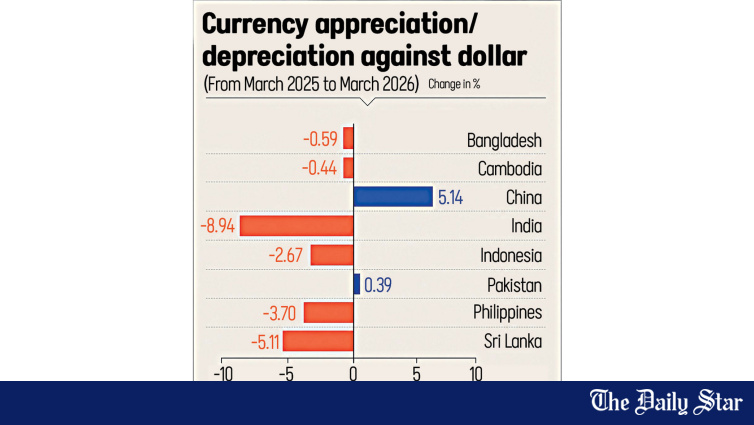
Dhaka, August 5, 2026 — The Bangladeshi taka remained one of the most stable currencies in South Asia and neighbouring economies over the past year, depreciating by just 0.59 percent against the US dollar between March 2025 and March 2026, according to the Bangladesh Bank quarterly report — a rare piece of positive macroeconomic news amid the broader challenges facing the economy.
The central bank's latest data showed that only Cambodia performed slightly better, with its currency weakening by 0.44 percent during the period. The relative stability of the taka stands in sharp contrast to the significant depreciation experienced by most peer currencies across South and Southeast Asia, and reflects the impact of Bangladesh Bank's shift to a market-based exchange rate regime in May 2025.
📊 Regional Currency Performance Comparison
- 🇰🇭 Cambodia (riel): -0.44% (best performer)
- 🇧🇩 Bangladesh (taka): -0.59% (second most stable)
- 🇵🇰 Pakistan (rupee): +0.39% (modest appreciation)
- 🇨🇳 China (yuan): +5.14% (strongest performer, appreciated)
- 🇮🇩 Indonesia (rupiah): -2.67%
- 🇵🇭 Philippines (peso): -3.70%
- 🇱🇰 Sri Lanka (rupee): -5.11%
- 🇮🇳 India (rupee): -8.94% (sharpest depreciation)
Among the peer countries, India experienced the sharpest depreciation, with the rupee losing 8.94 percent of its value against the US dollar. The Sri Lankan rupee depreciated by 5.11 percent, followed by the Philippine peso at 3.70 percent and the Indonesian rupiah at 2.67 percent. In contrast, the Chinese yuan appreciated by 5.14 percent, making it the strongest-performing currency among the countries compared. The Pakistani rupee also posted a modest appreciation of 0.39 percent against the US dollar.
🏛️ Why the Taka Held Steady
Officials at the central bank said that the relatively limited depreciation of the taka came after Bangladesh Bank adopted a more market-based exchange rate regime and tightened monetary and foreign exchange management to reduce volatility in the currency market. In May 2025, Bangladesh adopted a market-based exchange rate regime to meet a condition by the International Monetary Fund (IMF) — a structural reform that has fundamentally changed how the central bank manages currency stability.
The central bank has also been able to rebuild foreign exchange reserves through stronger remittance inflows and improved export earnings, helping ease pressure on the local currency. After the fall of the Awami League-led government in August 2024, remittance inflows continued to rise, and the BB was able to build its forex reserves, according to BB officials.
💰 Foreign Exchange Reserves Rebound
As of July 30, 2026, the foreign exchange reserves (BPM6) stood at $31.60 billion, up from $24.86 billion during the same period last year — a year-on-year increase of approximately $6.74 billion. The reserve rebuild has been one of the central bank's most significant achievements, providing a substantially larger buffer against external shocks than was available during the reserve depletion of 2024.
- 💰 Reserves (July 30, 2026): $31.60 billion
- 💰 Reserves (July 30, 2025): $24.86 billion
- 📈 Year-on-year increase: +$6.74 billion (+27.1%)
- 💲 Dollar range (past year): Tk 122 to Tk 123
- 💲 Dollar rate (Aug 4, 2026): Tk 123.81
Over the past year, the exchange rate of the US dollar against the local currency has hovered between Tk 122 and Tk 123, indicating a stable currency. This narrow trading range is itself a sign of the market-based regime's success in reducing volatility — a stark contrast to the wider fluctuations seen during the 2023-2024 period when the taka experienced sharp adjustments.
📋 Benefits for Importers and Inflation Control
Industry insiders said that a relatively stable exchange rate can help contain imported inflation by reducing the cost of essential imports such as fuel, food, and industrial raw materials. For Bangladesh's export-oriented industries, currency stability provides predictable pricing for international contracts — a critical advantage when competing against regional rivals whose currencies are experiencing greater volatility.
However, in recent months, the US dollar has continued to strengthen against the taka amid increased demand for foreign currency to settle import bills. On August 4, the interbank exchange rate of the US dollar stood at Tk 123.81, up from Tk 123.69 per dollar a few days earlier, according to Bangladesh Bank data. The modest uptick reflects the ongoing pressure from import demand, particularly for fuel and fertiliser imports by government agencies.
📋 Strategic Context
The Bangladesh Bank's positive currency stability assessment comes at a moment when the broader macroeconomic picture is mixed. While the taka's relative stability is genuinely encouraging — and reflects real policy improvements in exchange rate management — the currency stability has not translated into broader economic relief for households struggling with 9.2 percent inflation or for factories grappling with the gas crisis.
The stability of the taka is best understood as a necessary but insufficient condition for macroeconomic recovery. Currency stability prevents the kind of imported inflation spiral that would make the current inflation problem even worse, and it gives exporters a predictable operating environment. But sustained economic recovery requires the combination of currency stability, inflation moderation, energy supply restoration, and structural reforms outlined in the LDC graduation roadmap — none of which can be delivered by exchange rate management alone.
For now, the Bangladesh Bank can point to genuine progress on the currency front. The 0.59 percent depreciation rate is a meaningful improvement over the volatility of previous years, and the $31.60 billion reserve level provides a more comfortable buffer than at any point since 2024. Whether these gains can be sustained through the remainder of 2026 will depend on the trajectory of remittance inflows, the pace of import growth, and the broader geopolitical environment that determines global dollar strength.
This news was originally published by The Daily Star. For the full original report, please visit: https://www.thedailystar.net/business/economy/news/taka-ranks-among-regions-most-stable-currencies-bb-4240996
📬 Get Bangladesh Trade News in your inbox
Weekly digest of export industry news, policy updates, and market analysis.
📰 Related Stories