Bangladesh Stocks Extend Losses For Third Week As Investors Sell Off Amid Earnings Concerns
DSEX falls 0.43% to 5,452 points, down 23.52 points from previous week; total turnover drops to Tk 23.53 billion as DS30 and DSES also decline.
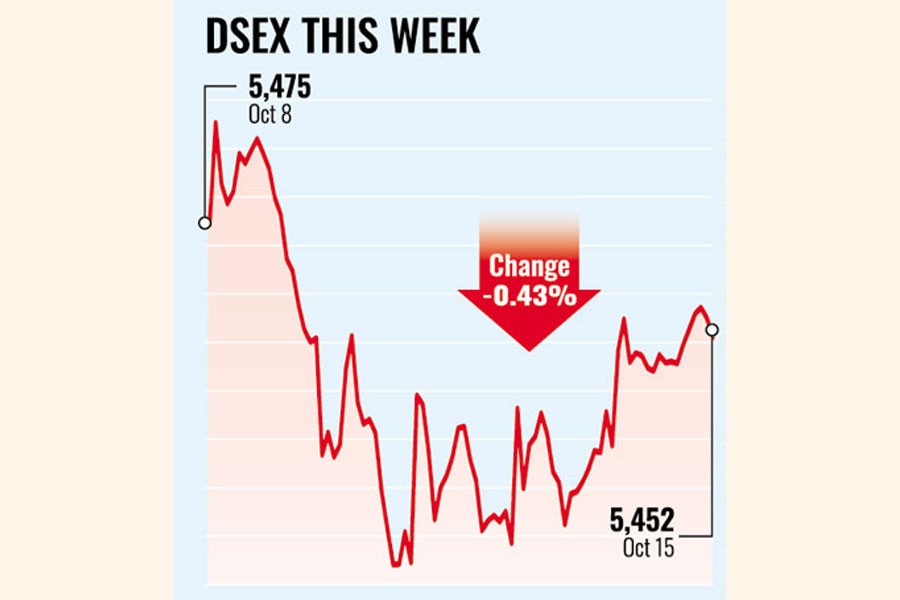
📉 Stocks ended the week on a negative note, extending their losing streak for three consecutive weeks as investors continued their sell-off amid persistent concerns over corporate earnings, rising business costs and renewed geopolitical tensions. Market operators said investors remained cautious amid ongoing earnings and dividend declaration season, while persistent domestic economic challenges kept them firmly on the defensive and constrained prospects for a sustainable near-term recovery.
📊 However, as the prolonged correction brought major stocks to attractive price levels, bargain hunters gradually resurfaced to snap up beaten-down stocks. Of the five trading sessions this week, the first three closed lower, while the final two managed to edge higher. DSEX, the benchmark index of Dhaka bourse, fell 0.43 per cent to settle the week at 5,452 points, down 23.52 points from the previous week's close of 5,475.58.
🏛 Index performance
Two other indices — DS30 and DSE Shariah Index (DSES) — also closed lower. The DS30, comprising 30 leading companies, declined 9.17 points, or 0.44 per cent, to 2,096.51 while the DSES, which tracks Shariah-compliant stocks, dropped 0.83 per cent to 1,078. The broad-based decline across all three major indices suggests that the selling pressure was systemic rather than concentrated in specific sectors or companies.
EBL Securities, in its weekly market analysis, said the market closed the week lower as concerns over weak corporate earnings and dividend declarations, persistent domestic macroeconomic headwinds, and renewed geopolitical uncertainties continued to weigh on investor confidence. The combination of these factors has created a challenging environment for the country's capital market, with investors reluctant to commit fresh capital amid so much uncertainty.
👥 Trading activity
Trading activity weakened considerably during the week, with the market recording a total turnover of Tk 23.53 billion, compared with Tk 27.82 billion in the previous week on the DSE. Consequently, the average daily turnover dropped by 15.4 per cent — a significant decline that reflects reduced investor participation. Lower turnover typically indicates that investors are sitting on the sidelines rather than actively trading — waiting for clearer signals before committing capital.
The decline in turnover is concerning because it suggests that the market is losing liquidity — which makes it harder for buyers and sellers to find each other at reasonable prices, and can lead to increased volatility. A liquid market with high turnover is generally healthier, as it allows investors to enter and exit positions easily and supports more accurate price discovery.
💰 Why investors are cautious
Several factors are contributing to investor caution in the Bangladeshi stock market:
- ⚠ Weak corporate earnings: June-closing companies are reporting their annual earnings, and many are showing weaker results than expected — reflecting the impact of macroeconomic headwinds on corporate profitability.
- ⚠ Disappointing dividend declarations: Several companies have declared lower dividends than in previous years, disappointing income-focused investors and putting downward pressure on share prices.
- ⚠ Persistent macroeconomic challenges: High inflation (8.26% in August), weak private sector credit growth (below 5% for six straight months), and banking sector stress (NPLs at 33%) continue to constrain economic activity.
- ⚠ Renewed geopolitical tensions: The Middle East conflict, elevated oil prices ($110/barrel), and broader global uncertainty are creating risk-off sentiment among investors.
- ⚠ Banking sector concerns: The City Group situation, the National Bank bailout, and broader banking sector stress are creating uncertainty about the financial sector's stability.
🌏 The bargain hunting dynamic
The fact that the final two trading sessions of the week managed to edge higher — after the first three sessions closed lower — suggests that bargain hunters are beginning to step in at lower price levels. This is a positive signal, as it indicates that there are buyers willing to commit capital when prices fall to attractive levels. However, the bargain hunting has been selective and tentative — not strong enough to reverse the broader downward trend.
For bargain hunting to translate into a sustained market recovery, several things need to happen. First, corporate earnings need to stabilise and begin to recover — demonstrating that the worst of the macroeconomic pressures has passed. Second, the macroeconomic environment needs to improve — with inflation coming down, credit growth recovering, and banking sector stresses being resolved. Third, investor confidence needs to be rebuilt — through credible policy actions, regulatory reforms, and visible improvements in market governance.
🤝 Looking ahead
For Bangladesh's capital market, the three-week losing streak is a reminder of the market's vulnerability to broader macroeconomic and geopolitical factors. The DSE has historically been characterised by high retail participation, limited institutional investor presence, and significant volatility — all of which amplify the market's reaction to news and macroeconomic developments.
The coming weeks will be critical for the market's direction. Corporate earnings announcements from June-closing companies will continue, with investors watching for signs of stabilisation or further weakness. Bangladesh Bank's first quarterly monetary policy statement (scheduled for late October) will provide important signals about interest rates and credit growth. And developments in the Middle East, oil markets, and the IMF programme will all influence investor sentiment.
If the macroeconomic environment begins to stabilise — with inflation easing, credit growth recovering, and the IMF programme providing external financing and reform momentum — the DSE could begin a sustained recovery. If the macroeconomic headwinds persist or worsen, the market is likely to remain under pressure, with periodic bargain hunting providing episodic support but limited upward momentum. The coming months will be critical for determining which scenario plays out.
This news was originally published by The Financial Express. For the full original report, please visit: https://thefinancialexpress.com.bd/bangladesh/stocks-extend-losses-for-third-week-2
📬 Get Bangladesh Trade News in your inbox
Weekly digest of export industry news, policy updates, and market analysis.
📰 Related Stories