Bangladesh Private Sector Credit Growth Falls to 33-Year Low: 4.47% in June
Weakest since 1993; businesses shelving investment, LCs nearly halted; NPLs at Tk 588,704 crore (32.26%); BB cut repo rate to 9.5% to spur lending
Dhaka, August 5, 2026 — Private sector credit growth fell to its lowest level in the past 33 years as businesses lost their appetite for borrowing, shelved investment plans, and banks remained cautious about lending amid mounting economic pressures — marking the weakest credit expansion since 1993 and underscoring the depth of Bangladesh's ongoing economic slowdown.
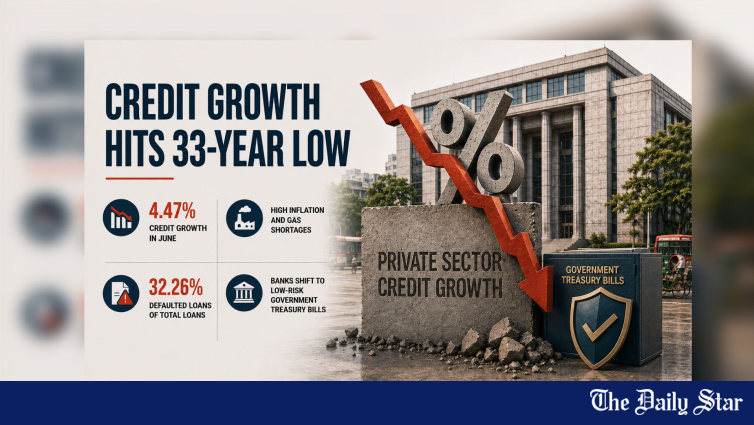
Private sector credit grew by just 4.47 percent in June, down from 4.98 percent in May, according to Bangladesh Bank (BB) data. Central bank officials said the June figure was the weakest since 1993. The previous low was 4.72 percent in March this year — meaning the June reading represents a further deterioration from an already historically depressed level.
📊 Credit Growth vs Targets
- 📉 June 2026 actual: 4.47% (33-year low)
- 📉 May 2026: 4.98%
- 📉 Previous low (March 2026): 4.72%
- 📈 BB original target (Jan-Jun FY26): 8.5%
- 📈 BB revised target (Jul-Dec FY27): 5.5%
- ❌ Gap from revised target: -1.03 percentage points
The June credit growth also missed the central bank's own target. The BB initially projected private sector credit growth of 8.5 percent for January to June under its monetary policy for FY26. It later revised the June target to 5.5 percent in the monetary policy statement for July to December of FY27. Even after the downward revision, actual growth remained well below the target — a pattern that has characterised the entire fiscal year.
💬 "Economic War" — Banker Perspectives
"You could say we are in a state of economic war," said Syed Mahbubur Rahman, managing director of Mutual Trust Bank. He said businesses are holding back investment because of weak export demand, declining household incomes, and an uncertain economic outlook. "Many factories are running below capacity because of gas shortages," said Mahbubur, who is also the former chairman of the Association of Bankers Bangladesh (ABB). He said inflation has also remained stubbornly high, further eroding demand for credit.
"When there is little investment, why would people borrow? Overall, the situation is quite bleak," said Mahbubur. "With export demand remaining weak, the opening of LCs [letters of credit] has also nearly come to a halt." The senior banker urged the government to respond quickly: "It should identify a few key priorities and act on them. This challenging period requires a collective effort, with everyone working together to overcome the crisis."
Md Touhidul Alam Khan, managing director and CEO of NRBC Bank PLC, shared a similar assessment. He said there are no major investment projects in the pipeline, while LC openings also remain weak. At the same time, many banks have limited capacity to extend fresh loans because of the growing burden of non-performing loans (NPLs). Touhidul said banks are instead focusing on smaller borrowers: "We are now focusing on the SME sector and trying to expand small-ticket lending."
💰 NPLs: The Binding Constraint
At the end of March, defaulted loans stood at Tk 588,704 crore, or 32.26 percent of the Tk 1,824,668 crore in outstanding loans, according to BB data. The staggering NPL ratio means that roughly one-third of all bank loans in Bangladesh are non-performing — a level that fundamentally constrains banks' ability and willingness to extend new credit.
Md Akhtar Hossain, chief economist at the central bank, said weak credit growth should not be viewed in isolation. He said rapid credit expansion during the previous Awami League government reached as high as 20 percent, but much of that lending went to large borrowers who later siphoned off the funds. "So, while credit expanded rapidly, it ultimately caused significant damage to the economy," said the BB chief economist.
Akhtar said banks are now reluctant to lend after a sharp deterioration in asset quality. "More than 30 percent of loans have turned non-performing, leaving banks uncertain about whether new loans will be repaid." He said many banks are investing in government treasury bills and bonds instead of extending loans because those investments carry little risk — a dynamic that was highlighted in the recent report on banks cutting deposit rates while investing in T-bills.
🏛️ Policy Response: Repo Rate Cut
The chief economist said conditions should gradually improve as recent policy measures begin to take effect. "The government and the central bank are taking measures to revive credit growth and support business activity." The policy interest rate has been reduced to encourage borrowing, while the central bank is urging banks to lend to creditworthy customers, he said.
On July 30, the BB cut its policy, or repo, rate from 10 percent to 9.5 percent, its first reduction in six years. "Stimulus packages have also been announced. As a result, private sector credit growth is expected to recover in the coming months," Akhtar added. The Tk 60,000 crore stimulus package announced in May, combined with the repo rate cut, represents the government's primary policy levers for reviving credit growth — though the impact of both measures will depend on whether banks are willing to lend and businesses are willing to borrow.
📋 Strategic Context
The 33-year low in private sector credit growth is perhaps the single most concerning macroeconomic indicator for Bangladesh at this moment. Credit growth of 4.47 percent is not just below the BB's revised target of 5.5 percent — it is below the rate of nominal GDP growth, meaning that the financial sector is shrinking relative to the overall economy. If this pattern persists, it will constrain investment, limit job creation, and make it impossible to achieve the 7 percent GDP growth targeted in the LDC graduation roadmap.
The BB chief economist's point about the previous government's reckless credit expansion is well-taken — 20 percent credit growth that went to politically connected borrowers who siphoned the funds did more harm than good. But the current 4.47 percent growth represents the opposite extreme: a banking sector so damaged by NPLs and so uncertain about the economic outlook that it has effectively stopped financing productive investment. The path back to healthy credit growth runs through NPL resolution, energy supply restoration, and export demand recovery — none of which can be achieved by monetary policy alone. The repo rate cut and stimulus package are necessary but insufficient; the structural constraints on credit growth require structural solutions.
This news was originally published by The Daily Star. For the full original report, please visit: https://www.thedailystar.net/business/economy/news/private-sector-credit-growth-falls-33-year-low-4240266
📬 Get Bangladesh Trade News in your inbox
Weekly digest of export industry news, policy updates, and market analysis.
📰 Related Stories