Bangladesh Imports 90 Percent of Medical Devices, Local Industry Stuck at 10
High lending rates, dollar costs and public procurement bias keep a billion-dollar manufacturing opportunity untapped, industry leaders say
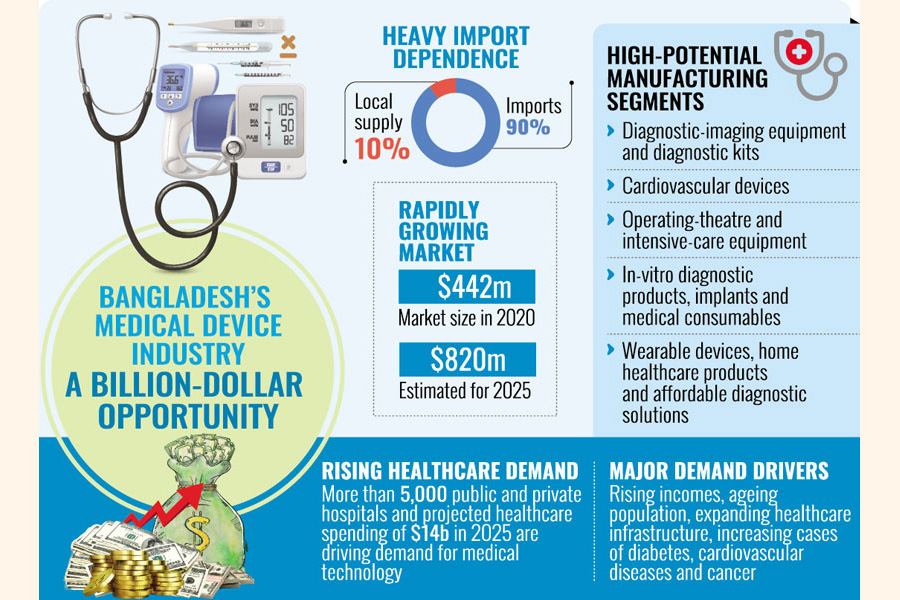
🩺 Bangladesh imports nearly 90 percent of its medical equipment as a potential billion-dollar manufacturing opportunity is left largely untapped, mainly because of policy shortcomings. As healthcare demand rises and hospitals expand, the country faces a paradox: a fast-growing market for medical technology, but a domestic industry that captures only a fraction of its value.
💸 The market was estimated at $442 million in 2020 and projected to reach about $820 million by 2025, according to industry estimates cited in a sector study. Rising incomes, an ageing population and the growing burden of non-communicable diseases are driving demand for diagnostic equipment, hospital supplies and medical technologies — yet converting that demand into a competitive manufacturing industry will require the government to fix policies that often make importing finished devices cheaper than producing them locally.
💉 We are manufacturing 99 per cent of our medicines but in the medical device and equipment market the share of local manufacturers is only 10 per cent, says Abdur Razzak, general secretary of the Bangladesh Association for Medical Devices and Surgical Instruments Manufacturers and Exporters' Association — and this is happening in the same market. Razzak, also the founder of JMI, a leading medical-device manufacturing company of the country, laments that the public healthcare sector had once stopped procuring his company's products for three years till 2025. Instead, they went for imported products, he says, adding that this kind of attitude is a barrier to promoting the local manufacturing sector. High lending rates and rising dollar prices are seriously affecting the industry as well, he notes.
🏥 A market growing faster than the world's
📈 Bangladesh's medical-device imports have grown at an annual compound rate of about 10 percent, compared with estimated global industry growth of 4.0-6.0 percent, according to the study — a gap that illustrates both the strength of domestic demand and the extent to which local manufacturers have yet to capture it. The country now has over 5,000 public and private hospitals, with healthcare spending estimated at $14 billion in 2025, while infrastructure upgrades and rural healthcare expansion keep driving device adoption.
🤕 The burden of non-communicable diseases — diabetes, cardiovascular issues and cancer — is fuelling particularly strong demand for diagnostic tools and medical equipment, with diabetes cases alone projected to reach 43 million by 2030, a Bangladesh Investment Development Authority (BIDA) report notes. Greater awareness of early diagnosis, alongside demand for long-term treatment, is expected to expand the use of medical devices across hospitals, clinics and households.
🧪 Nearly all of that demand is being met from abroad. Existing domestic manufacturing is concentrated in relatively low-technology products, including consumables, orthopaedic supplies, medical furniture and basic electro-diagnostic equipment. Diagnostic equipment, instruments and appliances account for about half of medical-device imports by value, with other segments including in-vitro diagnostic products, patient aids, implants and consumables. The study identifies cardiovascular devices, diagnostic-imaging equipment, diagnostic kits, and operating-theatre and intensive-care equipment as areas with strong growth potential.
💶 Financing gaps behind the technology gap
💳 Despite the growth potential, healthcare financing remains limited. Total health expenditure stood at 2.48 percent of gross domestic product in 2019, while government spending was less than 1.0 percent of GDP; healthcare accounted for about 5.0 percent of the national budget in recent years, the study notes. Patients bear a substantial share of medical costs — out-of-pocket payments accounted for about 73 percent of healthcare expenditure in 2019, while insurance penetration was just 0.5 percent, compared with an average of 3.3 percent in emerging economies. Per-capita health spending rose from $9 in 2000 to $46 in 2019, but remained low relative to regional peers, according to a JICA study.
🛡 For manufacturers, the operating environment adds friction at every step: complex regulations, bureaucratic procedures, limited backward-linkage industries and restricted access to finance. Incentives alone may therefore be insufficient, the JICA study argues — investors need predictable regulations, transparent registration procedures and a tax structure that encourages domestic production without compromising safety or quality.
🚀 What a viable industry strategy looks like
- 🤝 Attracting foreign manufacturers and joint ventures to give domestic companies access to production expertise, product designs and international distribution networks.
- 🎓 Developing technical skills and closer collaboration between industry and academia to design and commercialise products suited to local healthcare needs.
- 🏥 Encouraging hospitals to test new devices and build confidence among doctors and patients in locally made equipment.
- 📖 Improving access to finance, with banks and investment funds backing businesses that require substantial upfront capital.
🔬 Over the longer term, Bangladesh could move beyond basic equipment assembly towards designing and manufacturing more sophisticated technologies — wearable devices, home healthcare products and affordable diagnostic solutions offer particular opportunities for rural and underserved communities, the JICA report says. Low labour costs and an established manufacturing base provide a starting advantage, but they do not guarantee success in a sector where technical expertise, regulation and reliability are decisive.
📝 The government has recently offered some incentives, including zero-rated Advance Tax on imported capital equipment and parts for public-welfare-service sectors, hospitals and healthcare facilities; reductions in import duties on raw materials for medical equipment; a cut in customs duty on medical-device manufacturing inputs; and VAT exemption on locally manufactured medical beds. These measures point in the right direction, but industry players say procurement practice and credit costs still tilt the field against local makers.
🌏 The bigger prize is the export frontier. Industry experts feel that with sustained investment and effective policy support, medical devices could emerge as a new manufacturing sector complementing the country's export-oriented garment and pharmaceutical industries — a natural next step for an economy that has already proved it can scale labour-intensive manufacturing to world standards. Without reforms to tariffs, regulation and investment conditions, however, Bangladesh risks continuing to spend heavily on imported equipment while capturing only a small share of the value generated by its own expanding healthcare market.
This news was originally published by The Financial Express. For the full original report, please visit: https://thefinancialexpress.com.bd/economy/billion-dollar-medical-device-market-unexplored-import-dependence-grows
📬 Get Bangladesh Trade News in your inbox
Weekly digest of export industry news, policy updates, and market analysis.
📰 Related Stories