Bangladesh Garment Prices In EU Less Than Half Of Vietnam's: Eurostat Data
Bangladesh's EU export price fell to €13.80/kg while Vietnam rose to €29/kg, as BKMEA blames low-end product mix and unhealthy domestic price competition
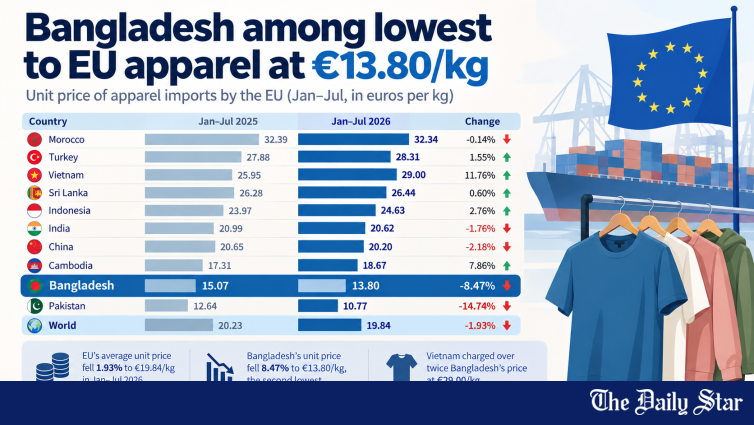
👕 Among the cheapest suppliers to EU buyers, Bangladesh ranks second-lowest in terms of export prices among major suppliers such as China, Vietnam, India and Cambodia. In the price chart, Bangladesh is only above Pakistan, the cheapest supplier. The pricing gap reflects a structural challenge for Bangladesh's RMG sector — the country's export basket remains dominated by low-value basic garments while competitors are successfully moving upmarket into higher-value products.
📊 For instance, the unit price of Bangladeshi garment items fell to €13.80 per kilogram (kg) from €15.07 in the corresponding period of 2025, posting an 8.47 percent year-on-year fall, according to data from Eurostat. However, Vietnam's average price rose to €29 per kg in the first six months of this year from €25.95 in the same period last year. Vietnam's €29/kg price is more than double Bangladesh's €13.80/kg — a gap that translates into billions of euros in foregone export revenue for Bangladesh.
💰 Price Comparison Across Competitors
- 💰 Bangladesh: €13.80/kg (down 8.47% YoY)
- 💰 Vietnam: €29.00/kg (up 11.75% YoY)
- 💰 China: Price fell 2.18% YoY
- 💰 Cambodia: €18.67/kg (up 7.86% YoY)
- 💰 Turkey: €28.31/kg (up 1.53% YoY)
- 💰 India: Price fell 1.76% YoY
- 💰 Pakistan: €10.77/kg (down 14.74% YoY) — cheapest
- 💰 EU average import price: €19.84/kg (down 1.93% YoY)
📜 BKMEA President: Product Mix And Price Competition
Mohammad Hatem, president of the Bangladesh Knitwear Manufacturers and Exporters Association (BKMEA), said Vietnam sends high-value garment items to the EU, while Bangladesh still exports low-end items. The price of low-end garment items is low, but the volume is high, he said. On the other hand, the value of high-end garment items is high, but the volume is low, he added. For instance, if a T-shirt is sold at $2 from Bangladesh, the price of the same T-shirt from Vietnam is over $4, he said.
He also blamed unhealthy price competition among exporters domestically for lower prices from international clothing retailers and brands. The domestic price competition dynamic — where Bangladeshi exporters undercut each other to secure orders from international buyers — creates a race to the bottom that benefits buyers at the expense of exporter margins. Without coordinated pricing discipline or value-added product development, Bangladeshi exporters remain trapped in a low-price, high-volume model that generates declining per-unit revenue.
🌏 Cambodia And Turkey: Rising Prices, Gaining Share
At the same time, Cambodia's price rose by 7.86 percent to €18.67, gaining share while charging more — the opposite of Bangladesh's pattern. Turkey also saw a price hike of 1.53 percent, hitting €28.31 from €27.88. The contrast between Bangladesh (falling prices, losing share) and Cambodia (rising prices, gaining share) is particularly instructive. Cambodia has been investing in higher-value product categories and building stronger buyer relationships that support premium pricing — demonstrating that developing country RMG exporters can move upmarket if they invest in product development, quality improvement and buyer relationship management.
Garments from India and Pakistan to the EU both registered a fall in prices. India experienced a 1.76 percent fall in garment export prices, while Pakistan recorded the highest decline, at 14.74 percent year-on-year, to €10.77. Pakistan's 14.74% price decline — the steepest among all competitors — reflects the country's macroeconomic challenges including currency depreciation and energy sector crisis, which have forced Pakistani exporters to accept lower prices to maintain volume.
📊 EU Market Contraction Affects All Suppliers
In the first six months of this year, the average import price of garments by the EU was €19.84 per kg, down 1.93 percent from €20.23 per kg in the same period last year, Eurostat also said. The EU apparel import market shrank overall. Total imports fell 5.10 percent by value to €54.38 billion and 3.23 percent by volume to 2,688.66 million kg. The average unit price across all sources dropped 1.93 percent to €19.84 per kg.
Bangladesh's exports fell further than the market, declining 13.65 percent to €10.37 billion in value and 5.66 percent in volume to 751.91 million kg in the January-July period. As a result, it lost share rather than simply following the wider pullback. The 13.65% value decline versus the 5.10% market contraction means Bangladesh lost approximately 8.5 percentage points of EU market share in just six months — a meaningful erosion that, if sustained, would fundamentally alter Bangladesh's position in the EU apparel import market.
🤝 Strategic Implications For Bangladesh's RMG Sector
For Bangladesh's RMG sector, the Eurostat data carries several strategic implications. First, the widening price gap with Vietnam (€13.80 vs €29) demonstrates that Bangladesh's failure to develop man-made fibre (MMF) garment manufacturing capacity — the segment where Vietnam has captured premium pricing — is now costing the country billions in foregone export revenue. Vietnam's MMF capability allows it to produce higher-value garments (technical textiles, performance wear, fashion items) that command premium prices, while Bangladesh remains concentrated in basic cotton garments.
Second, the domestic price competition that BKMEA President Hatem identifies is a structural problem that requires coordinated industry action. Without minimum pricing guidelines or quality-based differentiation, Bangladeshi exporters will continue to undercut each other, transferring margin to international buyers. The BGMEA and BKMEA could play a role in establishing industry-wide pricing norms — though competition law considerations would need to be addressed.
Third, the EU market contraction — combined with Bangladesh's disproportionate decline — underscores the urgency of export market diversification. Bangladesh's heavy dependence on the EU (which absorbs approximately 60% of RMG exports) creates vulnerability to EU-specific demand cycles. Diversifying into the US, Japan, Australia and emerging Asian markets would reduce this concentration risk while also providing opportunities to test higher-value product categories in markets with different competitive dynamics.
The coming months will reveal whether Bangladesh's RMG sector can reverse the EU market share erosion — or whether the pricing gap with Vietnam, Cambodia and Turkey will continue to widen, fundamentally reshaping the competitive landscape of the global apparel trade.
This news was originally published by The Daily Star. For the full original report, please visit: https://www.thedailystar.net/business/news/bangladeshs-garment-prices-eu-less-half-vietnams-4274711
Related on BangladeshExport
📬 Get Bangladesh Trade News in your inbox
Weekly digest of export industry news, policy updates, and market analysis.
📰 Related Stories