Bangladesh Bank Launches P2P Payments on Bangla QR from November 1
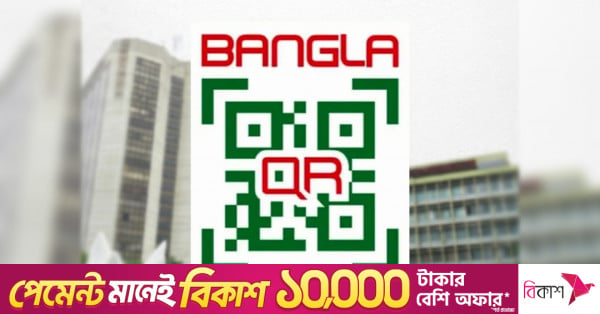
Dhaka, August 13, 2026 — Bangladesh Bank has instructed banks, mobile financial service (MFS) providers, payment service providers (PSPs), and payment system operators (PSOs) to integrate person-to-person (P2P) transfer functionality into their mobile applications via Bangla QR by October 31 — readying the service for a national rollout on November 1. The directive, issued on August 6, marks a major expansion of the country's unified QR payment system beyond its current customer-to-merchant (C2M) scope.
📱 How P2P Bangla QR Will Work
Currently, Bangla QR is used mainly for customer-to-merchant (C2M) payments — where a customer scans a merchant's QR code using a bank or MFS app to pay for a purchase. The new P2P system extends the same technology to person-to-person transfers:
- 📱 Personal QR codes — users generate their own QR code within their bank/MFS app
- 📷 Scan or upload — recipients can scan a shared QR code or upload an image of it
- 🤝 Interoperable — works across all banks and MFS providers
- 💰 No new charges — P2P transactions have no separate charging mechanism
- 👥 Universal access — works for any user with a bank or MFS account
For example, a child in Dhaka could generate a P2P Bangla QR code through their app and send it to their father, who could then scan the code and transfer the required amount — without needing to enter bank account numbers, routing numbers, or recipient names manually.
🚧 The Problem P2P Bangla QR Solves
Bangladesh Bank spokesperson Arief Hossain Khan explained the safety and convenience benefits of the new system. “At present, when someone uses Send Money, entering even one wrong digit can result in the money being transferred to the wrong account. With a unified QR code, that risk will no longer remain.”
The current manual-entry Send Money system has long been plagued by:
- ⚠️ Wrong-account transfers — simple typing errors send money to wrong recipients
- 📝 Manual entry fatigue — entering 11+ digit account numbers is error-prone
- 🔄 Recovery complexity — reversing wrong transfers takes days or weeks
- 🚧 Bank-specific friction — different banks have different Send Money interfaces
- 💰 Fee confusion — varying charges across banks and MFS providers
The unified QR approach eliminates these pain points — the QR code carries all the necessary account information, removing the need for manual data entry and the associated error risk.
📊 Bangla QR Growth: 8.6x in Six Months
Bangladesh Bank data shows explosive growth in Bangla QR adoption over the past six months:
- 📈 January 2026 — 7,23,378 transactions worth Tk 212.05 crore
- 📈 July 2026 — 62,54,938 transactions worth Tk 1,475.95 crore
- 📉 Volume growth — 8.6x increase in transaction count in 6 months
- 💰 Value growth — 7x increase in transaction value in 6 months
- 🏢 Merchant base — 24,25,133 merchants in July (up from 13,52,712 in May — 79% growth in 3 months)
- 💸 Daily volume — Tk 50-60 crore transacted daily through Bangla QR
BB Payment Systems Department Director Sharafat Ullah Khan told TBS that the central bank expects the volume to increase several times from the beginning of October — when the zero merchant charge takes effect.
🏛️ Zero Merchant Charges from October 1
As previously announced, Bangladesh Bank has reduced the merchant payment charge on Bangla QR to zero, effective October 1, 2026. This represents a major incentive for merchants to adopt QR payments — eliminating the 1-1.5 percent merchant discount rate (MDR) that previously applied to card and digital payments.
The combination of zero merchant charges (October 1) and P2P launch (November 1) is expected to drive a step-change increase in Bangla QR adoption — positioning the unified QR as the dominant digital payment rail in Bangladesh.
“We will take comprehensive steps to turn Bangla QR into a single, universal QR code for transactions,” said Sharafat Ullah Khan. “We will also introduce more services in line with market demand.”
🏢 Government Payments Integration
Bangladesh Bank is also in discussions with government agencies to use Bangla QR for payments in critical public service sectors:
- 🎓 Education — school fees, university tuition payments
- 💚 Healthcare — hospital bills, diagnostic fees, medicine purchases
- 📜 Tax collection — NBR tax payments via QR
- 🏛️ Public services — utility bills, licence fees, fines
“Necessary steps will be taken to introduce such services,” BB spokesperson Arief Hossain Khan confirmed — signalling that Bangla QR is being positioned as the foundation for a comprehensive digital government payment infrastructure.
📱 The Smartphone Barrier: 6 Crore Feature Phone Users
Despite the rapid growth, BB Governor Md Mostaqur Rahman identified a critical barrier to broader digital payment adoption: limited smartphone penetration. Speaking at a programme in Chattogram on August 8, the governor noted that around 6 crore (60 million) Bangladeshis still use feature phones — excluding them from the smartphone-based Bangla QR ecosystem.
The governor outlined the affordability challenge:
- 💰 Feature phone users willing to pay — around Tk 3,000 for a good phone
- 📱 Android phone floor price — Tk 8,000 (manufacturers' minimum viable cost)
- 🚧 Affordability gap — Tk 5,000 per device
- 💰 Total investment needed — Tk 30,000 crore to bridge the gap
The governor said work is under way to find ways to arrange the investment — including exploring instalment purchase options through mobile operators. If successful, this could bring tens of millions of feature-phone users into the digital and financial inclusion ecosystem.
💰 The Cash Management Cost: Tk 20,000 Crore Per Year
BB Payment Systems Department-1 Additional Director Md Parvez Anjam Munir highlighted a striking statistic: Bangladesh spends approximately Tk 20,000 crore per year managing cash — covering the entire lifecycle of banknotes from printing and production at the security printing press to distribution, circulation, collection of damaged and worn notes, and eventual destruction. Expanding digital payments could significantly reduce this cost — freeing up fiscal resources for productive investment.
🌐 Strategic Context: Digital Bangladesh Evolution
The P2P Bangla QR launch is the latest in a series of digital payment milestones that position Bangladesh as a regional fintech leader:
- 📱 Bangla QR launch — unified QR code standard introduced
- 🚧 Zero merchant charges — from October 1, 2026
- 🤝 P2P transfers — from November 1, 2026
- 🏢 Government payment integration — under discussion
- 📱 Smartphone affordability programme — to expand digital inclusion
For an economy preparing for LDC graduation and seeking to deepen financial inclusion, the unified QR infrastructure represents one of the most consequential digital public goods investments of the decade — with the potential to transform how 170 million Bangladeshis transact, save, and access financial services.
This news was originally published by The Business Standard. For the full original report, please visit: https://www.tbsnews.net/economy/banking/person-person-payments-coming-bangla-qr-bb-orders-all-apps-be-ready-31-oct-1513811
Related on BangladeshExport
📬 Get Bangladesh Trade News in your inbox
Weekly digest of export industry news, policy updates, and market analysis.
📰 Related Stories