BRAC Bank to Issue Bangladesh's First Bank Green Bond of Tk 1,000 Crore
Three-year zero-coupon instrument targets a 7.5 percent return, with proceeds ring-fenced for renewable energy,
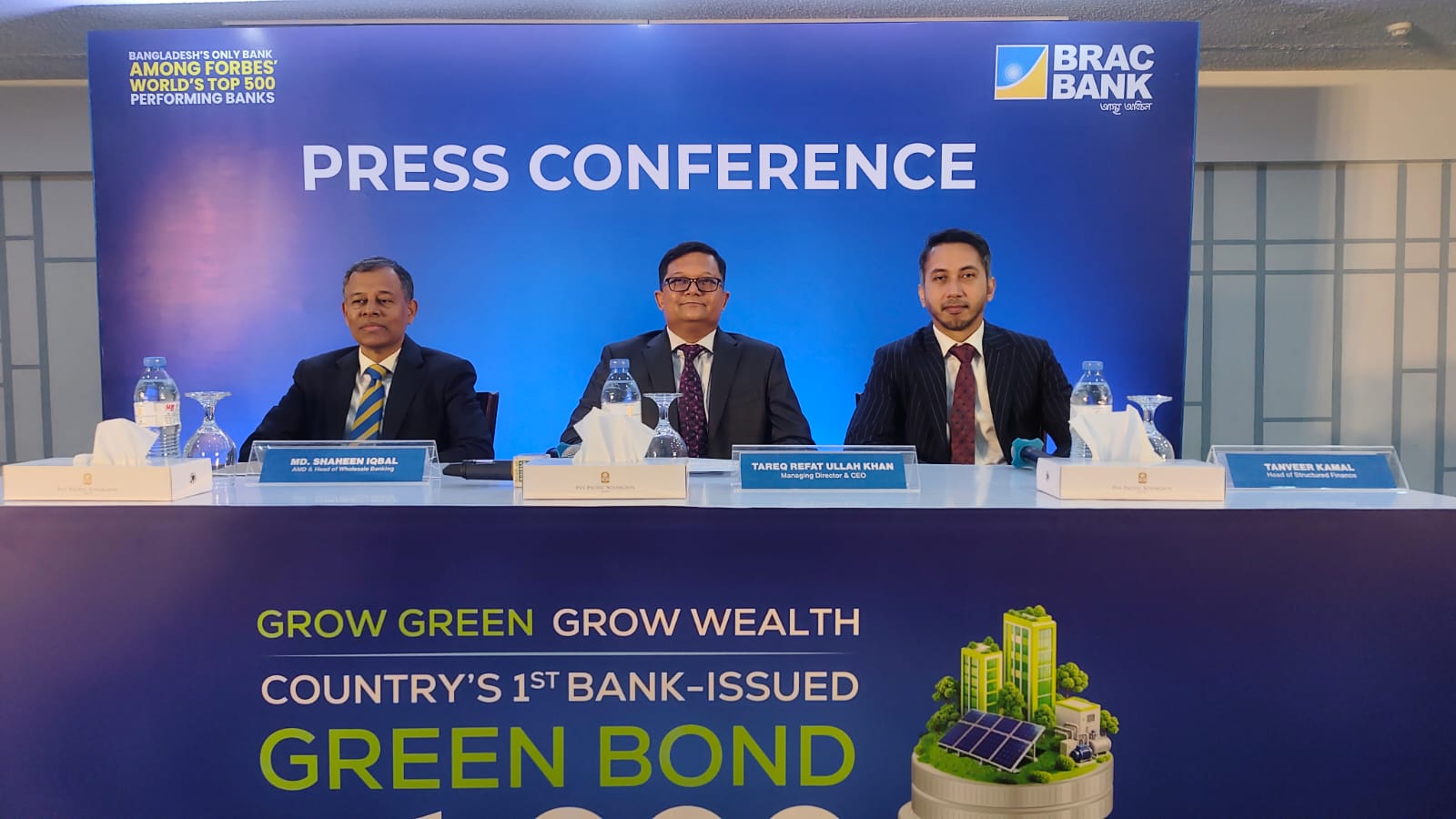
🌱 BRAC Bank is set to issue a Tk 10 billion (Tk 1,000 crore) green bond, becoming the first bank in Bangladesh to undertake such an issuance aligned with Bangladesh Bank's Green Bond Financing Policy for banks and financial institutions. The private lender will use the instrument to channel long-term money into renewable energy, green buildings and energy-efficient industry — a milestone that connects the country's capital market directly to its climate and energy agenda.
📄 The structure is unconventional for the local market: the three-year bond will be senior-unsecured, non-convertible, fully redeemable and zero-coupon, said Tareq Refat Ullah Khan, managing director and chief executive officer of BRAC Bank, at a press briefing in Dhaka. A zero-coupon bond pays no periodic interest — investors buy at a discount and receive the full face value at maturity, with the difference being their return. At the bank's targeted 7.5 percent yield, a Tk 10 lakh bond would be priced at roughly Tk 8.05 lakh at issue, assuming annual compounding. Each bond carries a face value of Tk 1 million (Tk 10 lakh) and will be offered to corporate institutions and individual investors, with eligible company provident and gratuity funds also able to invest subject to regulations.
🗳 The credentials behind the issuance are its distinguishing feature. The bond framework follows the International Capital Market Association's (ICMA) Green Bond Principles, reflecting commitment to internationally recognised sustainability standards, transparency and accountability, and it has received a second-party opinion from S&P Global Ratings — an independent assessment of its green credentials. The bank expects proceeds to contribute to four Sustainable Development Goals: affordable and clean energy (SDG 7), industry, innovation and infrastructure (SDG 9), sustainable cities and communities (SDG 11), and climate action (SDG 13). To ensure transparency, the bank will conduct annual audits verifying that proceeds are used only for eligible green projects.
🚀 Why factories need this money
⛽ The demand-side logic is grounded in the current energy squeeze. Many factories are turning to renewable energy amid the global energy crisis and rising fuel prices, but such projects need affordable, long-term financing, the BRAC Bank chief executive said. Most bank lending to renewable energy and energy-efficiency projects is tied to tenors that are hard to match with short-term deposits, so a three-year instrument — though modest in length — could help ease that mismatch. By mobilising capital specifically for eligible green projects, we aim to help businesses access financing for renewable energy, greener buildings and more energy-efficient industrial operations, he said.
🧭 The issuance also enjoys official encouragement: the managing director thanked the government and the Bangladesh Securities and Exchange Commission for their support for the tax benefits, noting that the tax treatment of zero-coupon bonds could make the paper attractive to investors. The bond is expected to broaden the range of sustainable investment instruments in the capital market while creating an additional channel for directing funds toward environmental objectives — and the MD framed it as a meaningful step towards deepening Bangladesh's capital market.
🏦 A sustainability track record behind the paper
📉 The issuance builds on an established record. BRAC Bank has been recognised as one of Bangladesh Bank's top sustainable banks for five consecutive years and ranked first among Bangladeshi banks in Bloomberg's environmental, social and governance (ESG) rating, according to the bank. More than 60 percent of its loan portfolio is dedicated to sustainable finance, and the bank previously issued a social bond — credentials that matter for a market where green labels have often lacked audit trails. The bank's ambition, its chief executive said, goes beyond financing individual projects: it wants to contribute to a financial ecosystem in which sustainability is embedded in investment decisions and responsible growth.
🔭 A test of the domestic bond market
💼 For a banking sector that has struggled with a shortage of long-term funding, the issue is also a test of the domestic corporate bond market, which remains shallow, BRAC Bank officials acknowledged. Bangladesh's financial system is overwhelmingly deposit-funded and equity-listed; the middle of the capital structure — corporate bonds — has never developed depth, leaving infrastructure and green projects scrambling for tenors beyond a few years. A successful placement of Tk 1,000 crore to institutions and provident funds would give regulators their first bank-led template for replicating the instrument across the sector — each subsequent issuance cheaper and faster than the first.
💰 The macro backdrop makes the timing sharper. Bangladesh's fuel import bill, power-sector subsidies and climate-finance needs all argue for exactly this class of instrument: domestic taka capital, aligned with global green standards, funding assets that cut the country's energy exposure. If BRAC Bank's zero-coupon structure proves digestible to institutional investors — and the 7.5 percent return holds against competing treasury yields — the green bond could become the template through which Bangladesh's climate ambitions tap private savings rather than waiting on international climate finance. That is a first worth more than its face value.
This news was originally published by The Financial Express. For the full original report, please visit: https://thefinancialexpress.com.bd/bangladesh/brac-bank-to-issue-tk-10b-green-bond-first-by-a-bank-in-bangladesh
📬 Get Bangladesh Trade News in your inbox
Weekly digest of export industry news, policy updates, and market analysis.
📰 Related Stories