Fazli Mango: Bangladesh's Premium Late-Season GI Mango — Buyer's Guide (2026)
Fazli Mango — Bangladesh's 2024 GI mango, premium late-season variety (July-August). Complete buyer's guide: 200-year history, Rajshahi-Chapainawabganj-Naogaon origin, 400-800g large fruit, 18-25 day shelf life, HS codes (08045031/39), cold-chain logistics, authenticity, 709 verified suppliers.
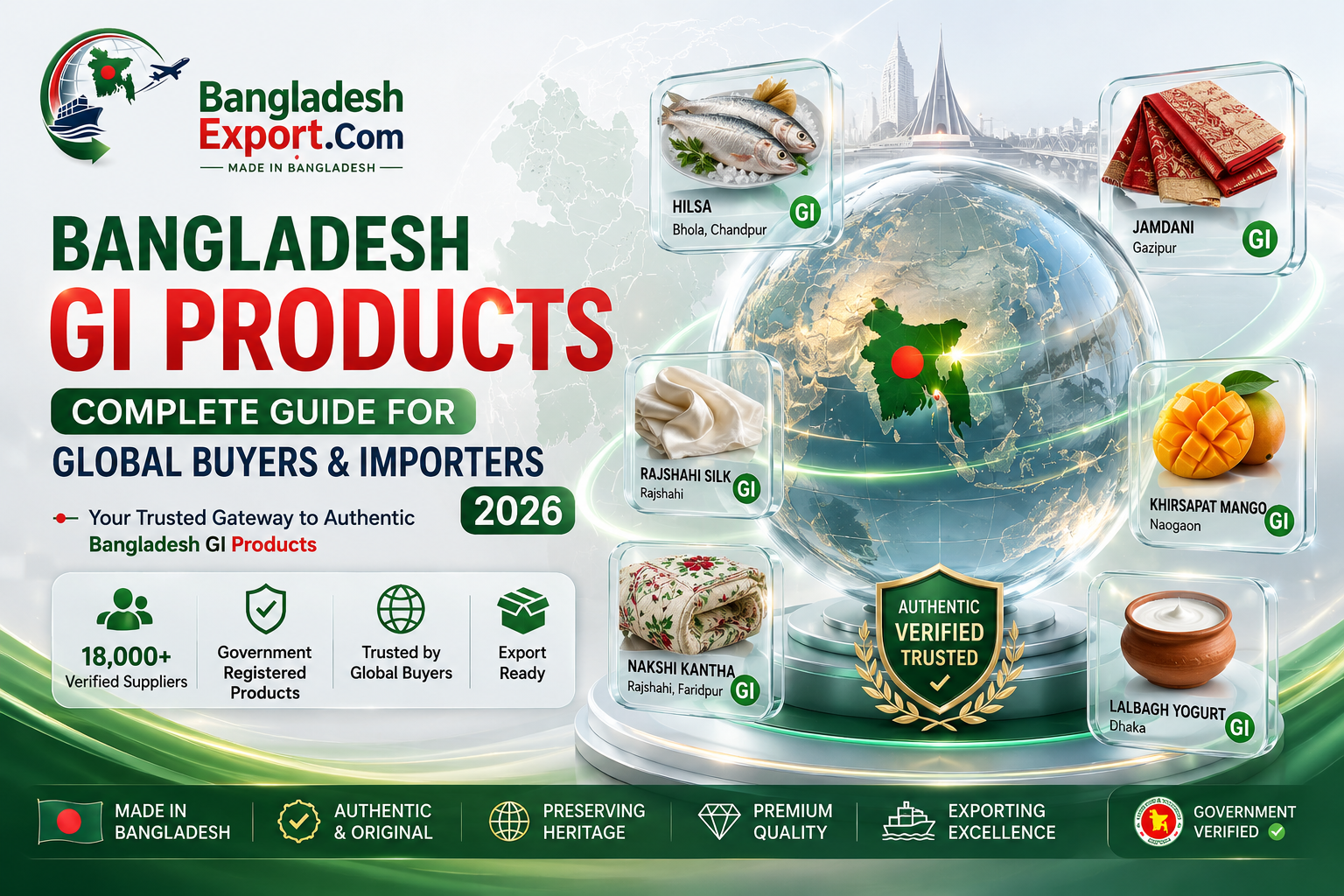
Fazli Mango is one of Bangladesh's most commercially important GI mango varieties, registered by DPDT in 2024 as part of the historic wave that expanded the country's GI register from ~20 to 60+ products in a single year. Grown primarily in the Rajshahi-Chapainawabganj region and Naogaon district of northern Bangladesh, Fazli is a late-season mango (harvested July–August) known for its large size (typically 400–800 grams per fruit), thick skin, firm fiberless flesh, and excellent shelf life — making it the most logistics-friendly of the Bangladeshi GI mango varieties and the highest-volume mango in formal export channels. Annual Fazli exports exceed USD 8 million, with established demand in the Middle East, EU, and Indian markets. For international buyers seeking a mango variety that combines GI authenticity with practical export logistics, Fazli is the most accessible entry point.
This guide is the complete buyer's reference for international importers, gourmet retailers, diaspora grocers, and food wholesalers sourcing authentic Bangladesh-origin Fazli mangoes directly from verified growers. It covers the variety's history, the 2024 GI registration, the Rajshahi-Chapainawabganj-Naogaon production region, quality characteristics, harvest season logistics, HS codes, packaging and cold-chain requirements, authenticity verification, and direct sourcing from verified agriculture exporters on BangladeshExport.com.
📜 History & Origin of Fazli Mango
Buyers can verify the official list of Bangladesh's registered Geographical Indication (GI) products through the Bangladesh Trade Portal maintained by the Government of Bangladesh. Refer to the official GI products page for the latest registrations and updates:
bangladeshtradeportal.gov.bd — GI Products Page
The Fazli variety has a documented history of over 200 years in the Bengal region, with historical accounts tracing its cultivation to the mango orchards of the Bardhaman (Burdwan) region of present-day West Bengal, from where it spread to the Rajshahi-Chapainawabganj belt of present-day Bangladesh. The variety's name is believed to derive from the Arabic word "fazl" (meaning "bounty" or "abundance"), reflecting the large fruit size and generous yield that distinguished Fazli from other regional varieties. By the late 19th century, Fazli had become one of the dominant commercial mango varieties in northern Bengal, prized for its combination of large size, firm flesh, and excellent transport durability — qualities that made it suitable for the long river-and-rail journeys to Kolkata markets during the British colonial period.
The partition of India in 1947 and the subsequent political reorganization of Bengal left Fazli cultivation distributed across both West Bengal (India) and the Rajshahi-Chapainawabganj-Naogaon region of East Pakistan (later Bangladesh). Today, the Bangladesh-origin Fazli — grown in the specific alluvial soil and climate conditions of the greater Rajshahi division — has developed distinct quality characteristics that justified its 2024 GI registration as a separate product from Indian-origin Fazli. The GI registration protects the "Fazli Mango of Rajshahi-Chapainawabganj" and "Nak Fazli Mango of Naogaon" designations, both registered in 2024, for mangoes grown in these specific Bangladeshi districts.
Modern Fazli cultivation in Bangladesh covers an estimated 15,000–20,000 hectares across the Rajshahi-Chapainawabganj-Naogaon belt, with annual production of 80,000–120,000 metric tons. The variety accounts for approximately 20–25% of Bangladesh's total mango production by weight — making it the second-largest commercial variety after Langra. The late-season harvest (July–August) extends the Bangladeshi mango export season by 4–6 weeks beyond the Khirsapat window, allowing buyers to maintain mango supply through late summer.
🏛️ GI Registration Details & Region of Origin
Fazli Mango was registered as a Bangladesh GI product in 2024 by DPDT — with two specific registrations: "Fazli Mango of Rajshahi-Chapainawabganj" covering the greater Rajshahi-Chapainawabganj production region, and "Nak Fazli Mango of Naogaon" covering the specific Naogaon-district variant distinguished by its characteristic "nose" (nak) tip at the fruit's blossom end. The registered production regions cover the districts of Rajshahi, Chapainawabganj, and Naogaon in northern Bangladesh — the country's premier mango-growing belt along the Padma and Mahananda river floodplains.
The legal implication for buyers is significant: a mango sold as "Fazli Mango of Rajshahi-Chapainawabganj" or "Nak Fazli of Naogaon" in any WTO member state must genuinely originate from the registered Bangladeshi districts. Indian West Bengal-origin Fazli, mangoes from other Bangladeshi districts, and any other large-mango variety marketed under the Fazli name cannot legally carry the GI-protected designation. Importers who source verified Bangladesh-origin Fazli have legal protection against these counterfeits in their destination markets under TRIPS enforcement provisions.
For buyers, authenticity is verifiable through: (1) DPDT GI registration certificate from the exporter, (2) Department of Agricultural Extension (DAE) origin certificate naming the registered district, (3) harvest season documentation (Fazli is harvested July–August; outside this window is suspect for fresh fruit), and (4) BangladeshExport.com multi-source supplier verification. See our 4-layer GI verification framework for the complete process.
🥭 Quality Characteristics & Unique Selling Points
Fazli's premium market position is built on five distinct quality characteristics that differentiate it from other South Asian mango varieties, including the related Khirsapat (also Bangladeshi GI) and Indian Fazli.
Large fruit size: Fazli is among the largest commercially cultivated mango varieties in South Asia, typically weighing 400–800 grams per fruit — significantly larger than Khirsapat (250–400g) or Alphonso (150–300g). This large size makes Fazli the preferred variety for premium gift packs, hotel fruit baskets, and gourmet retail where visual impact matters. A single Fazli mango can serve 2–4 people, making it ideal for family consumption and gifting.
Firm fiberless flesh: Fazli's flesh is firm and essentially fiberless, with a creamy texture that holds its shape when sliced. This makes it suitable for fresh-cut fruit applications (fruit salads, dessert plating, smoothie bowls) where softer varieties would become mushy. The firmness also contributes to the variety's excellent transport durability — Fazli can withstand the rigors of air freight and cold-chain handling better than softer varieties.
Excellent shelf life: Fazli has the longest shelf life of any Bangladeshi GI mango variety — 18–25 days under optimal 10–13°C cold-chain conditions, compared to 14–18 days for Khirsapat and 10–14 days for Langra. This extended shelf life is the structural reason Fazli dominates formal export channels: it can be air-freighted to distant markets (EU, North America) and still arrive in sellable condition, while softer varieties are limited to closer Middle Eastern markets.
Late-season harvest: Fazli is harvested July–August, extending the Bangladeshi mango export season 4–6 weeks beyond the Khirsapat window (May–July). For buyers, this means continuous mango supply from Bangladesh from May through August — covering the entire peak-demand summer period in Middle Eastern and EU markets. The late harvest also avoids the peak Ramadan demand spike (which shifts annually), allowing Fazli to capture post-Ramadan demand.
Thick protective skin: Fazli's thick skin provides natural protection against bruising and post-harvest disease, reducing the need for chemical fungicide treatments during storage and transport. For buyers targeting organic or low-chemical-input retail segments, Fazli's natural skin protection is an advantage over thinner-skinned varieties.
Quality grading for export follows the same A Premium / A Standard / B / Cull system used for Khirsapat, but with Fazli-specific size thresholds: A Premium is 600–800g, A Standard is 450–600g, B is 350–450g, and Cull is under 350g or with significant blemishes. The larger fruit size means Fazli gift packs typically contain 4–6 mangoes per 5kg carton, compared to 8–12 Khirsapat mangoes per equivalent carton.
🌍 Main Export Markets & Buyer Industries
Fazli export demand is concentrated in markets with established South Asian mango import infrastructure and in EU premium-fruit retail. The late-season harvest and excellent shelf life allow Fazli to access markets that Khirsapat cannot reach.
| Market | Buyer Profile | Typical Use | Price Range (USD/kg) |
|---|---|---|---|
| Saudi Arabia, UAE, Qatar, Kuwait | Diaspora grocers + premium fruit retailers | Fresh fruit, gift packs, post-Ramadan demand | 4–10 |
| European Union | Premium fruit importers + ethnic retailers | Fresh fruit, gourmet retail, fruit salads | 6–15 |
| United Kingdom | British-Bangladeshi grocers + premium retailers | Fresh fruit, gift packs | 5–12 |
| USA & Canada | Bangladeshi-American diaspora + ethnic grocers | Fresh fruit (APHIS-irradiated), gourmet retail | 8–20 |
| India (informal) | Bengali community in West Bengal | Fresh fruit, cultural affinity | 2–6 |
| Processed fruit buyers (global) | Fresh-cut fruit, smoothie, juice manufacturers | Industrial ingredient (firm flesh suitable) | 1.2–3 |
The Middle East remains the largest volume market, but the EU and UK represent the highest per-kg prices for fresh Fazli — driven by the variety's ability to survive the longer air-freight transit to European airports and arrive in sellable condition. The USA and Canada market is regulated by APHIS irradiation requirements but is growing rapidly as the Bangladeshi-American diaspora expands. Processed-fruit buyers value Fazli's firm flesh for fresh-cut fruit applications — sliced mango for smoothie bowls, fruit salads, and hotel breakfast buffets — where softer varieties would lose their shape.
🏷️ HS Codes & Customs Classification
Bangladesh uses the 8-digit HS code system. Fazli mangoes use the same HS codes as all other mango varieties — classified under chapter 0804 (dates, figs, pineapples, avocados, guavas, mangoes, and mangosteens). Our DB contains the two relevant mango HS codes:
| HS Code | Description | Typical Use |
|---|---|---|
| 08045031 | Mangoes, fresh or dried, not wrapped/canned (bulk) | Bulk air-freight cartons (5kg, 10kg) to wholesale importers |
| 08045039 | Mangoes, fresh or dried, nes (wrapped/canned up to 2.5 kg) | Premium retail gift packs (2kg, 3kg boxes) |
Most Fazli fresh fruit exports use HS 08045031 (bulk 5–10 kg cartons) for wholesale importers. Premium retail gift packs use HS 08045039 (2–3 kg wrapped boxes). Processed Fazli (slices, pulp, puree) uses different HS codes under chapter 20 (preparations of fruit). For US-bound shipments, additional APHIS irradiation certification is required. Always confirm the HS code with your destination-country customs broker. For full HS code lookup, see our HS code directory.
📦 Packaging, Cold Chain & Shipping
Fazli's thick skin and firm flesh make it the most logistics-friendly of the Bangladeshi GI mango varieties, but proper cold-chain management remains essential for premium-quality arrival.
Harvest and pre-cooling: Fazli is hand-picked at the mature-green stage (with stem attached) and pre-cooled to 10–12°C within 4 hours of harvest. The thick skin tolerates slightly longer pre-cooling windows than Khirsapat, but pre-cooling remains essential for shelf-life optimization.
Export packaging formats:
- Bulk cartons (5 kg): Single-layer corrugated carton with each mango wrapped in tissue paper and nestled in foam net sleeves. 6–8 large Fazli mangoes per carton. Standard format for Middle Eastern and EU wholesale importers.
- Bulk cartons (10 kg): Double-layer carton for larger buyers. 12–16 Fazli mangoes per carton. Used for high-volume Middle Eastern importers.
- Premium gift packs (2–3 kg): Gift-grade carton with 4–6 large Fazli mangoes (600–800g each) individually wrapped in tissue + foam net + custom-printed outer sleeve. Used for high-end EU and Middle Eastern retail, especially Eid and late-summer gifting.
- Processed-fruit packaging: For fresh-cut slices, IQF frozen chunks, or pulp — packed in 1–10 kg food-grade polyethylene bags within corrugated cartons. Used by industrial processed-fruit buyers.
Refrigerated transport: Fazli must be maintained at 10–13°C throughout transit — same temperature range as Khirsapat. The variety's thicker skin provides slightly better tolerance of temperature fluctuations, but consistent cold-chain management remains essential. Air freight (3–7 days transit) is standard for all fresh Fazli exports. Fazli's 18–25 day shelf life makes it theoretically viable for controlled-atmosphere sea freight to closer Middle Eastern destinations (12–18 day transit), though air freight remains the dominant mode.
Required export documentation: Phytosanitary Certificate (DAE-issued), Certificate of Origin (Chamber of Commerce or DAE confirming Rajshahi/Chapainawabganj/Naogaon origin), DPDT GI registration certificate copy, packing list with carton counts and net weight, commercial invoice with HS code 08045031 or 08045039. For US-bound shipments, additional APHIS irradiation certification is required. See our export documentation guide for the full process.
✅ How to Identify Authentic Fazli Mango
Counterfeit Fazli is less common than counterfeit Khirsapat (due to Fazli's larger size and distinctive appearance), but Indian-origin Fazli and other large-mango varieties marketed under the Fazli name still appear in international markets. Use this verification checklist:
- Origin documentation: The exporter must provide a DAE-issued origin certificate naming Rajshahi, Chapainawabganj, or Naogaon district as the growing region. No origin documentation = high fraud risk.
- GI registration certificate: The exporter must hold a valid DPDT GI registration for Fazli Mango (either "Fazli Mango of Rajshahi-Chapainawabganj" or "Nak Fazli Mango of Naogaon"). Request the registration number and verify independently.
- Harvest season declaration: Authentic Fazli is harvested July–August. Fresh Fazli exported outside this window is suspect (likely cold-storage fruit of reduced quality, or substitute variety).
- Fruit size and shape: Authentic Fazli is large (400–800g), oval-to-oblong shaped, with a distinctive slightly-beaked blossom end. The "Nak Fazli" variant from Naogaon has a more pronounced "nose" (nak) tip. Round mangoes or significantly smaller fruit are not Fazli.
- Skin appearance: Fazli has thick, smooth skin that turns from green to yellow-gold when ripe, often with a pinkish-red blush on the sun-exposed side. Thin-skinned or uniformly green mangoes are not Fazli.
- Flesh color and texture: Authentic Fazli flesh is deep golden-yellow, firm, and fiberless. Pale yellow flesh, fibrous texture, or soft mushy flesh indicate wrong variety or over-ripeness.
- Export packaging labeling: Each carton must show the exporter name, harvest date, origin district (Rajshahi/Chapainawabganj/Naogaon), net weight, and "Product of Bangladesh" origin marking. Generic labeling with no origin district is a fraud signal.
For the full four-layer verification framework — including how BangladeshExport.com cross-checks agro exporters against multiple government databases — see our GI verification guide. For comparison with the other Bangladeshi GI mango, see our Khirsapat Mango guide.
🤝 Where to Source Verified Fazli Exporters
BangladeshExport.com hosts verified Bangladeshi agriculture and food exporters. To source authentic Fazli directly from verified Rajshahi-Chapainawabganj-Naogaon growers:
- Browse verified agriculture suppliers: View 709 verified Agriculture & Agro suppliers — includes mango growers, agro-processors, and fresh-fruit exporters. Also browse 435 verified Food & Beverage suppliers for processed mango products.
- Post a free RFQ: Submit a Request for Quotation specifying "Fazli Mango" with grade (A Premium / A Standard / B), size range, quantity, target price, packaging format, and destination country. Verified suppliers respond within 24–72 hours.
- Check exporter credentials: On each supplier profile, verify EPB registration, DAE licensing, Agro-Processors Association membership, and DPDT GI registration certificate. Suppliers with the "Verified" badge have been cross-checked against at least two independent data sources.
- Order a trial shipment first: For new supplier relationships, order 200–500 kg as a trial during the July–August harvest season. Inspect fruit quality, packaging, cold-chain handling, and documentation accuracy before committing to multi-ton orders.
- Finalize directly with the exporter: Communicate via in-platform messaging, negotiate payment terms (L/C recommended for first orders), arrange pre-shipment inspection. BangladeshExport.com takes no commission on any deal.
For Bangladeshi Fazli mango growers and exporters reading this: register as a supplier on BangladeshExport.com (free), select "Agriculture & Agro" as your category, and upload your DPDT GI registration certificate and DAE grower licence. Our verification team will validate your documents at no cost.
Relevant industry associations supporting Bangladesh agro exporters include the Naogaon Chamber of Commerce & Industry (the Nak Fazli production region), the Rajshahi Chamber of Commerce & Industry, and the broader Bangladesh exporters' association directory.
🚀 Source Authentic Fazli Mango — Free RFQ
Post a free Request for Quotation on BangladeshExport.com for authentic Bangladesh-origin Fazli mangoes from verified Rajshahi-Chapainawabganj-Naogaon growers. Specify grade, size range, packaging format, and destination — verified suppliers respond within 24–72 hours. Plan orders 4–6 weeks before the July–August harvest season for best availability.
🚀 Post a Free RFQ → 🔍 Browse 709 Verified Agriculture Suppliers🎯 Conclusion
Fazli Mango is Bangladesh's most logistics-friendly GI mango variety — legally protected, internationally distinctive, and supported by the established Rajshahi-Chapainawabganj-Naogaon grower community. For global buyers, the July–August harvest window extends the Bangladeshi mango sourcing season by 4–6 weeks beyond Khirsapat, while the variety's large size, firm flesh, and excellent shelf life open export markets (EU, North America) that softer varieties cannot reach. For first-time Bangladeshi mango buyers, Fazli is the most accessible entry point — combining GI authenticity with practical export logistics.
The buyers who succeed with Fazli long-term are those who source directly from verified Rajshahi-Chapainawabganj-Naogaon growers, plan orders around the July–August harvest, document the GI origin chain rigorously, and build multi-year supplier relationships that secure priority allocation during the late-season window. BangladeshExport.com makes that process free, transparent, and built on multi-source verification — start with a free RFQ today, or browse our verified agriculture supplier directory.
For the complete catalog of 60+ Bangladesh GI products, see our full GI products list. For the earlier-season Bangladeshi GI mango, see our Khirsapat Mango guide. For the broader context on Bangladesh GI product export trends, see our 2026 global demand analysis.
❓ Frequently Asked Questions
What makes Fazli Mango a GI product?
Fazli Mango was registered as a Bangladesh GI product by DPDT in 2024, with two specific registrations: "Fazli Mango of Rajshahi-Chapainawabganj" and "Nak Fazli Mango of Naogaon". The GI registration legally protects these names for mangoes grown in the registered districts of Rajshahi, Chapainawabganj, and Naogaon using traditional cultivation methods. The registration distinguishes Bangladesh-origin Fazli from Indian West Bengal-origin Fazli and from other large-mango varieties marketed under the Fazli name.
How is Fazli different from Khirsapat Mango?
Both are Bangladeshi GI mangoes but they are distinct varieties with different characteristics. Khirsapat (registered 2018, Chapainawabganj) is harvested May–July, weighs 250–400g, has softer flesh, and has a 14–18 day shelf life — best for closer Middle Eastern markets. Fazli (registered 2024, Rajshahi-Chapainawabganj-Naogaon) is harvested July–August, weighs 400–800g, has firm fiberless flesh, and has an 18–25 day shelf life — suitable for longer EU and North American transit. Fazli is the more logistics-friendly variety; Khirsapat has higher sugar content and more intense aroma.
When is the Fazli mango harvest season?
The Fazli harvest season runs from July to August each year, with peak volume in late July and early August. This late-season window extends the Bangladeshi mango export season 4–6 weeks beyond the Khirsapat window (May–July), allowing buyers to maintain continuous mango supply from Bangladesh from May through August. Plan orders 4–6 weeks before harvest for best availability and to secure priority allocation with verified growers.
What is the HS code for Fazli mango exports?
Fazli mangoes use the same HS codes as all other mango varieties: 08045031 (mangoes, fresh or dried, not wrapped/canned — for bulk 5–10 kg cartons) and 08045039 (mangoes, fresh or dried, nes — for premium 2–3 kg gift packs). Processed Fazli (slices, pulp, puree) uses different HS codes under chapter 20 (preparations of fruit).
Can Fazli mangoes be shipped by sea freight?
Potentially yes for closer Middle Eastern destinations. Fazli's 18–25 day shelf life under optimal 10–13°C cold-chain conditions is long enough to survive 12–18 day sea-freight transit to Middle Eastern ports — making it the only Bangladeshi GI mango variety suitable for sea freight. For EU and North American destinations (20–35 day sea transit), air freight remains necessary. Most Fazli exports still use air freight for quality assurance.
How do I verify that Fazli mangoes are authentic?
Verify via: (1) DAE-issued origin certificate naming Rajshahi, Chapainawabganj, or Naogaon district; (2) exporter's DPDT GI registration certificate; (3) harvest season declaration (authentic fresh Fazli is harvested July–August); (4) fruit size and shape (400–800g, oval-to-oblong, slightly-beaked blossom end; "Nak Fazli" has pronounced nose tip); (5) thick smooth skin with yellow-gold and pinkish-red blush when ripe; (6) deep golden-yellow firm fiberless flesh; (7) export carton labeling with origin district. Full checklist is in the section above.
What is the minimum order quantity (MOQ) for Fazli mangoes?
Typical MOQ is 500–2,000 kg for fresh fruit exports. For first-time buyers, exporters may accept a 200–500 kg trial shipment at a slightly higher per-kg price. Bulk orders of 5+ tons typically have 2–4 week lead time during the July–August harvest season. Processed Fazli (pulp, IQF chunks) has MOQs of 1–5 tons with year-round availability from cold storage.