Black Bengal Goat: Bangladesh Heritage GI Livestock Breed — Buyer's Guide (2026)
Black Bengal Goat — Bangladesh's 2024 GI heritage livestock breed. Premium tender meat, world-class fine-grain leather, BLRI DNA authentication. Buyer's guide: breed biology, HS 01042000/02045010, halal meat + leather export markets, 8-point authenticity (spot cross-breeding fraud).
When people think of Bangladeshi GI products, textiles and fish usually come to mind first. Few realize that the country's livestock heritage is also GI-protected — and the Black Bengal Goat, registered by DPDT in 2024, is the standout. This small, hardy, jet-black goat breed is native to Bangladesh and parts of eastern India, and is prized for three things: exceptionally tender and flavorful meat, high-quality leather with a distinctive fine grain, and the breed's remarkable adaptability to harsh tropical conditions. For international buyers in the halal meat trade, premium leather goods, and livestock genetics segments, Black Bengal Goat is a genuinely distinctive offering — and the 2024 GI registration now protects the breed name internationally.
This guide is for international halal meat importers, premium leather goods manufacturers, livestock genetics buyers, and diaspora food distributors sourcing authentic Black Bengal Goat products directly from verified Bangladeshi suppliers. We'll cover the breed's history, the 2024 GI registration, biology and breed characteristics, the meat and leather export markets, HS codes, cold-chain logistics, authenticity verification, and direct sourcing from verified livestock suppliers on BangladeshExport.com.
📜 The Black Bengal Goat Heritage
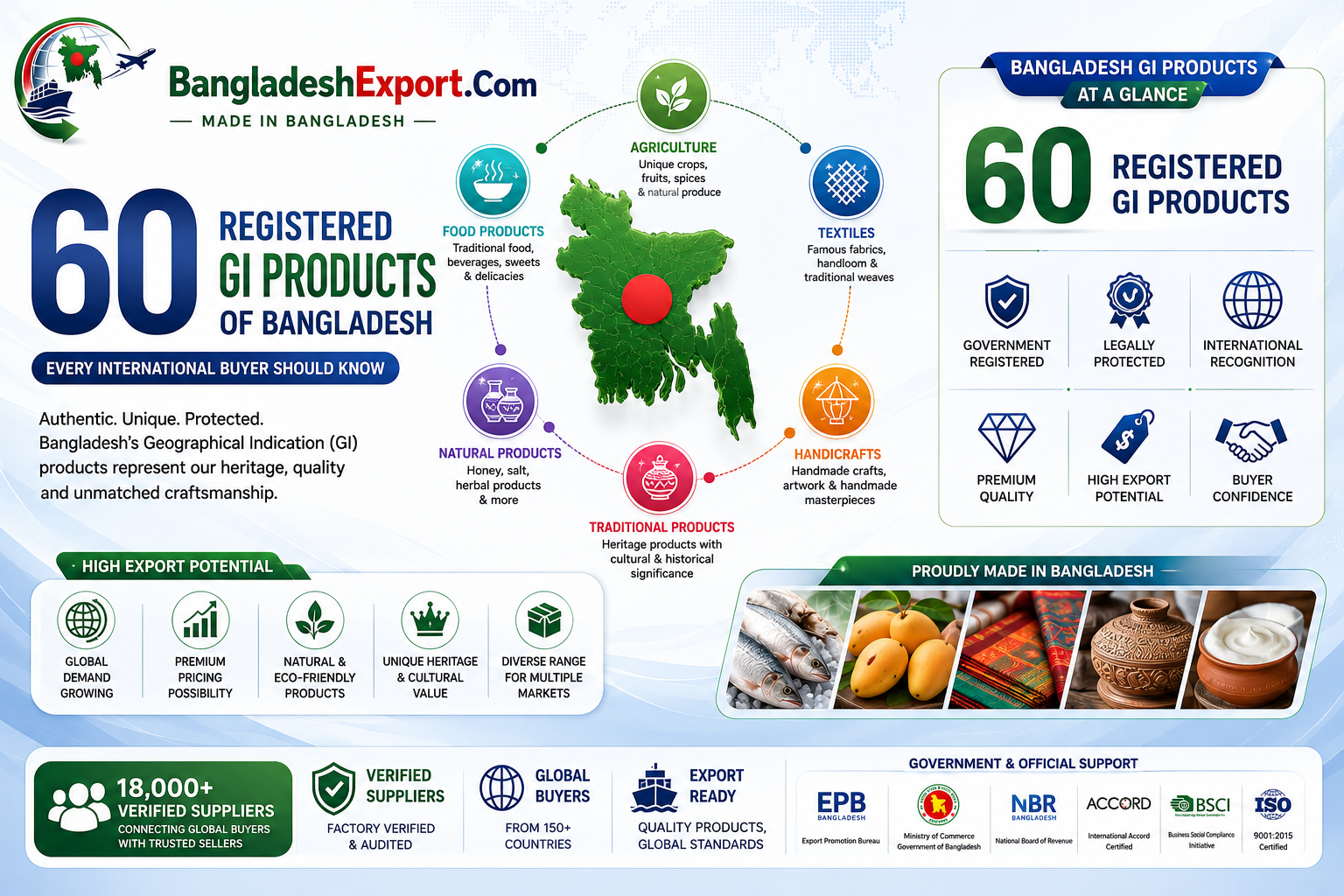
Buyers can verify the official list of Bangladesh's registered Geographical Indication (GI) products through the Bangladesh Trade Portal maintained by the Government of Bangladesh. Refer to the official GI products page for the latest registrations and updates:
bangladeshtradeportal.gov.bd — GI Products Page
The Black Bengal Goat is one of South Asia's oldest documented goat breeds, with a history in the Bengal region stretching back several thousand years. The breed evolved in the specific agro-climatic conditions of the Ganges-Brahmaputra delta — adapting to the hot humid climate, the seasonal flooding, the predominantly vegetarian agricultural landscape, and the smallholder farming system where goats were typically raised as a supplementary household activity. The result is a breed that is uniquely suited to tropical South Asian conditions and has characteristics that no European or African goat breed can replicate.
The breed gets its name from its characteristic jet-black coat color, though brown and spotted variants also occur (these are considered less pure). The "Bengal" in the name refers to the broader Bengal region — the breed is found across Bangladesh and in the neighboring Indian states of West Bengal, Odisha, and Assam. Within Bangladesh, the breed is most concentrated in the greater Rajshahi, Faridpur, and Jessore regions, where smallholder goat-rearing is most prevalent.
The 2024 GI registration was a milestone for Bangladesh's livestock sector. It legally recognized the Black Bengal Goat as a distinct Bangladeshi breed and protected the name internationally. This was particularly important because the breed had been cross-bred with imported Boer goats (a South African meat breed) in commercial farming operations, threatening the genetic purity of the native breed. The GI registration doesn't ban cross-breeding — but it requires that only genetically pure Black Bengal Goats can be marketed under the protected name, giving buyers a verifiable distinction.
🏛️ GI Registration & the Bangladesh Production Region
Black Bengal Goat was registered as a Bangladesh GI product in 2024 by DPDT. Unlike most Bangladeshi GI products (which are typically region-specific), the Black Bengal Goat registration is nationwide — reflecting the breed's distribution across multiple regions of Bangladesh. The GI registration covers genetically pure Black Bengal Goats (Capra aegagrus hircus, Black Bengal breed) raised in Bangladesh using traditional smallholder or commercial farming methods. The registration distinguishes Bangladesh-origin Black Bengal Goats from Indian West Bengal-origin goats (which are the same breed but legally distinct under TRIPS) and from cross-bred goats marketed under similar names.
The legal implication for buyers is significant. Goats, goat meat, or goat leather sold as "Black Bengal Goat" products in any WTO member state must genuinely originate from genetically pure Black Bengal Goats raised in Bangladesh. Indian-origin goats (even of the same breed), cross-bred goats (Black Bengal × Boer or other crosses), and any non-Black-Bengal breed marketed under the name cannot legally carry the GI-protected designation. Importers who source verified Bangladesh-origin Black Bengal Goat products have legal protection against these counterfeits.
Verification follows the standard four-layer framework we describe in our GI verification guide: DPDT registration certificate, Bangladesh Livestock Research Institute (BLRI) breed authentication, Department of Livestock Services (DLS) certification, and BangladeshExport.com multi-source supplier verification. For broader context, see our complete 60-product GI list.
🐐 Breed Characteristics & Biology
Understanding the breed's biology is essential for buyers — it explains both the product's premium positioning and its specific quality characteristics.
Physical characteristics: Black Bengal Goats are small — adult males weigh 25–35 kg, adult females 20–25 kg, significantly smaller than Boer goats (which can reach 100+ kg). The coat is short, glossy, and predominantly jet-black (brown and spotted variants exist but are less prized). The ears are short and erect, the beard is pronounced in males, and the horns (when present) are short and curved. The breed's small size is actually a commercial advantage for the diaspora market — a single Black Bengal Goat carcass is the right size for a family feast or religious occasion (Eid al-Adha, traditional Bengali celebrations).
Meat quality: Black Bengal Goat meat is renowned for its tenderness, flavor, and low fat content. The small-breed physiology produces fine-grained muscle fibers with intramuscular fat distributed evenly throughout — producing the tender, flavorful meat that South Asian consumers prize. The meat is darker red than typical commercial goat meat (from larger breeds), with a firmer texture and a distinctive rich flavor. For South Asian diaspora consumers who grew up eating Black Bengal Goat meat in Bangladesh or West Bengal, the flavor is recognizable and preferred over larger-breed goat meat.
Leather quality: Black Bengal Goat leather is considered among the finest goat leathers in the world. The small breed size produces leather with a tight, fine grain structure that is both durable and supple. The leather is particularly prized for premium leather goods — gloves, wallets, small leather accessories, and lining leather for luxury shoes. Bangladesh is one of the world's leading goat-leather exporters, and the Black Bengal breed is the primary raw material source. The leather's distinctive fine grain and dark natural color (which takes dye beautifully) make it a premium input for European and Japanese leather goods manufacturers.
Adaptability and disease resistance: The breed has evolved natural resistance to many tropical diseases and parasites that affect imported European breeds. Black Bengal Goats thrive on poor-quality forage, tolerate heat and humidity well, and require minimal veterinary intervention when raised in their native environment. This natural hardiness is part of why the breed has persisted for thousands of years in the Bengal delta — and it makes the breed attractive for low-input, sustainable livestock farming models.
Reproductive characteristics: Black Bengal Goats are prolific breeders — does typically produce twins or triplets, with kidding intervals of 7–9 months (faster than larger breeds). This high reproductive rate is a commercial advantage for breeders and is part of why the breed has been the dominant small-ruminant choice for Bangladeshi smallholders for centuries.
📊 Quality Grading & Product Forms
Black Bengal Goat products are graded differently depending on the form — live animals, carcass meat, or leather. Here's the practical breakdown:
| Product Form | Grade | Specifications | Retail/Export Range (USD) |
|---|---|---|---|
| Live goat (breeding stock) | A Premium (BLRI-registered) | Genetically pure, 12–24 months, 25–35 kg | 200–600 per head |
| Live goat (sacrificial — Eid) | A Premium (large male) | 30–40 kg, 18–30 months, perfect conformation | 250–500 per head |
| Fresh/chilled carcass meat | A Premium | 8–12 kg carcass, fresh-chilled, halal-cut | 12–22 per kg |
| Frozen carcass meat | A Standard | 8–12 kg carcass, IQF, halal-cut | 8–15 per kg |
| Premium leather (wet-blue) | A Premium (fine grain) | 5–7 sq ft per skin, tight grain, minimal defects | 8–18 per sq ft |
| Standard leather (wet-blue) | A Standard | 5–7 sq ft per skin, standard grain | 4–10 per sq ft |
Live goat exports for breeding stock typically go to South Asian and Middle Eastern countries seeking to introduce the breed. Live sacrificial goats are in peak demand during Eid al-Adha (the annual Islamic festival of sacrifice, when millions of goats are slaughtered globally). Fresh/chilled carcass meat primarily serves the Middle Eastern and UK halal markets. Frozen carcass meat has broader geographic reach. Leather exports go primarily to European and Asian leather goods manufacturers.
🌍 Export Markets & Buyer Industries
Black Bengal Goat product export demand is divided across three distinct buyer segments: meat, leather, and live breeding stock.
- Middle East (Saudi Arabia, UAE, Qatar, Oman, Kuwait): The largest halal meat market. Black Bengal Goat meat is preferred by South Asian diaspora for its tenderness and flavor. Live sacrificial goats for Eid al-Adha command premium prices (USD 250–500 per head). Frozen carcass meat retails at USD 12–22 per kg.
- European Union (Italy, France, Spain, Portugal): The largest premium leather market. European leather goods manufacturers source Black Bengal Goat leather for premium gloves, wallets, and accessories. Wet-blue leather exports at USD 8–18 per square foot. Italy is the largest single EU buyer.
- USA and Canada: Bangladeshi-American diaspora demand for fresh/frozen goat meat (for traditional preparations). Live goat import is restricted by USDA APHIS regulations, but frozen carcass meat is importable. Retail USD 12–20 per kg for frozen carcass.
- United Kingdom: British-Bangladeshi community demand for fresh/frozen goat meat. Halal butchers and ethnic grocers in London (Brick Lane, Whitechapel), Birmingham, Manchester. Retail GBP 10–18 per kg.
- Japan: Premium niche leather market. Japanese leather goods manufacturers (particularly glove and small-accessory makers) value Black Bengal Goat leather for its fine grain. Premium wet-blue leather at USD 15–22 per square foot.
- Live breeding stock export (regional): Pakistan, Nepal, Bhutan, and some African countries import live Black Bengal goats for breed introduction. Prices USD 200–600 per head depending on BLRI registration status.
For halal meat buyers, Black Bengal Goat offers a distinctively flavored, tender product that diaspora consumers specifically request. For premium leather buyers, the breed's fine-grain leather is a genuine competitive advantage for high-end goods. For livestock genetics buyers, the breed's hardiness and disease resistance make it valuable for cross-breeding programs in other tropical regions.
🏷️ HS Codes & Customs Classification
Bangladesh uses the 8-digit HS code system. Black Bengal Goat products use different HS codes depending on the form — live animals, fresh/chilled meat, frozen meat, or leather. Our DB contains the relevant codes:
| HS Code | Description | Typical Use |
|---|---|---|
| 01042000 | Live goats | Live Black Bengal Goat export (breeding stock or sacrificial) |
| 02045010 | Fresh, chilled or frozen goat meat (wrapped/canned up to 2.5 kg) | Premium retail cuts, halal butcher supply |
HS 01042000 covers all live goat exports — both breeding stock and sacrificial goats. HS 02045010 covers fresh, chilled, or frozen goat meat in retail packs (up to 2.5 kg). For bulk carcass meat (whole or half carcasses), HS 02045090 applies (the "nes" subheading). For leather, chapter 41 codes apply (4101xxxx for raw hides, 4102xxxx for goat-specific leather). Always confirm the HS code with your destination-country customs broker — live animal imports typically require extensive quarantine and veterinary documentation. See our HS code directory for full tariff details.
📦 Packaging, Cold Chain & Shipping
Black Bengal Goat products require specialized handling depending on the form — live animals, fresh meat, frozen meat, or leather.
Live animal shipping: Live goats are shipped by air in specialized IATA-compliant animal containers. Health certificates (DLS-issued), vaccination records, and import permits (destination country) are mandatory. Quarantine periods (typically 14–30 days) apply in most destination countries. Live animal shipping is logistically complex — work with exporters experienced in IATA live-animal regulations.
Fresh/chilled carcass meat: Carcasses are chilled to 0–4°C immediately after halal slaughter, then packed in EPS insulated boxes with gel ice packs. Box capacity typically 1–3 carcasses (8–36 kg total). Air freight (3–7 days transit) is mandatory — fresh meat shelf life is 10–14 days under optimal cold-chain conditions. Halal certification documentation (Bangladesh Halal Authority or recognized certifier) is required for Middle Eastern and most Muslim-majority destination markets.
Frozen carcass meat: Carcasses are IQF-processed at -30°C and shipped at -18°C in refrigerated containers or insulated air-freight boxes. Frozen meat shelf life is 12–18 months at -18°C. Both air freight and sea freight (refrigerated container) are viable for frozen product.
Leather (wet-blue): Wet-blue (chrome-tanned) leather is the standard export form — preserved against decomposition, ready for further processing by the buyer. Wet-blue leather is packed in palletized bundles with plastic sheet separation, typically 200–500 sq ft per pallet. Sea freight (20–35 days) is viable and cost-effective. Air freight is used for urgent sample shipments or premium small-batch orders.
Required export documentation: Health Certificate (DLS-issued, for meat and live animals), Halal Certificate (Bangladesh Halal Authority, for meat), Certificate of Origin (Chamber of Commerce), DPDT GI registration certificate copy, veterinary vaccination records (for live animals), BSTI quality certification (for leather). Destination-country import permits typically required for live animals and meat. See our export documentation guide.
✅ Authenticity Verification — Spotting Cross-Breds and Substitutes
The most common Black Bengal Goat fraud is cross-breeding — Black Bengal × Boer cross-bred goats sold as pure Black Bengal, and goat meat from larger breeds sold as Black Bengal meat. Use this verification checklist:
- Breed physical characteristics (live animals): Pure Black Bengal Goats are small (adult 20–35 kg), jet-black (predominantly), with short erect ears and a distinctive body shape. Cross-bred goats typically show larger size, longer ears (Boer influence), or non-black coat colors. BLRI breed inspection certification is the strongest verification.
- BLRI breed authentication: For breeding stock and premium meat, request Bangladesh Livestock Research Institute breed authentication. BLRI can verify genetic purity through DNA testing — this is the strongest technical authenticity test for live animals.
- Meat visual characteristics: Black Bengal Goat meat is darker red than typical commercial goat meat, with fine-grained muscle fibers and even intramuscular fat distribution. Pale meat, coarse fibers, or large muscle bundles suggest a different breed.
- Meat flavor profile: Black Bengal Goat meat has a distinctive rich flavor and exceptional tenderness that South Asian consumers familiar with the breed can recognize. Bland flavor or tougher texture suggests a different breed.
- Carcass size: A typical Black Bengal Goat carcass weighs 8–12 kg — significantly smaller than Boer or other larger-breed carcasses (which can weigh 18–25 kg). Carcass weight outside the 8–12 kg range suggests cross-breeding or different breed.
- Leather grain structure: Black Bengal Goat leather has a distinctive tight, fine grain that experienced leather buyers can identify. Coarser grain or larger skin size suggests cross-bred or different breed source.
- DPDT GI registration certificate: The exporter must hold a valid DPDT GI registration for Black Bengal Goat. Request the registration number and verify independently.
- DLS certification: Bangladesh Department of Livestock Services certification confirms the animals were raised in Bangladesh under DLS-registered farming conditions.
For the full four-layer verification framework — including how BangladeshExport.com cross-checks livestock suppliers against DLS, BLRI, and EPB registries — see our GI verification guide.
🤝 Sourcing Verified Black Bengal Goat Suppliers
BangladeshExport.com hosts verified Bangladeshi agriculture and leather suppliers, including livestock farmers and meat processors. Here's the practical sourcing workflow:
- Browse verified suppliers: View 709 verified Agriculture & Agro suppliers (includes livestock farmers) and 703 verified Leather & Footwear suppliers (includes leather exporters). Look for the "Verified" badge.
- Post a free RFQ: Submit a Request for Quotation specifying "Black Bengal Goat" with the product form you need (live breeding stock / live sacrificial / fresh-chilled carcass / frozen carcass / wet-blue leather), quantity, target price, and destination country. Verified suppliers respond within 24–72 hours.
- Check supplier credentials: On each supplier profile, verify DLS livestock-farm registration, BLRI breed authentication (for breeding stock and premium meat), EPB registration, Halal Authority certification (for meat), BSTI quality certification (for leather), and DPDT GI registration. For breeding stock, request BLRI DNA authentication documentation.
- Order a trial shipment first: For meat, order 100–500 kg frozen carcass as a trial. For leather, order 500–2,000 sq ft of wet-blue as a trial. For live breeding stock, request a small initial shipment of 5–20 head. Verify quality, packaging, documentation, and cold-chain handling before placing larger orders.
- Finalize directly with the supplier: Communicate via in-platform messaging, negotiate payment terms (L/C recommended for first orders over USD 10,000), arrange pre-shipment inspection. BangladeshExport.com takes no commission on any deal.
If you're a Bangladeshi Black Bengal Goat farmer, meat processor, or leather exporter reading this: register as a supplier on BangladeshExport.com (free), select "Agriculture & Agro" (for livestock/meat) and/or "Leather & Footwear" (for leather) as your categories, and upload your DPDT GI registration certificate, DLS farm registration, BLRI breed authentication (where applicable), and Halal Authority certification. Our verification team will validate your documents at no cost.
Relevant industry support includes the Federation of Bangladesh Chambers of Commerce & Industry (FBCCI) (the nationwide apex chamber, since Black Bengal Goat is a nationwide GI) and the broader Bangladesh exporters' association directory.
🚀 Source Authentic Black Bengal Goat Products — Free RFQ
Post a free Request for Quotation on BangladeshExport.com for authentic Black Bengal Goat products from verified Bangladeshi suppliers. Specify product form (live / fresh-chilled meat / frozen meat / wet-blue leather), quantity, target price, and destination — verified suppliers respond within 24–72 hours. Halal-certified meat and BLRI-authenticated breeding stock available. No middlemen, no commission, completely free for buyers.
🚀 Post a Free RFQ → 🔍 Browse 709 Verified Agriculture Suppliers🎯 Conclusion — Why Black Bengal Goat Is Worth Sourcing
Black Bengal Goat is Bangladesh's most significant GI livestock product — a heritage breed with thousands of years of evolution in the Bengal delta, prized for tender flavored meat, world-class fine-grain leather, and natural tropical hardiness. For halal meat buyers serving South Asian diaspora markets, premium leather goods manufacturers, or livestock genetics buyers seeking tropical-adapted breeds, authentic Black Bengal Goat products offer a defensible premium position with a breed heritage that no cross-bred or substitute breed can replicate. The 2024 GI registration now provides legal protection against the cross-breeding fraud that has historically plagued the breed.
The buyers who succeed with Black Bengal Goat products are those who source directly from verified Bangladeshi suppliers, document the BLRI breed authentication and GI provenance rigorously, understand the distinction between pure-bred and cross-bred products, and build multi-year supplier relationships that secure priority allocation of pure-bred animals. BangladeshExport.com makes that process free, transparent, and built on multi-source verification — start with a free RFQ today, or browse our verified agriculture supplier directory.
For the complete catalog of 60+ Bangladesh GI products, see our complete GI products list. For broader context on Bangladesh GI product export trends, see our 2026 global demand analysis.
❓ Frequently Asked Questions
What makes Black Bengal Goat a GI product?
Black Bengal Goat was registered as a Bangladesh GI product by DPDT in 2024. The registration legally protects the "Black Bengal Goat" name for genetically pure Black Bengal breed goats raised in Bangladesh. The registration is nationwide (rather than region-specific) reflecting the breed's distribution across multiple Bangladeshi regions. The registration distinguishes Bangladesh-origin Black Bengal Goats from Indian West Bengal goats (same breed but legally distinct under TRIPS) and from cross-bred goats (Black Bengal × Boer or other crosses) that have been marketed under similar names.
Why is Black Bengal Goat meat so prized?
Three reasons. First, tenderness: the small-breed physiology produces fine-grained muscle fibers with even intramuscular fat distribution, resulting in exceptionally tender meat. Second, flavor: Black Bengal Goat meat has a distinctive rich flavor profile that South Asian consumers specifically recognize and prefer. Third, carcass size: at 8–12 kg per carcass, the size is ideal for family consumption and religious occasions — perfectly portioned for a Bengali family feast or Eid al-Adha celebration, without the excess of larger-breed carcasses.
How is Black Bengal Goat different from Boer goats?
Three main differences. First, size: Black Bengal adults weigh 20–35 kg; Boer adults can reach 100+ kg. Second, origin: Black Bengal evolved in the Bengal delta over thousands of years; Boer was developed in South Africa in the 20th century. Third, meat character: Black Bengal meat is darker red, finer-grained, and more richly flavored; Boer meat is lighter, leaner, and milder in flavor. The breeds also differ in adaptability — Black Bengal thrives in tropical South Asian conditions where Boer requires more intensive management.
What is the HS code for Black Bengal Goat exports?
Different HS codes apply depending on the product form: 01042000 (live goats — for breeding stock or sacrificial animals), 02045010 (fresh, chilled or frozen goat meat in retail packs up to 2.5 kg), or 02045090 (bulk goat meat). For leather, chapter 41 codes apply (4101xxxx for raw hides, 4102xxxx for goat-specific leather). Live animal imports typically require extensive quarantine and veterinary documentation — confirm requirements with your destination-country customs broker.
How do I verify that Black Bengal Goat products are authentic?
Eight-point checklist: (1) breed physical characteristics — small size, jet-black coat, short erect ears; (2) BLRI breed authentication (DNA-based, for breeding stock and premium meat); (3) meat visual characteristics — dark red, fine-grained; (4) meat flavor profile — distinctive rich flavor; (5) carcass size — 8–12 kg for pure Black Bengal; (6) leather grain structure — tight, fine grain; (7) DPDT GI registration certificate; (8) DLS certification confirming Bangladesh-origin. Full checklist is in the section above.
How many verified Black Bengal Goat suppliers are on BangladeshExport.com?
BangladeshExport.com hosts 709 verified Agriculture & Agro suppliers (includes livestock farmers and meat processors) and 703 verified Leather & Footwear suppliers (includes leather exporters). Not all handle Black Bengal Goat products specifically. Post a free RFQ specifying "Black Bengal Goat" with your product form and quantity requirements, and verified Black Bengal Goat suppliers will respond within 24–72 hours.
What is the minimum order quantity (MOQ) for Black Bengal Goat products?
MOQ varies by product form. Live breeding stock: typically 5–50 head per shipment. Live sacrificial goats (Eid): 10–100 head per shipment. Fresh/chilled carcass meat: 200–1,000 kg per shipment. Frozen carcass meat: 500–5,000 kg per shipment. Wet-blue leather: 1,000–10,000 sq ft per shipment. For first-time buyers, suppliers may accept smaller trial shipments at slightly higher per-unit pricing.