Over 90% of Bangladesh Economic Units Have No TIN, BBS Economic Census 2024 Reveals
Sirajganj, August 17, 2026 — More than 90 percent of Bangladesh's economic units have no Taxpayer Identification Number (TIN), according to the Bangladesh Bureau of Statistics (BBS) Economic Census 2024. The finding underscores the enormous challenge facing the National Board of Revenue (NBR) as Bangladesh struggles with one of the lowest tax-to-GDP ratios among comparable economies — and seeks to broaden the tax base ahead of LDC graduation.
📊 The Scale of the TIN Gap
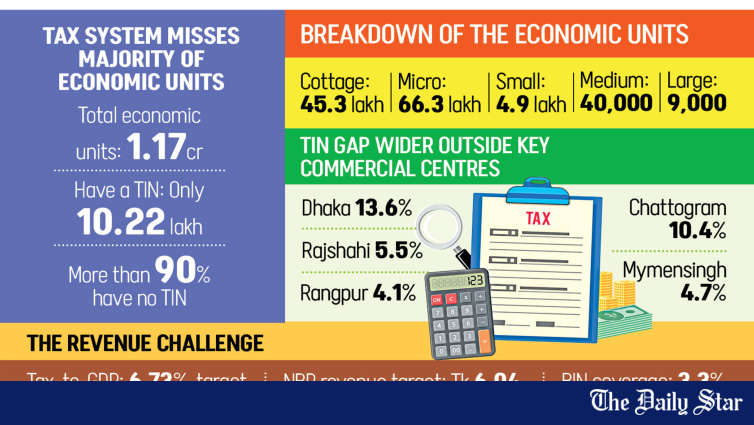
The BBS Economic Census 2024 estimates that Bangladesh has 1.17 crore (11.7 million) economic units. Of these:
- 💰 1.17 crore economic units — total in Bangladesh (BBS 2024)
- 📉 Only 10.22 lakh have TIN — approximately 1 in 12 units
- 📉 Over 90% have no TIN — the vast majority operate outside tax net
- 📊 1.07 crore units without TIN — not necessarily tax evaders but outside identification system
The census defines an economic unit as a single establishment or economic household engaged in economic activities for profit, household gain, or indirect benefit to the community.
🏭 Breakdown by Enterprise Size
The economic census reveals the predominantly micro-scale nature of Bangladesh's economy:
- 🏠 45 lakh cottage enterprises — smallest category, often household-based
- 🏭 66 lakh micro ventures — small businesses with minimal employees
- 🏢 5 lakh small businesses — slightly larger formal enterprises
- 🏢 40,000 medium-sized enterprises — the most likely TIN holders
The overwhelming majority of economic units — 111 lakh out of 117 lakh — are cottage or micro enterprises. These small, informal, often rural businesses are the hardest to reach for tax authorities and the least likely to have TIN registration.
👥 The Rural Challenge
According to the BBS, the low TIN coverage reflects the sheer number of small and household-based businesses. Besides, a large chunk of the economic units is based in rural areas, making the reach of the revenue authority even more challenging. Abul Kalam Azad's story illustrates this reality:
Kalam runs a small grocery shop, about thirty-five square feet, next to his home at Ratankandi union in Sirajganj Sadar upazila. Like many village shops, it stocks almost everything from rice and biscuits to soft drinks and bakery items. When asked about TIN, he said he had never heard that his grocery shop needed one. “I have never faced the need for it, and nobody has ever asked me to get one,” said Kalam.
His case is not unusual — it represents the millions of rural economic units that operate entirely outside the formal tax system, not from deliberate evasion but from lack of awareness, institutional reach, and administrative capacity.
🚧 Not All Without TIN Are Tax Evaders
The more than 90 percent figure does not mean that all 1.07 crore units without a TIN have taxable income and are evading tax. A TIN is an identification number, and tax liability depends on factors such as income and the nature of the activity. A business may have a TIN but owe no tax while still being required to file a return. Many cottage and micro enterprises may simply not meet the income threshold for tax liability.
However, the lack of TIN registration means these units are invisible to the tax system — making it impossible for NBR to assess whether they should be paying tax or not.
💼 CPD Expert View
Towfiqul Islam Khan, additional director (research) at the Centre for Policy Dialogue (CPD), provided expert analysis: “The data point to a significant gap in the tax net, although not every economic unit is required to have a TIN or BIN. The major issue is whether the NBR can identify those eligible and bring them into the tax net.”
Khan's framing shifts the focus from the headline 90 percent figure to the practical challenge of identification — separating those who should have TIN from those who genuinely don't need it.
📊 Why This Matters: Tax-to-GDP Ratio
The TIN gap comes as Bangladesh struggles with one of the lowest tax-to-GDP ratios among comparable economies:
- 📉 Tax-to-GDP ratio: 6.8% — in FY25 (down from 7.4% in FY24)
- 🌐 Among lowest in Asia — well below regional peers
- 💰 Revenue mobilisation crisis — identified by IMF as key vulnerability
- 🚧 Debt-to-revenue ratio rising — 4.5x in FY25 (up from 3.3x in FY21)
- 🏛️ LDC graduation pressure — need domestic revenue to replace donor support
🌐 Strategic Context: Revenue Mobilisation and Economic Formalisation
For Bangladesh's export economy, the TIN gap has indirect but significant implications. Low tax revenue forces the government to rely on borrowing — crowding out private sector credit and raising borrowing costs. It also constrains public investment in the infrastructure, education, and trade facilitation that exporters need to remain competitive.
Addressing the TIN gap requires a multi-pronged strategy:
- 📱 Digital TIN registration — mobile app-based simplified registration
- 🌾 Rural outreach — NBR field offices in upazila-level locations
- 👥 Awareness campaigns — educating small business owners about TIN
- 💰 Threshold-based approach — focus on units above income threshold
- 📜 Integration with trade licences — auto-TIN for registered businesses
- 💻 Digital infrastructure — NBR modernisation for broader reach
For an economy preparing for LDC graduation — which will trigger the loss of preferential financing and trade arrangements — building a robust domestic revenue base is non-negotiable. The 90 percent TIN gap represents both a challenge and an opportunity: the challenge of reaching 1.07 crore unregistered units, and the opportunity of potentially significant new revenue if even a fraction of those units are brought into the formal tax system.
This news was originally published by The Daily Star. For the full original report, please visit: https://www.thedailystar.net/business/economy/news/over-90-economic-units-have-no-tin-4250251
📬 Get Bangladesh Trade News in your inbox
Weekly digest of export industry news, policy updates, and market analysis.
📰 Related Stories