IMF Forecasts Bangladesh Economic Growth To Slow To 3.2%, Inflation To Rise To 10.9% In Current Fiscal
IMF World Economic Outlook projects Bangladesh GDP growth at 3.2% in FY27 and just 2.2% in FY28, with inflation reaching 10.9% — lowest growth in 3.5 decades if forecast proves accurate.
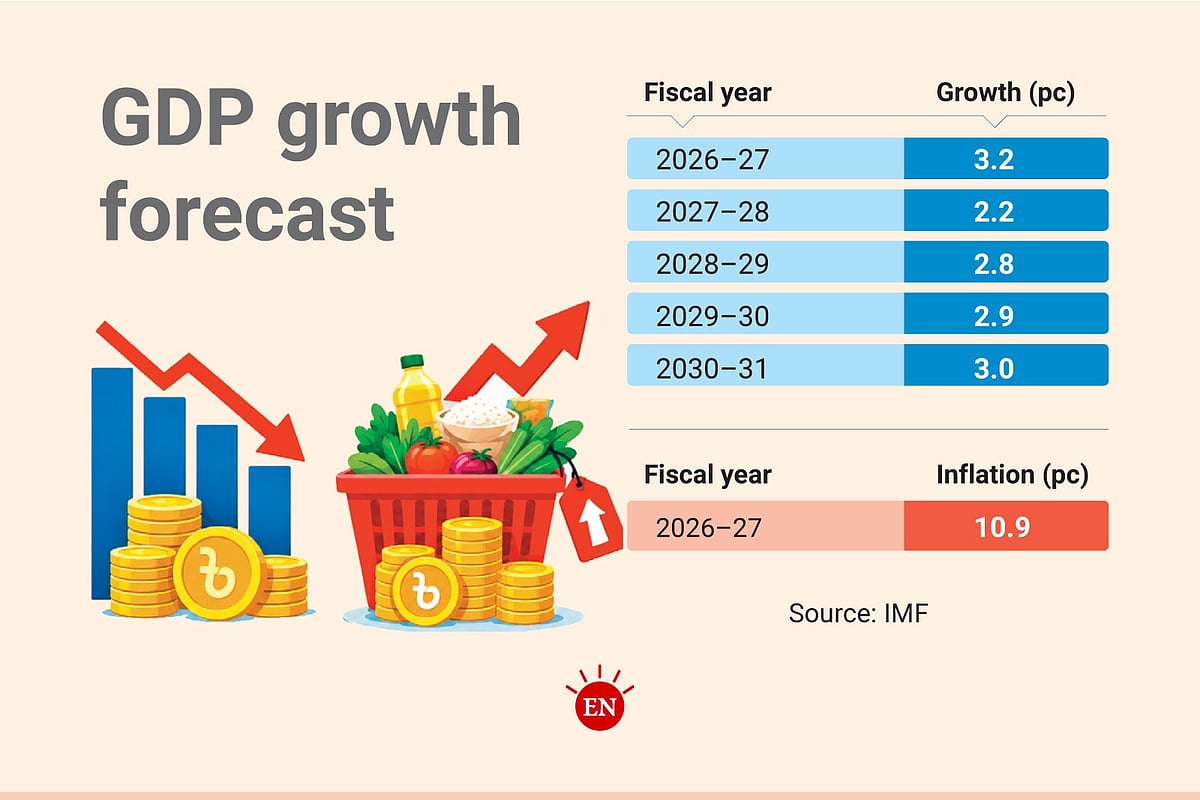
📉 Bangladesh''s economy could grow more slowly than those of other South Asian countries, while inflationary pressure is likely to remain the highest in the region. According to forecasts by the International Monetary Fund (IMF), Bangladesh''s gross domestic product (GDP) growth could fall to 3.2 per cent in the current fiscal year, while average annual inflation could reach 10.9 per cent. There is little indication of a strong economic recovery over the next few years. The IMF expects growth to fall further, to 2.2 per cent in the following fiscal year.
📊 On Tuesday, the IMF published its World Economic Outlook, which included GDP growth and inflation forecasts for Bangladesh and other countries. Sluggish growth will put further pressure on investment and employment, while high inflation will erode people''s purchasing power. The World Bank recently reported that around eight million people had fallen below the poverty line over the past four years. Approximately 62.5 million people in Bangladesh are at risk of falling into poverty. The strain caused by economic weakness is therefore not confined to growth figures; it is directly affecting people''s living standards.
⚠ Multiple structural challenges
Weakness in the banking sector, energy shortages, stagnant private investment and shortfalls in revenue collection are making the situation more complicated. Taken together, these factors are fuelling concerns about economic recovery, job creation and people''s quality of life. The IMF is not alone in projecting relatively weak growth — the World Bank and the Asian Development Bank (ADB) have also issued modest forecasts.
The World Bank''s Bangladesh Development Update, published on 6 September, projected growth of 3.4 per cent in the current fiscal year. Last month, the ADB forecast growth of 4 per cent. The IMF''s projection is lower than both. The government, however, has set a growth target of 6.5 per cent for the current fiscal year. Official figures put growth at 4.14 per cent in the previous fiscal year.
🏛 Historical context
If the IMF''s forecast for the current fiscal year proves accurate, Bangladesh will not have recorded such a low growth rate in the past three and a half decades. Its inflation forecast would also imply the highest average annual inflation in 15 years. The combination of multi-decade-low growth and multi-decade-high inflation represents a worst-case scenario for the country''s macroeconomic stability and the welfare of its citizens.
Bangladesh''s previous growth trajectory — averaging 6-7% per year for much of the past two decades — was a key driver of the country''s poverty reduction and rising living standards. The slowdown to 3-4% growth, combined with elevated inflation, threatens to reverse some of those gains and push more Bangladeshis into poverty. The World Bank''s estimate that 8 million people fell below the poverty line over the past four years is a stark reminder of the human cost of macroeconomic underperformance.
👥 Comparison with South Asian peers
The IMF''s forecast also places Bangladesh behind several South Asian peers in growth terms. India is projected to grow at over 7% in the current fiscal year, while other regional economies are also expected to outperform Bangladesh. This represents a significant shift from the previous decade, when Bangladesh was often among the fastest-growing economies in South Asia. The slowdown therefore has implications not just for domestic welfare but also for Bangladesh''s relative position in the regional economic landscape.
The growth gap with India is particularly concerning because Bangladesh and India are direct competitors in several export sectors, including readymade garments, textiles, and pharmaceuticals. If India grows at 7% while Bangladesh grows at 3%, India''s competitive position will strengthen relative to Bangladesh''s — potentially eroding some of the gains that Bangladesh has made in global export markets over the past two decades.
💰 Banking sector weakness
The IMF''s emphasis on banking sector weakness as a key constraint on growth reflects the depth of Bangladesh''s banking sector problems. Non-performing loans have climbed to around 33% of total loans — far above the IMF''s previous target of 10%. Several banks, including National Bank and Sammilito Islami Bank, have required central bank intervention to continue operations. The banking sector''s inability to channel credit efficiently to productive sectors has been a major drag on private investment and economic growth.
Private sector credit growth has been stuck below 5% for six straight months — well below the historical trend of 12-15%. This means that businesses are not borrowing and investing at healthy rates, which constrains their ability to expand production, hire workers, and contribute to economic growth. The IMF''s call for strategic measures to address banking sector problems reflects a recognition that the sector''s structural weaknesses are now a binding constraint on the broader economy.
🌏 Energy shortages
Energy shortages have also been a significant constraint on industrial production and economic growth. The QatarEnergy LNG supply disruption — which has suspended LNG shipments to Bangladesh until November — has created gas supply uncertainties for power generation and industrial operations. Higher international oil prices have increased operating costs for businesses across the economy, while fuel price adjustments have added to inflationary pressures.
The government''s energy security strategy — including plans to expand gas storage capacity to 90 days, accelerate domestic gas exploration, and scale up renewable energy — will take years to deliver results. In the meantime, the country''s growth prospects will continue to be constrained by energy sector challenges.
🤝 Government response
The annual meetings of the IMF and the World Bank are under way in Bangkok, the capital of Thailand. Finance Minister Amir Khosru Mahmud Chowdhury met World Bank representatives there on Tuesday. Asked after the meeting about the growth and inflation forecasts, the minister has been engaged with the IMF on a proposed $4.5 billion loan programme that would provide critical external financing while supporting structural reforms in revenue mobilisation, banking sector supervision, and monetary policy.
The government''s growth target of 6.5% for the current fiscal year is significantly above the IMF, World Bank, and ADB projections. Achieving that target would require a significant acceleration of growth from current levels — which seems unlikely given the structural constraints facing the economy. The gap between the government''s target and the international institutions'' projections suggests a difference in assessment about the pace at which reforms can deliver growth dividends.
💰 Looking ahead
For Bangladesh, the IMF''s forecast underscores the urgency of structural reform. Without meaningful progress on banking sector clean-up, revenue mobilisation, energy security, and private sector investment, the country''s growth trajectory is likely to remain subdued for the foreseeable future. The proposed IMF programme — if successfully negotiated and implemented — could provide the financing and reform momentum needed to break out of the current slowdown.
But the deeper challenge is political and institutional: can the government muster the will to implement the difficult reforms that the IMF, World Bank, and ADB are all calling for? The next two years will be critical for answering that question — and for determining whether Bangladesh can return to the higher growth trajectory that lifted millions out of poverty over the past two decades, or whether the country is entering a prolonged period of slower growth and elevated inflation.
This news was originally published by Prothom Alo English. For the full original report, please visit: https://en.prothomalo.com/business/local/u02xvzddwp
📬 Get Bangladesh Trade News in your inbox
Weekly digest of export industry news, policy updates, and market analysis.
📰 Related Stories