Bangladesh Gold Price Rises by Tk 2,158 per Bhori to Tk 236,779 for 22-Carat
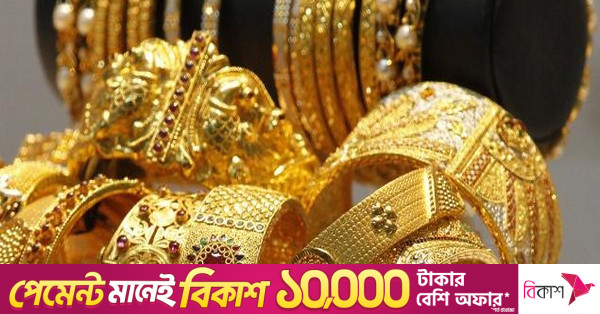
Dhaka, August 15, 2026 — The price of gold has been increased in the local market, with the best quality 22-carat gold now costing Tk 2,158 more per bhori (11.664 grams), effective from August 15. According to the new price set by the Bangladesh Jewellers Association (Bajus), the price of 22-carat gold now stands at Tk 236,779 per bhori, including VAT — marking the latest in a series of volatile price movements in Bangladesh's gold market.
💰 New Gold Price Structure
The Bajus notification set new prices across all gold categories:
- 👑 22-carat gold — Tk 236,779 per bhori (up Tk 2,158)
- 👑 21-carat gold — Tk 226,165 per bhori (up Tk 2,100)
- 👑 18-carat gold — Tk 194,206 per bhori (up Tk 1,808)
- 👑 Traditional (sanatan) gold — Tk 158,630 per bhori (up Tk 1,458)
🧊 Silver Prices Unchanged
Despite the rise in gold prices, silver prices remain unchanged:
- 🧊 22-carat silver — Tk 5,074 per bhori (including VAT)
- 🧊 21-carat silver — Tk 4,841 per bhori
- 🧊 18-carat silver — Tk 4,199 per bhori
- 🧊 Traditional silver — Tk 3,159 per bhori
🔄 Price Volatility: Up and Down Within 24 Hours
Notably, the price of the same category of gold was reduced by the same amount — Tk 2,158 — just a day earlier on August 14. The latest hike comes within 24 hours of that price cut, effectively reversing it. This whipsaw price movement illustrates the extreme volatility in the local gold market:
- 📉 August 14 — price reduced by Tk 2,158 per bhori
- 📈 August 15 — price increased by Tk 2,158 per bhori (reversal)
- 🔄 Net change — zero over 2 days, but high volatility
- 📊 Tejabi gold influence — Bajus cited rising tejabi (pure) gold prices
🏛️ Bajus: The Price Setter
The Bangladesh Jewellers Association (Bajus) is the official body that sets gold prices in Bangladesh's local market. The association adjusts prices based on:
- 💰 International gold prices — global market trends
- 💵 Exchange rate — taka-dollar movements affect import costs
- 📊 Local market conditions — demand and supply dynamics
- 📜 Tejabi gold prices — pure gold market rates
- 💰 VAT and duties — government tax structure
🌐 Strategic Context: Gold as Inflation Hedge and Economic Indicator
Gold price movements in Bangladesh reflect broader economic dynamics:
- 📈 Inflation hedge — investors turn to gold amid 9.21% inflation
- 💵 Taka depreciation — weaker taka raises gold import costs
- 🌏 Global gold prices — international market drives local pricing
- 💰 Safe haven demand — Middle East conflict and Iran war uncertainty
- 💼 Jewellery industry — price volatility affects jeweller margins and consumer demand
For Bangladesh's broader economy, gold price volatility is both a consumer welfare issue (affecting marriage season jewellery purchases and household savings) and a macroeconomic signal (reflecting inflation expectations and currency pressures). The whipsaw price movements — up Tk 2,158 one day, down the same amount the next, then back up — suggest that the local gold market is struggling to find equilibrium amid global price fluctuations, taka-dollar exchange rate movements, and shifting investor sentiment driven by the Middle East conflict and domestic economic uncertainty.
The gold price volatility also affects Bangladesh's jewellery export sector — which has been identified as a potential export diversification opportunity. Jewellery manufacturers need stable input costs to plan production and pricing for export orders. Extreme price volatility — with swings of Tk 2,158 per bhori within 24 hours — makes it difficult for jewellery exporters to quote fixed prices to international buyers, potentially undermining the sector's competitiveness in global markets. The Bajus price-setting mechanism, while providing some standardisation, also creates a single point of price determination that can amplify volatility when the association adjusts rates in response to rapid international market movements.
For ordinary Bangladeshis, the gold price volatility has direct household implications. Gold remains the primary form of savings for many Bangladeshi families — particularly in rural areas where formal banking access is limited. When gold prices swing dramatically, household wealth fluctuates — affecting consumer confidence and spending decisions. The current volatility, driven by a combination of global uncertainty (Middle East conflict, Iran war, oil prices) and domestic factors (taka depreciation, inflation pressure, economic reform uncertainty), reflects the broader economic anxiety that Bangladesh's middle class is experiencing during this period of structural transition and energy crisis.
Looking ahead, gold price stability in Bangladesh will depend on both global factors (international gold prices, US dollar strength, Middle East geopolitics) and domestic factors (exchange rate stability, inflation management, investor confidence). Until these underlying drivers stabilise, Bangladesh's gold market is likely to continue experiencing the kind of whipsaw volatility seen in mid-August 2026 — making it challenging for both consumers and the jewellery industry to plan with confidence.
This news was originally published by The Business Standard. For the full original report, please visit: https://www.tbsnews.net/economy/gold-price-rises-again-tk2158-bhori-1515556
📬 Get Bangladesh Trade News in your inbox
Weekly digest of export industry news, policy updates, and market analysis.
📰 Related Stories