Bangladesh Taka Falls to Tk 123.88 Per Dollar as Import Demand Pressures Forex
USD up from Tk 123 on July 13 to Tk 123.88 on July 30; imports grow 6.26% to $64B while exports fall 2% to $40B in July-May FY26
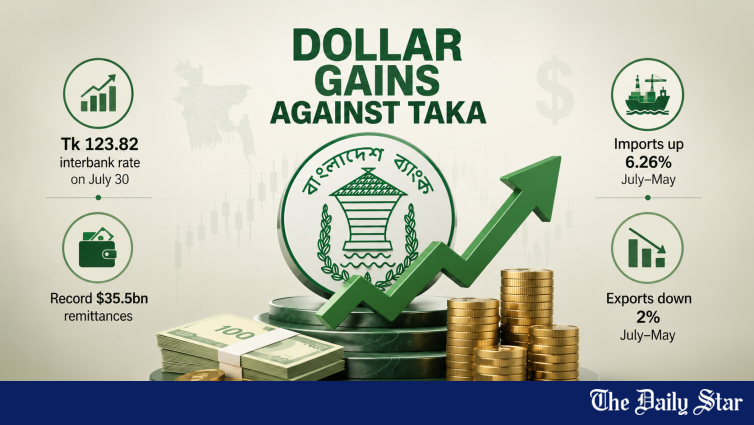
Dhaka, August 4, 2026 — The US dollar continues to gain against the Bangladesh taka amid increased demand for foreign currency to clear import bills, with the interbank exchange rate rising from Tk 123 per dollar on July 13 to Tk 123.82 per dollar on July 30 — and the spot market rate reaching Tk 123.88 on the same day, according to Bangladesh Bank (BB) data.
The rate, after remaining steady for three days around the Tk 123 level, began to increase gradually as demand for foreign currency intensified, driven primarily by import payments for fuel, fertiliser, and other essential commodities. The depreciation marks the latest leg of a sustained pressure on the taka that has shaped Bangladesh's macroeconomic trajectory throughout 2026.
📊 Exchange Rate Movement
The dollar's appreciation against the taka has been gradual but persistent, reflecting underlying supply-demand dynamics in the foreign exchange market rather than any single shock event. The trajectory tells a clear story of mounting pressure on the local currency:
- 💰 July 13: Tk 123.00 per dollar (interbank weighted average)
- 💰 July 13-16: Rate held steady for 3 days
- 💰 July 30 (interbank): Tk 123.82 per dollar
- 💰 July 30 (spot market): Tk 123.88 per dollar
- 📈 July appreciation: ~0.88 taka per dollar (+0.71%)
💬 What's Driving the Pressure
"We are seeing increased pressure for import payments, particularly for the import of fuel and fertiliser by government agencies. Overall, imports have increased too," said a top executive of a private bank, speaking on condition of anonymity. The banker's comment points to a structural source of dollar demand that is unlikely to ease soon — government imports of fuel and fertiliser are non-discretionary, required to keep power plants running and agricultural production on track.
The trade data confirm the banker's observation. During the July-May period, Bangladesh's imports grew 6.26 percent year-on-year to $64 billion. By contrast, exports declined 2 percent year-on-year to $40 billion, according to Bangladesh Bank. The widening gap between imports and exports means that the trade-driven demand for dollars is outpacing the supply of dollars from export earnings — putting continuous downward pressure on the taka.
- 📦 Imports (July-May FY26): $64 billion (+6.26% YoY)
- 🚢 Exports (July-May FY26): $40 billion (-2% YoY)
- 📈 Trade gap: $24 billion (imports minus exports)
- 💰 USD/BDT appreciation in July: From Tk 123 to Tk 123.88
👥 Remittances: Record But Slowing
Bankers said that although the country received a record $35.5 billion in remittances sent by migrant workers and Bangladeshis living abroad in the most recent fiscal year, the inflow has slowed recently as the two major festivals — Eid-ul-Fitr and Eid-ul-Azha — have already been celebrated. Remittance inflows typically peak ahead of major religious festivals, when migrant workers send money home to fund family celebrations, and then moderate in the months that follow.
The post-festival slowdown in remittances has removed one of the key buffers that had been cushioning the taka against import-driven depreciation. With export earnings declining and remittance growth slowing, the foreign exchange market is now more exposed to the full force of import-driven dollar demand — a combination that explains the steady upward drift of the dollar-taka exchange rate through July.
🌏 Geopolitical Concerns and Oil Prices
"It appears exports are likely to remain dull. The fresh escalation of the war in the Middle East and the consequent spike in oil prices have also raised concern," said another banker. "It appears that the taka will remain under pressure for some time."
The Middle East conflict is doubly problematic for Bangladesh's currency. First, higher oil prices directly increase the dollar value of fuel imports — forcing the central bank and commercial banks to release more foreign exchange to settle fuel import bills. Second, the geopolitical uncertainty tends to depress global consumer demand, which in turn weakens Bangladesh's export orders — reducing the inflow of dollars from export earnings. The combination of higher import costs and lower export revenues creates a textbook pressure scenario for an import-dependent developing country's currency.
💰 Bangladesh Bank's Response
As demand for foreign currency has increased, Bangladesh Bank has stopped buying US dollars from the market since June 8. The central bank had bought $6.4 billion from the market between July 2025 and June 2026 as part of its effort to build foreign exchange reserves — a strategy that had the side effect of absorbing excess dollar supply and supporting the taka.
By halting dollar purchases, BB has effectively stopped providing price support to the taka, allowing market forces to determine the exchange rate more freely. The decision reflects the central bank's difficult balancing act: continued dollar purchases would deplete reserves further at a time when foreign exchange coverage is already thin, but stopping purchases puts downward pressure on the taka — raising the cost of essential imports and potentially fuelling imported inflation.
- 🏛️ BB dollar purchases (FY26): $6.4 billion
- 🚫 BB halted purchases: June 8, 2026
- 📊 Record FY26 remittances: $35.5 billion
📋 The Export Competitiveness Flip Side
However, there is a flip side to the taka's depreciation. A weaker taka will enhance the competitiveness of exports, bankers said, as Bangladeshi products become cheaper in dollar terms for foreign buyers. For the ready-made garment sector, which has been struggling with weak global demand and intensifying competition from Vietnam and other regional rivals, the weaker taka could provide a modest margin boost on existing export contracts — though the benefit is partly offset by the higher cost of imported raw materials, particularly cotton and dyes.
The competitiveness benefit also extends to remittance recipients, who now receive more taka per dollar sent home — potentially incentivising higher remittance inflows through formal channels. If the depreciation is moderate and orderly, the export and remittance benefits could partially offset the inflationary cost of higher import prices. If the depreciation becomes disorderly, however, the inflationary effects would dominate, eroding purchasing power and potentially triggering a wage-price spiral.
📋 Strategic Context
The taka's gradual depreciation reflects the broader macroeconomic pressures that Bangladesh has been navigating throughout 2026: a widening trade deficit, declining export earnings, slowing remittance growth, and the looming burden of fuel and fertiliser imports at a time of elevated global commodity prices. Bangladesh Bank's decision to halt dollar purchases signals that the central bank is unwilling to defend a particular exchange rate at the cost of further reserve depletion — a pragmatic choice that accepts short-term currency weakness in exchange for preserving limited foreign exchange buffers.
For exporters, the weaker taka offers a small competitive advantage at a moment when the sector desperately needs one. For importers and consumers, however, the depreciation translates directly into higher prices for fuel, food, and manufactured goods — reinforcing the inflationary pressures that have already pushed real deposit interest rates into negative territory. The path back to exchange rate stability runs through export recovery, remittance growth, and structural reduction of import dependence — none of which can be delivered quickly, and all of which will shape Bangladesh's macroeconomic trajectory in the months ahead.
This news was originally published by The Daily Star. For the full original report, please visit: https://www.thedailystar.net/business/news/dollar-continues-gain-against-taka-4237716
📬 Get Bangladesh Trade News in your inbox
Weekly digest of export industry news, policy updates, and market analysis.
📰 Related Stories