Over Half of Bangladesh Farmers Earn Below Tk 34,000 a Year: BBS Survey
BBS survey: 53.65% small-scale producers earn avg Tk 33,639/year; large producers earn 8x more; survey covered 12,879 households across 8 divisions
Dhaka, August 5, 2026 — Bangladesh's small-scale farmers, who make up more than half the country's food producers, earn less than half the reported national average income, according to a new Bangladesh Bureau of Statistics (BBS) survey — revealing the stark income inequality that underpins the country's agricultural sector and raising questions about the long-term sustainability of food production.
The Income and Productivity of Small-Scale Food Producers Survey 2025 found that small-scale producers make up 53.65 percent of all food producers, and large-scale producers make up 46.35 percent. However, when it comes to income, small producers fall far behind the national average and further behind the large producers. As per the report, small producers earn an average of Tk 33,639 a year — a figure that places them well below the poverty line and far below the income levels enjoyed by large-scale agricultural operators.
📊 Survey Scope and Methodology
The survey covered 12,879 households across all eight divisions and five agricultural sectors: temporary crops, permanent crops, forestry, livestock, and aquaculture, BBS said in the report. It defines small-scale producers as those in the bottom 40 percent nationally across three measures at once — land area, livestock holdings, and annual agricultural revenue. This category of producers represents the most economically vulnerable segment of Bangladesh's agricultural workforce.
- 🌾 Small-scale producers: 53.65% of all food producers
- 🏢 Large-scale producers: 46.35%
- 💰 Small producer avg annual income: Tk 33,639
- 👥 Households surveyed: 12,879
- 🌏 Divisions covered: All 8
- 🌿 Sectors: Temporary crops, permanent crops, forestry, livestock, aquaculture
The national average ends up much closer to what large-scale producers earn, masking how little most farmers actually take home. The disparity means that headline statistics about agricultural income growth paint a misleadingly optimistic picture of the sector's financial health — a statistical artefact that obscures the reality facing the majority of Bangladesh's food producers.
💬 Expert View: BIDS Research Director
Mohammad Yunus, research director of the Bangladesh Institute of Development Studies (BIDS), said the trend toward smaller landholdings cannot be stopped because people are gradually leaving the agricultural sector. "Economic development has helped reduce poverty because people have found alternative sources of income. However, for agriculture to remain sustainable, farmers must receive fair prices for their produce," he said.
The development expert stressed that introducing technology into agriculture is necessary to increase productivity. "If farmers receive a fair return for their labour, similar to what they could earn in other sectors, they will remain engaged in agriculture," he said. He warned that if farmers continue to leave the sector, the consequences will not be limited to them; urban populations will also be affected through reduced food supply and higher food prices.
📋 Three Key Requirements for Food Security
The BIDS research director identified three key requirements for ensuring food security in Bangladesh:
- ✅ Fair prices for farmers: So they remain committed to agricultural production rather than abandoning farming for urban migration
- ✅ Market system reform: Addressing why prices increase significantly between the producer level and the consumer market, including issues related to syndicates and middleman markups
- ✅ Technology adoption: Introducing modern agricultural technology to increase productivity and reduce the per-unit cost of production
📋 Strategic Context
The BBS survey's finding that more than half of Bangladesh's food producers earn below Tk 34,000 per year is a sobering reminder that the country's agricultural sector — which employs a significant portion of the workforce and is critical for food security — is operating under severe economic stress. The Tk 33,639 average annual income for small-scale producers translates to less than Tk 2,800 per month — a figure that makes it nearly impossible for farming families to meet basic needs, invest in their children's education, or adopt productivity-enhancing technologies.
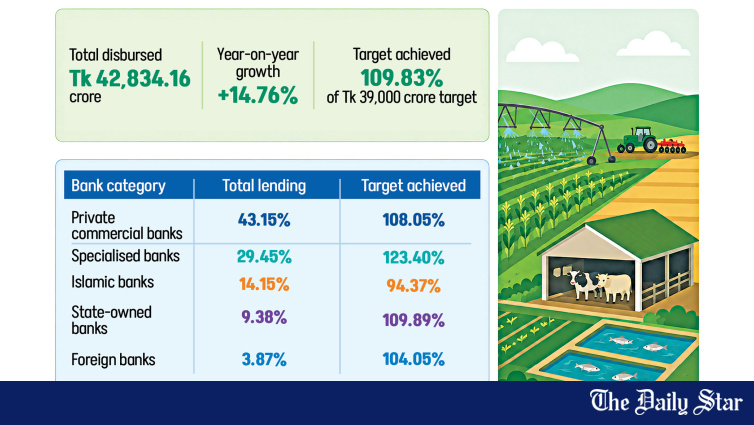
The income gap between small and large producers is not just a social justice issue; it is a structural threat to Bangladesh's food security. If small-scale farmers continue to earn incomes that cannot sustain their families, the exodus from agriculture will accelerate — leaving food production increasingly concentrated in the hands of a smaller number of large operators. While consolidation can improve efficiency, it also increases vulnerability to supply shocks and reduces the diversity of agricultural output. The BIDS recommendations for fair prices, market reform, and technology adoption represent the right policy direction, but implementing them requires confronting powerful middleman networks and vested interests that have resisted agricultural market reform for decades. The disconnect between agricultural sector statistics and farmer livelihoods is striking: while Bangladesh reports record agricultural lending growth of 15 percent and record rice production, more than half of the farmers who produce that rice earn less than Tk 34,000 per year. The lending growth and production records are real achievements, but they are not translating into improved livelihoods for the majority of farmers — a failure that demands policy attention beyond mere credit expansion. Without targeted interventions to ensure that productivity gains and credit flows reach small-scale farmers, the structural inequality documented in this BBS survey will continue to widen, with consequences for food security, rural stability, and the broader economy that extend far beyond the agricultural sector itself.
This news was originally published by The Daily Star. For the full original report, please visit: https://www.thedailystar.net/business/economy/news/over-half-all-farmers-earn-below-tk-34000-year-bbs-4240261
📬 Get Bangladesh Trade News in your inbox
Weekly digest of export industry news, policy updates, and market analysis.
📰 Related Stories