Bangladesh Overtakes India In Per Capita GDP In FY26, But IMF Sees India Regaining Lead In FY29
IMF World Economic Outlook puts Bangladesh's GDP per capita at $2,886 vs India's $2,750 in FY26, but India projected to retake lead at $3,662 in FY29.
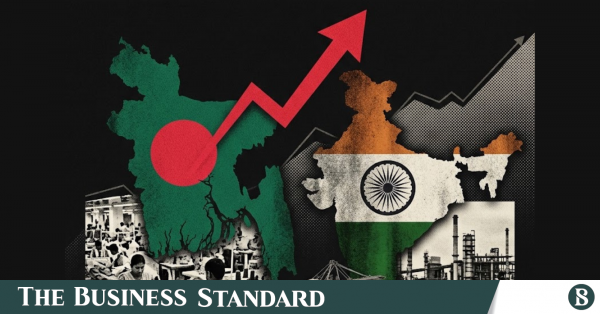
📊 Bangladesh''s GDP per capita surpassed India''s in FY26 and is projected to remain higher for the next two fiscal years, but the International Monetary Fund (IMF) expects India to regain the lead in FY29 and widen the gap through FY31. The latest IMF World Economic Outlook database, released on Tuesday, puts Bangladesh''s GDP per capita in current US dollars at $2,886 in FY26, compared with $2,750 for India — a difference of just $136.
🏛 Despite having an economy roughly eight times larger, India is projected to stay behind Bangladesh until FY28. The forecast shows India''s GDP per capita rising to $3,662 in FY29, surpassing Bangladesh''s $3,334. By FY31, the gap is expected to widen to around $709, with India''s figure projected to reach $4,389 and Bangladesh''s $3,680.
👥 Historical context: Bangladesh''s seven-year lead
Bangladesh had previously maintained a higher GDP per capita than India for seven consecutive years from 2018, before India overtook it in 2025. The reversal in FY26 therefore marks a return to the historical pattern of Bangladesh leading India on this measure. GDP per capita is calculated by dividing a country''s total economic output by its population, and is commonly used to compare average economic output per person — although it does not directly measure how income is distributed or the cost of living.
The dynamics between Bangladesh and India on per capita GDP have been a source of significant interest in South Asian economic commentary for years. Bangladesh''s previous lead, achieved despite having a much smaller total economy, was driven by a combination of factors: faster population growth in India, stronger export performance from Bangladesh''s ready-made garment sector, and relatively more stable macroeconomic management in Dhaka for much of the past decade.
🌏 The picture changes with PPP adjustment
The picture changes significantly when differences in living costs are taken into account. India remains ahead of Bangladesh in GDP per capita measured at purchasing power parity (PPP), which adjusts for differences in the prices of goods and services between countries. According to the IMF database, India''s GDP per capita in PPP terms is projected at $12,998 in FY26, compared with $10,884 for Bangladesh, giving India a 19.4% advantage.
India has remained ahead on this PPP measure every year since 1994, and the IMF expects it to retain that position through 2031, with the gap widening to around 45%. The PPP comparison is generally considered a more accurate reflection of actual living standards because it accounts for the fact that the same goods and services cost different amounts in different countries. The fact that India leads on PPP per capita but trails on nominal per capita reflects India''s lower price levels relative to Bangladesh.
💰 Growth rate divergence
Moreover, despite Bangladesh''s projected lead in GDP per capita at current prices, India is expected to remain South Asia''s fastest-growing economy over the forecast period. Its GDP is projected to rise from $4.06 trillion in FY26 to $6.74 trillion in FY31, with annual growth forecast at 7.02% in FY27 and 6.81% in FY31. Bangladesh, by contrast, is projected to record the region''s slowest economic growth. Its annual growth rate is forecast to fall to 2.21% in FY28 before recovering to 2.97% by FY31.
The growth rate divergence is critical for understanding the trajectory of the per capita GDP comparison. Even though Bangladesh currently leads India on nominal per capita GDP, India''s much faster growth rate means that it will eventually overtake Bangladesh and widen the gap. The IMF''s projection of India regaining the lead in FY29 reflects this growth differential — India''s economy is growing fast enough to overcome Bangladesh''s current per capita advantage within three years.
🤝 The trillion-dollar dream vs IMF projections
The projections also place Bangladesh''s ambition of becoming a $1 trillion economy by 2034 well above the IMF''s current estimates. The Fund puts the country''s GDP at $506.4 billion in FY26 and projects it to reach $674.4 billion by FY31. To reach the $1 trillion mark by 2034, Bangladesh''s GDP would need to grow at roughly 8.5% per year from FY31 to FY34 — significantly above the IMF''s projected growth rates of around 3% for that period.
This gap between Bangladesh''s trillion-dollar aspiration and the IMF''s growth projections has been a subject of significant policy debate. The government has argued that with the right reforms — particularly in revenue mobilisation, banking sector supervision, and trade facilitation — Bangladesh can achieve higher growth rates than the IMF''s projections suggest. The IMF, however, has been more cautious, pointing to the structural constraints — including weak governance, high non-performing loans in the banking sector, and low revenue-to-GDP ratio — that have held back growth in recent years.
👥 South Asian comparison
Bangladesh also remains behind several other South Asian economies in GDP per capita. The Maldives is projected to have the region''s highest figure in FY26, at $19,507, followed by Sri Lanka at $5,062 and Bhutan at $4,933. Pakistan''s GDP per capita is estimated at $1,836, while Nepal is projected to have the region''s lowest figure, at $1,540. Bangladesh''s position is therefore in the middle of the South Asian pack — ahead of India, Pakistan, and Nepal on nominal per capita, but behind the Maldives, Sri Lanka, and Bhutan.
The South Asian comparison provides important context for Bangladesh''s development trajectory. The Maldives'' high per capita GDP reflects its small population and tourism-driven economy, while Sri Lanka and Bhutan have benefited from different economic strategies. Bangladesh''s challenge is to maintain its current lead over India while closing the gap with the higher-income South Asian economies — a task that will require sustained investment in human capital, infrastructure, and structural reform.
🌏 What this means for Bangladesh
For Bangladesh, the IMF projections send a mixed message. On one hand, the FY26 overtaking of India on nominal per capita GDP is a positive milestone that reflects the country''s relatively stable macroeconomic performance and the strength of its export sector. On the other hand, the projected reversal in FY29 — and the widening gap thereafter — underscores the urgency of structural reform to accelerate growth.
The IMF''s projection of just 2.21% growth in FY28, recovering to 2.97% by FY31, is well below the rates needed to achieve Bangladesh''s development aspirations. To sustain a meaningful lead over India on per capita GDP — and to make progress towards the $1 trillion economy aspiration — Bangladesh would need growth rates of 6-7% or higher. Achieving those rates will require sustained reform momentum on revenue mobilisation, banking sector supervision, trade facilitation, energy security, and infrastructure investment.
The IMF''s caution about Bangladesh''s growth trajectory also reflects concerns about the country''s macroeconomic vulnerabilities — including elevated inflation, weak private sector credit growth, banking sector stress, and external sector pressures. Addressing these vulnerabilities through the proposed IMF programme and associated reforms will be critical to delivering the growth rates needed to maintain Bangladesh''s competitive position in South Asia.
The coming years will show whether Bangladesh can beat the IMF''s growth projections and maintain its lead over India on per capita GDP. The current FY26 milestone is a positive signal — but the IMF''s projected reversal in FY29 is a reminder that past performance is no guarantee of future success. Sustained reform, investment, and macroeconomic stability will be needed to translate the current milestone into a longer-term competitive advantage.
This news was originally published by The Business Standard. For the full original report, please visit: https://www.tbsnews.net/economy/bangladesh-overtakes-india-capita-gdp-imf-sees-india-regaining-lead-fy29-1574521
📬 Get Bangladesh Trade News in your inbox
Weekly digest of export industry news, policy updates, and market analysis.
📰 Related Stories