Bangladesh Economic Recovery May Linger as Stabilisation Remains Fragile: CPD
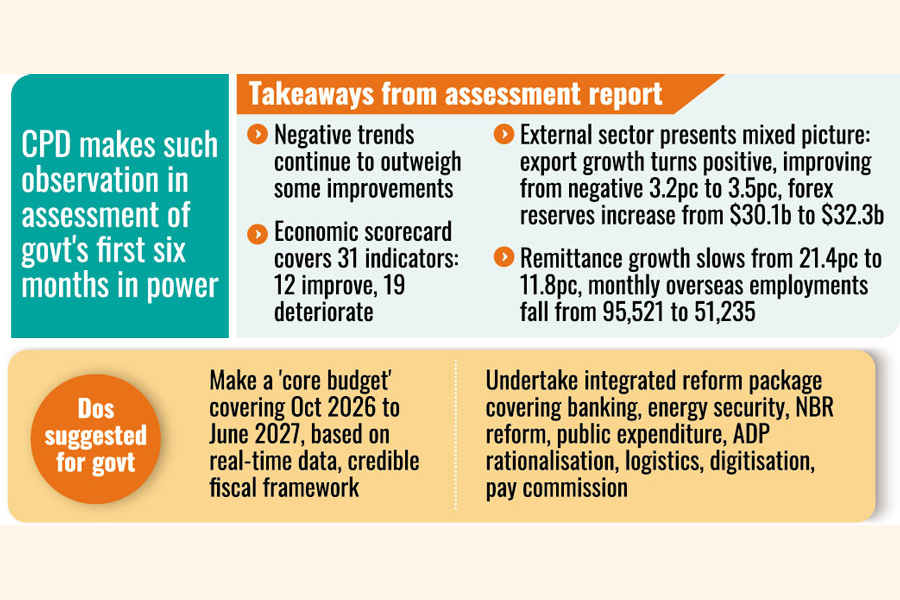
Dhaka, August 24, 2026 — Bangladesh's economic recovery is likely to linger as stabilisation remains fragile and structural weaknesses continue to weigh on investment, employment, and growth, according to the Centre for Policy Dialogue (CPD). Presenting its assessment at a media dialogue on 24 August 2026, CPD Distinguished Fellow Dr Debapriya Bhattacharya said the economy made some progress, particularly in containing inflation, but negative trends continued to outweigh improvements.
"The change required is structural, not about people only," he said, stressing the need for stronger institutions, better coordination, and a comprehensive reform programme. The policy think-tank reviewed 362 concrete government actions across nine areas, including governance, public finance, industry and trade, banking, energy and transport, agriculture, education, health, and social protection.
📊 Economic Scorecard: 31 Indicators
CPD's economic scorecard covered 31 indicators, of which 12 improved while 19 deteriorated:
- 🟢 Inflation improved: Headline 9.1% → 8.3%; Food 9.3% → 7.2%
- 🟢 Export growth: -3.2% → +3.5%
- 🟢 FX reserves: $30.1B → $32.3B
- 🔴 Remittance growth: 21.4% → 11.8% (slowed)
- 🔴 Overseas employment: 95,521/month → 51,235/month (sharp fall)
- 🔴 Trade deficit: $6.7B → $10.4B (widened)
- 🔴 Current account: +$1.3B surplus → -$0.6B deficit
- 🔴 Manufacturing growth: 3.4% → 0%
- 🔴 Net FDI: $662M → $594M (declined)
- 🔴 Private credit growth: 6% → 4.5% (all-time low)
💰 Fiscal Challenge: Revenue Shortfall
The fiscal situation emerged as one of the biggest challenges. Total tax growth fell from 12.3% to 4.9%, while NBR revenue growth declined from 12.4% to 11.1%. The CPD estimates that the FY2026 revenue shortfall could approach Tk 1.0 trillion (17% of annual target). For FY2027, the government has set a revenue target of Tk 6.95 trillion, requiring around 42% growth. CPD says a shortfall of Tk 1.30-1.40 trillion (19-20% of target) should be anticipated.
Dr Bhattacharya warned that the revenue shortfall would put pressure on public spending. Given the government's commitment to keeping the budget deficit within 3.6% of GDP and limited scope to cut non-ADP expenditure, the Annual Development Programme could again bear the brunt of fiscal adjustment. He urged the government to protect allocations for education, health, and social protection.
🌐 Strategic Context for Bangladesh's Export Economy
The CPD's detailed assessment provides the most comprehensive picture yet of Bangladesh's economic trajectory under the BNP government. The manufacturing sector's zero growth, combined with the decline in FDI and private credit growth at an all-time low of 4.5%, directly threatens the export economy's capacity to maintain current production levels, let alone expand into new sectors. The widening trade deficit to $10.4 billion and the current account swing from surplus to deficit add further pressure on the taka and the country's external position.
For Finance Minister Amir Khosru Mahmud Chowdhury, the CPD's assessment reinforces the need for the integrated reform package that the think tank has been advocating. The revenue target of Tk 6.95 trillion requiring 42% growth is, as Debapriya noted, akin to asking a child to grow from three feet to six feet in a year — historically, the highest tax revenue growth Bangladesh has achieved was 17% in 2011. Without a realistic fiscal framework that acknowledges the revenue shortfall and adjusts spending priorities accordingly, the government risks repeating the pattern of unrealistic budget targets followed by underperformance that has characterised Bangladesh's fiscal management for years.
This news was originally published by The Financial Express. For the full original report, please visit: https://thefinancialexpress.com.bd/economy/economic-recovery-may-linger
Related on BangladeshExport
📬 Get Bangladesh Trade News in your inbox
Weekly digest of export industry news, policy updates, and market analysis.
📰 Related Stories