Adamjee EPZ: From Closed Jute Mill to Billion-Dollar Bangladesh Export Hub
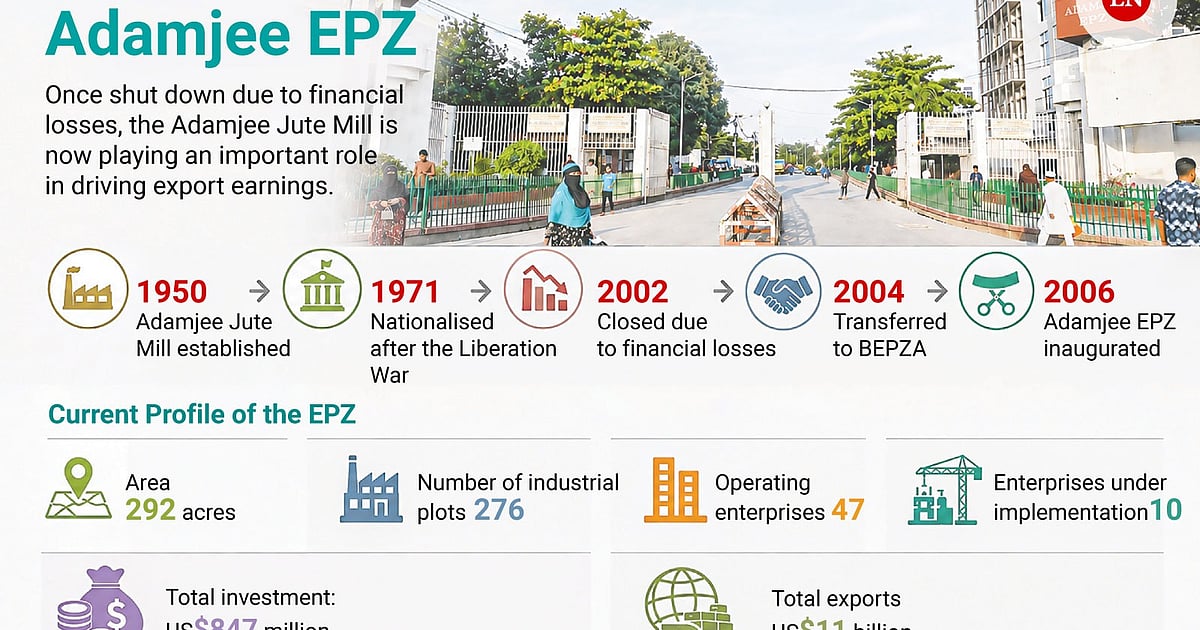
Siddhirganj, Narayanganj, August 17, 2026 — As the sun rises over Siddhirganj in Narayanganj, the area bustles with workers arriving at the Adamjee Export Processing Zone (AEPZ) from different parts of the city. Some carry lunch boxes, while others have bags in their hands. The area of the former Adamjee Jute Mill — once silent after its closure in 2002 — now comes alive with the activity of around 80,000 workers, both men and women, producing goods that generate approximately US$1 billion in export revenue every year.
💰 Billion-Dollar Export Milestone
Adamjee EPZ was established in 2006 on 292 acres of land along the river, with 276 industrial plots. Since its inception, the transformation has been remarkable:
- 💰 $847 million invested — total investment since establishment
- 💰 $11 billion exported — over the past 20 years
- 💰 $1.18 billion — exports in FY2025-26 (latest fiscal year)
- 💰 $1.15 billion — exports in FY2024-25
- 👥 80,000 workers — currently employed at 47 industrial enterprises
- 🏭 10 more enterprises — set to begin production within 2026
- 👥 20,000 additional jobs — will be created once new enterprises operational
- 👥 100,000+ total workers — projected workforce after expansion
👕 Products Manufactured at Adamjee EPZ
Through the skilled hands of workers, factories in the EPZ produce a diverse range of products for global brands:
- 🧥 Safety jackets — for industrial and construction use
- 👕 Blazers — formal wear for Western markets
- 👚 Bridal gowns — for newlyweds, exported to Europe and beyond
- 👖 Garments accessories — supporting the broader RMG supply chain
- 👞 Safety shoes — industrial footwear (Ukraine's Super Protective Shoe Company)
- 🧵 Textiles — fabric manufacturing
- 🔌 Electronic and electrical products — tech manufacturing
- 🖨️ OPC drums — for laser printers and photocopy machines
- 🚗 Car seat covers — Japan's TS Tech manufactures for global auto industry
- 🚲 Bicycles — new factories planned
Factories at Adamjee EPZ produce garments for brands such as Tommy Hilfiger, Ralph Lauren, Michael Kors, and Van Heusen — demonstrating the EPZ's positioning in the premium apparel segment.
🏢 Investment Sources: 26 Foreign Companies
Of the 47 enterprises at Adamjee EPZ, the investment composition is diverse:
- 🌐 26 foreign companies — fully foreign-owned
- 🤝 9 joint ventures — local and foreign investment combined
- 🇧🇩 12 domestic companies — fully locally owned
Among the 26 foreign-invested enterprises, the country composition is:
- 🇨🇳 China and Hong Kong — 9 enterprises (largest foreign presence)
- 🇮🇳 India — 5 enterprises
- 🇺🇨 United States — 5 enterprises
- 🇯🇵 Japan — 5 enterprises
- 🇰🇷 South Korea, Malaysia, Netherlands, Romania, Singapore, Spain, Sri Lanka, Ukraine — also present
Existing foreign companies are also interested in making additional investments in the EPZ. Ukraine's Super Protective Shoe Company manufactures safety shoes there and employs more than 1,000 people. Its General Manager, Md Aslam Uddin, told Prothom Alo: “We are looking for space for a new investment. We plan to invest another US$10 million. If we cannot find land in Adamjee, we may have to acquire land elsewhere.”
🏭 BEPZA Leadership: Why Investors Choose Adamjee
Adamjee EPZ is operated under the Bangladesh Export Processing Zones Authority (BEPZA). Speaking to Prothom Alo, Adamjee EPZ Executive Director Md Abdur Rahman Bhuiyan explained the EPZ's appeal: “Investors are showing strong interest in investing in this EPZ because uninterrupted supplies of gas, electricity and water are ensured. That is why new factories are being established to manufacture bicycles and various other products.”
The uninterrupted utility supply is a critical differentiator — as many factories outside EPZs in Bangladesh struggle with gas shortages and power cuts. This reliability makes EPZs attractive investment destinations.
👶 Worker Welfare: Daycare and Female Empowerment
Many enterprises at Adamjee EPZ also provide daycare facilities — supporting female workforce participation. One such factory is Japan's TS Tech, which manufactures car seat covers. Around 400 workers are employed there. The Japanese company has a daycare centre designed for 19 children, with four trained female employees looking after them. The company's manager, Md Mahbubur Rahman, said: “We take special care of female workers from the time they become pregnant.”
This worker welfare model — combining industrial production with social support — represents a best practice that could be replicated across other EPZs and industrial zones in Bangladesh.
👥 Worker Stories: Livelihoods Transformed
The Adamjee EPZ has not only boosted export earnings; it has also transformed the livelihoods of workers across the area. Farzana Akter from Brahmanbaria works at a factory in Adamjee EPZ. She earns Tk 19,000 a month. She has been working at the same company for seven years because of its good working environment — demonstrating the EPZ's ability to retain skilled workers through decent working conditions.
🏛️ Historical Context: From Jute Mill to EPZ
Adamjee Jute Mill was established in 1950 in Siddhirganj, Narayanganj, at the initiative of three brothers from the Adamjee family. Production began in 1951, and within a short time the mill became one of the largest jute mills in the country. After independence, the mill was nationalised and came under the management of the Bangladesh Jute Mills Corporation (BJMC). It subsequently fell into crisis due to prolonged financial losses, management weaknesses, technological limitations, and worker unrest.
Because of continued losses, the government shut down the jute mill in 2002 on the advice of the World Bank. The closure left 20,000–25,000 workers and employees without jobs. But the story of Adamjee Jute Mill did not end there:
- 📅 2002 — Jute mill shut down, 20,000-25,000 workers lost jobs
- 📅 2004 — Government transferred land to BEPZA
- 📅 2006 — PM Begum Khaleda Zia formally inaugurated Adamjee EPZ
- 📈 2006-2026 — 20 years of sustained growth and export expansion
- 👥 80,000 workers — new livelihoods created on same site
The once-silent industrial area once again came alive with the bustle of workers. At the same site where more than 20,000 workers once lost their jobs after the jute mill was shut down, new industries have now created livelihoods for hundreds of thousands of people.
🌐 Strategic Context: EPZ Model as Export Engine
Adamjee EPZ's success story carries important lessons for Bangladesh's broader industrial strategy. The EPZ model — with dedicated infrastructure, uninterrupted utilities, customs facilitation, and investor-friendly governance — has proven effective at attracting both domestic and foreign investment. Key success factors:
- ⚡ Uninterrupted utilities — gas, electricity, water guaranteed
- 🏭 Ready infrastructure — industrial plots, factory buildings
- 📜 Customs facilitation — bonded warehouse, duty-free imports
- 💰 Tax benefits — tax holidays for EPZ enterprises
- 🤝 BEPZA governance — one-stop service for investors
- 👥 Large workforce — access to skilled and semi-skilled labour
For an export economy preparing for LDC graduation and seeking to maintain $45+ billion in annual exports, the Adamjee EPZ model demonstrates that well-managed industrial zones with reliable infrastructure can create world-class export hubs. The planned addition of 10 more enterprises — creating 20,000 additional jobs and pushing total employment past 100,000 — signals that the EPZ's growth trajectory is far from plateauing.
This news was originally published by Prothom Alo English. For the full original report, please visit: https://en.prothomalo.com/business/9vrgz7ljou
Related on BangladeshExport
📬 Get Bangladesh Trade News in your inbox
Weekly digest of export industry news, policy updates, and market analysis.
📰 Related Stories