Japanese Firms Warm to Bangladesh as Market and Manufacturing Base
JETRO surveys show 72 percent plan expansion, drawn by consumers, labour costs and the Big B industrial corridor vision
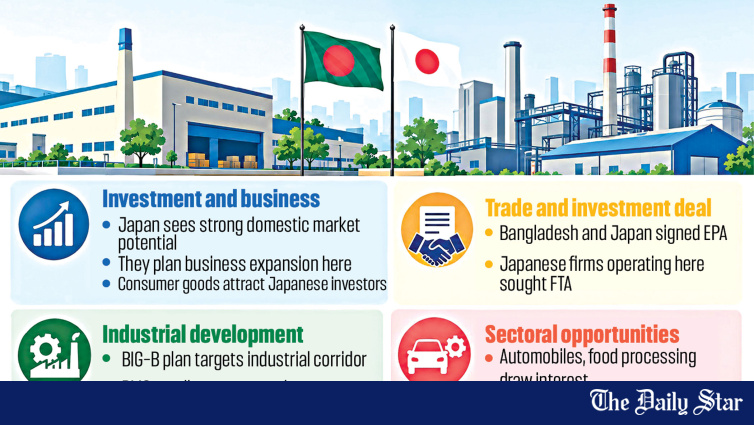
🌋 Japanese companies are increasingly looking to Bangladesh, attracted by its large consumer base, growing middle class and potential for investment — a warmth measured, not merely asserted, in survey data. The Japan External Trade Organisation's (JETRO) polls show consumer goods are among the main areas of firm interest, and the organisation has identified Bangladesh as one of South Asia's most promising business destinations, citing its large population and rising purchasing power.
📈 The numbers have shifted in Bangladesh's favour over the years. A few years ago, more than 85 percent of the nearly 338 Japanese companies then running businesses in Bangladesh told JETRO they wanted a free trade agreement between the two countries to boost bilateral trade and investment. More recently, nearly 72 percent said they planned to expand in Bangladesh within a year or two, viewing the country as a promising market — and business leaders say more than 350 Japanese companies now operate in Bangladesh across trading, manufacturing and infrastructure.
🗺 The strategic frame is Japan's Big B plan — the Bay of Bengal Industrial Growth Belt — under which Tokyo has spent years planning to expand investment and relocate industries to Bangladesh, particularly in garments and textiles. The plan envisages an industrial corridor linking Dhaka, Chattogram and Cox's Bazar, modelled on the industrial hubs of Tokyo and Osaka that developed between the 1960s and 1980s and drove Japan's own industrial growth. In February this year, the two countries signed an Economic Partnership Agreement (EPA) to strengthen trade and investment ties.
💬 Kazuiki Kataoka, country representative of JETRO Bangladesh and current president of the Japan-Bangladesh Chamber of Commerce and Industry (JBCCI), said many Japanese companies are relocating from China to Bangladesh, drawn mainly by lower labour costs and the size of the domestic market. The companies are investing mainly in readymade garments (RMG) and consumer goods, he said, as a large and growing middle-income population drives demand. Mitsubishi and Toyota, for example, have already approached the government for help with producing cars in Bangladesh, and Japanese firms are also interested in fast-moving consumer goods and food processing, he added. Japan is now focused on Bangladesh as a market in its own right, rather than using the country as a gateway to other markets — a strategic reframing that explains why the relationship is being emphasised during Prime Minister Tarique Rahman's visit.
🗓 Tareq Rafi Bhuiyan, immediate past president of the JBCCI, noted that Big B — or the Free and Open Indo-Pacific (FOIP) framework — was adopted mainly with Bangladesh's market in mind, with regional issues now also discussed to some extent under FOIP. Several major projects were planned with the domestic market in mind, including the third terminal at Hazrat Shahjalal International Airport, the deep-sea port and power plants at Matarbari, and the Japanese economic zone at Araihazar — while Matarbari's strategic significance lies in serving as a hub linking the Indian subcontinent with ASEAN and East Asian countries, including Japan.
👕 The apparel channel: already a billion dollars
🧵 The garment industry has institutionalised its Japan push. In July, the Bangladesh Garment Manufacturers and Exporters Association (BGMEA) launched a dedicated Japan desk to tap the market's potential. BGMEA President Mahmud Hasan Khan said Bangladesh's apparel exports to Japan have already exceeded $1 billion, with considerable scope to increase further — though he stressed the need for single-stage rules of origin under the EPA, which would make exports simpler and cheaper. About 98 percent of Bangladeshi goods currently enter Japan duty-free under the least developed country (LDC) category, and Japan is the only Asian country where Bangladesh's exports have exceeded $1 billion over the past decade — annual exports have topped $1 billion since FY2015-16, while two-way trade exceeded $3 billion in FY18, according to the Export Promotion Bureau. Bangladesh imports iron and steel, vehicles and accessories, ships, machinery, mineral fuels, medical and surgical instruments, plastics and electrical machinery from Japan, Bangladesh Bank data show.
🕊 The deeper context is the China-plus-one strategy industrialised countries have adopted, which industry people say makes South Asia a natural investment destination: an economy of nearly $5 trillion, a population of almost 2 billion, a largely young workforce and a strategic location. Japanese manufacturers from motorcycle makers to clothing firms already create jobs and help upgrade technology in Bangladesh, and small and medium-sized Japanese enterprises are exploring the information technology, logistics and other service sectors.
🔭 From interest to factories: the unfinished work
💰 If the survey warmth is to become concrete investment, the known frictions need the EPA's fine print and administrative follow-through: single-stage rules of origin for garments, banking and remittance channels that work for SMEs, the Araihazar economic zone's one-stop services operating as promised, and — above all — power, ports and logistics that hold the cost line the surveys quietly price in. Japanese firms are famously patient but equally famously rigorous: they will scale where execution matches the brochure.
🚀 Business leaders in both countries expect more Japanese companies to enter Bangladesh once the EPA comes into force. If the Matarbari corridor and its satellite investments stay on schedule, the 2020s could be remembered as the decade Bangladesh moved from being Japan's development partner to being its production partner — a graduation at least as consequential as the one from LDC status, and one where the private sector, not the treaty text, will write the proof.
This news was originally published by The Daily Star. For the full original report, please visit: https://www.thedailystar.net/business/economy/news/japanese-firms-warming-bangladesh-4307316
Related on BangladeshExport
📬 Get Bangladesh Trade News in your inbox
Weekly digest of export industry news, policy updates, and market analysis.
📰 Related Stories