Semiconductor Investment in Bangladesh: Asia's Next Emerging Chip Design Destination
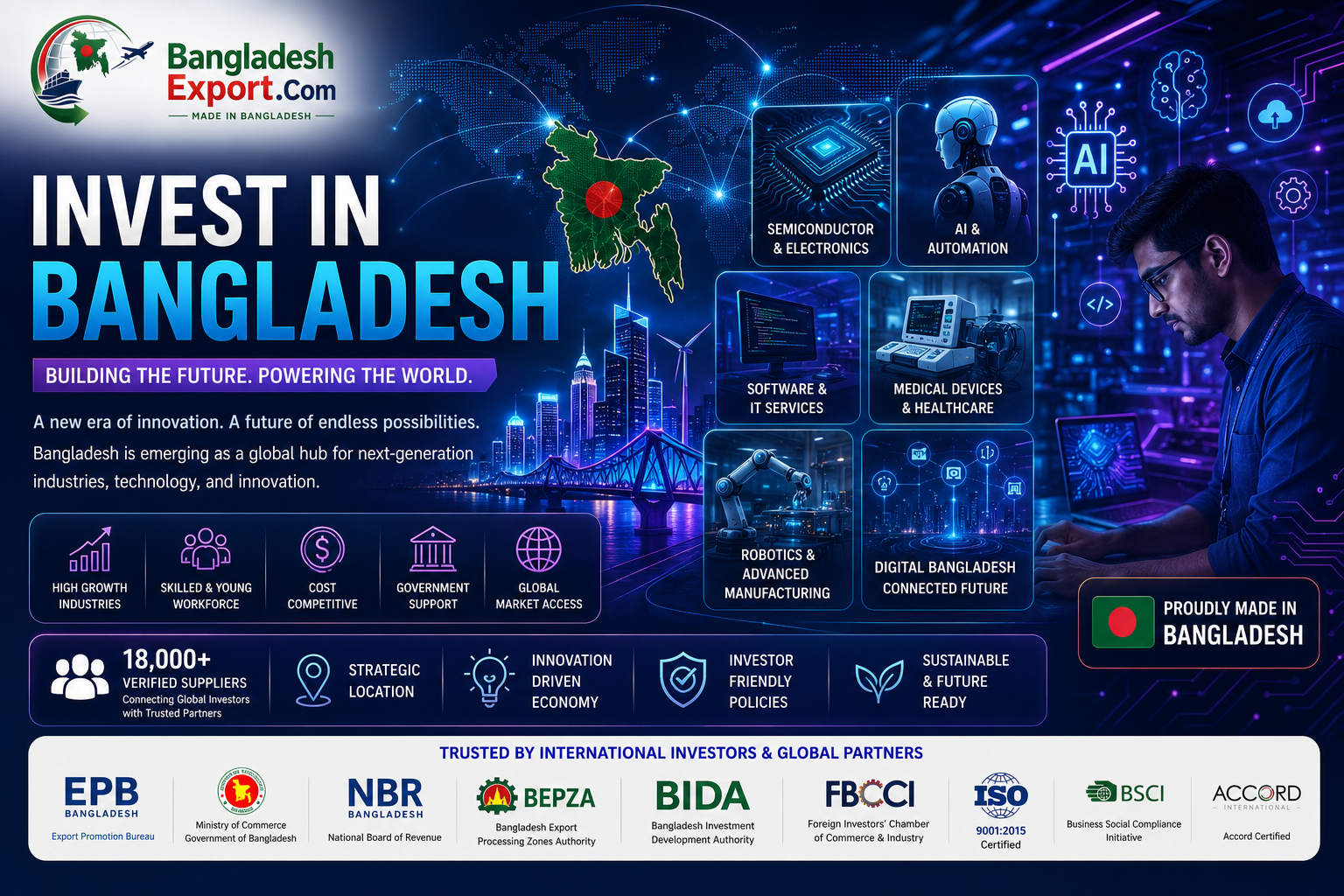
Bangladesh is positioning itself as Asia's next semiconductor destination — 20K+ EEE graduates annually, Bangabandhu Hi-Tech City, tax holidays through 2032, and emerging partnerships with Korean and Taiwanese chip design houses.
The global semiconductor industry is undergoing its most significant restructuring in 30 years. With the US-China tech decoupling, the CHIPS Act in the United States, the EU Chips Act, and Japan's semiconductor revival, the industry is looking for new talent hubs beyond the traditional strongholds of Taiwan, South Korea, and China. Bangladesh is positioning itself as Asia's next emerging chip design destination — and the early signals are promising.
While Bangladesh is not — and likely will not become — a frontline semiconductor manufacturing (fab) destination, it has a credible value proposition in chip design, verification, embedded systems, and OSAT (Outsourced Semiconductor Assembly and Test). With 20,000+ engineering graduates in EEE and CSE annually, the Bangabandhu Hi-Tech City providing dedicated infrastructure, government tax holidays through 2032, and emerging partnerships with Korean and Taiwanese firms, the country is quietly building a semiconductor ecosystem that deserves serious attention from global investors.
This guide is for semiconductor company executives, chip design house founders, fab site-selection teams, venture capital investors, and government technology promotion agencies evaluating Bangladesh as a potential chip design or OSAT destination. We cover the engineering talent pipeline, government policy framework, existing industry ecosystem, investment opportunities, and how to connect with verified Bangladeshi IT and engineering companies.
- Global Semiconductor Restructuring — The 2026 Context
- Why Bangladesh — The Talent and Cost Equation
- The Engineering Ecosystem
- Government Support and Policy Framework
- Investment Opportunities — Where the Money is Going
- The Local Ecosystem — Companies and Clusters
- Challenges and Honest Assessment
- Find Technology Partners in Bangladesh
- Frequently Asked Questions
1. Global Semiconductor Restructuring — The 2026 Context
The semiconductor industry in 2026 is shaped by four converging forces:
- US-China tech decoupling — US export controls on advanced nodes to China, forcing companies to diversify design and assembly locations
- CHIPS and Science Act (US) — $52 billion in subsidies for domestic semiconductor manufacturing, creating demand for global design talent
- EU Chips Act — €43 billion to double EU's global semiconductor market share to 20% by 2030
- India Semiconductor Mission — $10 billion incentive scheme attracting fabs from Taiwan and Israel
Amidst this restructuring, the global semiconductor industry faces a critical talent shortage. The US alone needs 50,000+ additional semiconductor engineers by 2030; Europe needs 30,000+. Bangladesh, with its growing engineering graduate pool and 1/10th the wage cost of US engineers, is a logical talent extension.
2. Why Bangladesh — The Talent and Cost Equation
| Metric | Bangladesh | India | Vietnam | USA |
|---|---|---|---|---|
| Annual EEE+CSE Graduates | 20,000+ | 250,000+ | 15,000 | 75,000 |
| Entry-level Chip Design Engineer Salary | $500-800/mo | $1,000-1,500/mo | $700-1,000/mo | $8,000-12,000/mo |
| Mid-level Engineer (5 yrs) | $1,200-2,000/mo | $2,500-4,000/mo | $1,800-2,800/mo | $12,000-18,000/mo |
| English Proficiency | Moderate (EF EPI) | Moderate-High | Low-Moderate | Native |
Bangladesh's cost advantage of 40-50% over India and 90%+ over the US makes it the most cost-competitive chip design talent base in Asia after Vietnam — with the additional advantage of stronger English proficiency than Vietnam.
3. The Engineering Ecosystem
Bangladesh's engineering education ecosystem produces graduates equipped for chip design, verification, and embedded systems work:
- Bangladesh University of Engineering and Technology (BUET) — premier engineering university, EEE department with VLSI design labs
- BRAC University, North South University, East West University — private universities with strong EEE/CSE programs and international curriculum
- Islamic University of Technology (IUT) — OIC-funded, producing engineers for 57 member countries
- 30+ engineering universities nationwide — producing 45,000+ engineering graduates annually across all disciplines
Key technical capabilities available in Bangladesh:
- VLSI design — RTL coding, synthesis, simulation (Verilog/VHDL)
- Verification — UVM methodology, formal verification
- Physical design — place and route, timing closure, DFT
- Embedded systems — ARM Cortex, RISC-V, microcontroller programming
- FPGA development — Xilinx, Intel (Altera) FPGA design flows
- PCB design — Altium, KiCad, multi-layer PCB
4. Government Support and Policy Framework
The Bangladesh government has designated semiconductor and electronics as a priority sector with significant incentives:
- Tax holiday through 2032 — 100% tax exemption for semiconductor design, verification, and OSAT companies in Hi-Tech Parks
- Customs duty exemption — duty-free import of EDA tools, test equipment, and specialized machinery
- Repatriation of profits — full repatriation for foreign investors with BIDA approval
- Hi-Tech Park infrastructure — 39 Hi-Tech Parks under BHTPA, with dedicated power, fiber, and ready-to-occupy space
- Cash incentive — 4-10% cash incentive on IT/ITES export earnings
- Skills development fund — government co-financing for technical training programs aligned with industry needs
• BIDA (Investment Approval): bida.gov.bd
• BHTPA (Hi-Tech Parks): bhtpa.gov.bd
• BASIS (IT Industry Association): basis.org.bd
5. Investment Opportunities — Where the Money is Going
For semiconductor investors, Bangladesh offers opportunities across three investment tiers:
Tier 1: Chip Design Centers (Lowest CapEx, Highest Talent Leverage)
Establish offshore design centers employing 50-300 Bangladeshi engineers for RTL design, verification, and physical design. CapEx: $2-5M. Time-to-operation: 6-9 months. Ideal for mid-size US/EU chip design houses seeking cost arbitrage.
Tier 2: Embedded Systems and IoT (Medium CapEx, Product-Focused)
Hardware-software co-design for IoT devices, automotive electronics, consumer electronics. CapEx: $5-15M. Leverages Bangladesh's existing electronics manufacturing base.
Tier 3: OSAT (Outsourced Semiconductor Assembly and Test) — High CapEx, Long-Term Play
Packaging and test facilities serving global semiconductor companies. CapEx: $50-200M. Requires significant infrastructure investment but qualifies for maximum government incentives. Bangabandhu Hi-Tech City has dedicated zones for this.
6. The Local Ecosystem — Companies and Clusters
While the semiconductor ecosystem is nascent, several companies and clusters are emerging:
- Bangabandhu Hi-Tech City (Kaliakair) — flagship Hi-Tech Park with 355 acres, dedicated semiconductor zone, Korean and Taiwanese investor interest
- BASIS member companies — 2,500+ IT/ITES companies, several with embedded systems and FPGA design capabilities
- BUET VLSI research groups — university-industry collaboration for talent pipeline
- Emerging startups — chip design startups in IoT and edge AI accelerators
- Electronics manufacturing — Samsung mobile manufacturing in Narsingdi (4,000+ workers) demonstrates electronics manufacturing capability
7. Challenges and Honest Assessment
An honest assessment must acknowledge Bangladesh's current limitations:
| Challenge | Status | Mitigation |
|---|---|---|
| Limited VLSI industry experience | Few domestic chip design companies | Partner with BUET; start with verification (lower risk); build talent via 2-year training |
| EDA tool licensing costs | High upfront cost | Hi-Tech Park tenants qualify for customs duty exemption on tool imports |
| IP protection framework | Improving but not yet world-class | DPDT (Department of Patents, Designs and Trademarks) registration; use NDAs and segmented access |
| Fab infrastructure | No commercial fab yet | Focus on design + OSAT first; fab requires $5B+ investment and 5+ years |
8. Find Technology Partners in Bangladesh
If you're evaluating Bangladesh for semiconductor operations, BangladeshExport.com provides direct access to verified IT and engineering companies:
🔍 Verified Technology Company Databases
| ✓ BASIS Members — 2,500+ IT/ITES companies | Browse → |
| ✓ IT & Software Category — verified IT suppliers | Browse → |
| ✓ Electronics & Electrical — verified electronics suppliers | Browse → |
| ✓ Invest in Bangladesh — comprehensive investment guide | View → |
9. Frequently Asked Questions
Not yet. Bangladesh currently focuses on chip design, verification, embedded systems, and OSAT (assembly and test). A commercial fab would require $5B+ investment, 5+ years to build, and specialized infrastructure (ultra-pure water, dedicated power, chemical supply chain) that is not yet in place. The current strategy is to build the design and OSAT ecosystem first.
Semiconductor design, verification, and OSAT companies operating in Hi-Tech Parks qualify for: (1) 100% tax holiday through 2032, (2) customs duty exemption on EDA tools and test equipment, (3) duty-free import of capital machinery, (4) 4-10% cash incentive on export earnings, (5) full repatriation of profits.
Approximately 2,000-3,000 graduates with VLSI-relevant coursework (RTL design, digital systems, computer architecture) annually. Of these, ~500 have hands-on VLSI project experience. BUET, BRAC, and NSU produce the strongest VLSI talent. Specialized training programs (Synopsys, Cadence certified) can bridge industry-readiness within 6-12 months.
Approximate CapEx: $500K-1M (office build-out, EDA tool licenses, computing hardware). Annual OpEx: $1.5-2M (salaries, benefits, infrastructure). This compares to $8-12M annually for the same team in the US. Payback period typically 18-24 months.
Bangladesh has DPDT (Department of Patents, Designs and Trademarks) for IP registration. While the framework is improving, foreign investors typically supplement with: (1) robust NDAs with segmented access controls, (2) keeping critical IP blocks onshore, (3) using version control and audit logging, (4) building engineering teams in phases to verify trust over time.
While no major semiconductor IDMs have publicly announced Bangladesh operations yet, several Korean and Taiwanese firms have expressed interest in Bangabandhu Hi-Tech City. Samsung operates a mobile manufacturing facility in Narsingdi (4,000+ workers) demonstrating electronics manufacturing capability. Huawei and ZTE run R&D centers in Dhaka with engineering teams.
🔬 Explore Semiconductor Investment in Bangladesh
Connect with verified Bangladeshi IT and engineering companies, explore Bangabandhu Hi-Tech Park infrastructure, and access the official BIDA investment facilitation portal.
Register as Buyer — Free →Last updated: July 2026. Industry data sourced from Bangladesh Investment Development Authority (BIDA), Bangladesh Hi-Tech Park Authority (BHTPA), BASIS, ILOSTAT, and industry analyst reports. For the latest semiconductor investment policies, please verify on bida.gov.bd and bhtpa.gov.bd.