Sadamati of Bijoypur: Bangladesh Heritage GI Clay Craft — Buyer's Guide (2026)
Sadamati of Bijoypur — Bangladesh's 2024 GI clay craft, distinctive white-clay artisanal items from Netrokona district. Buyer's guide: traditional hand-molding, HS 69139000, authenticity checklist, fair-trade export markets, 255 verified handicraft suppliers.
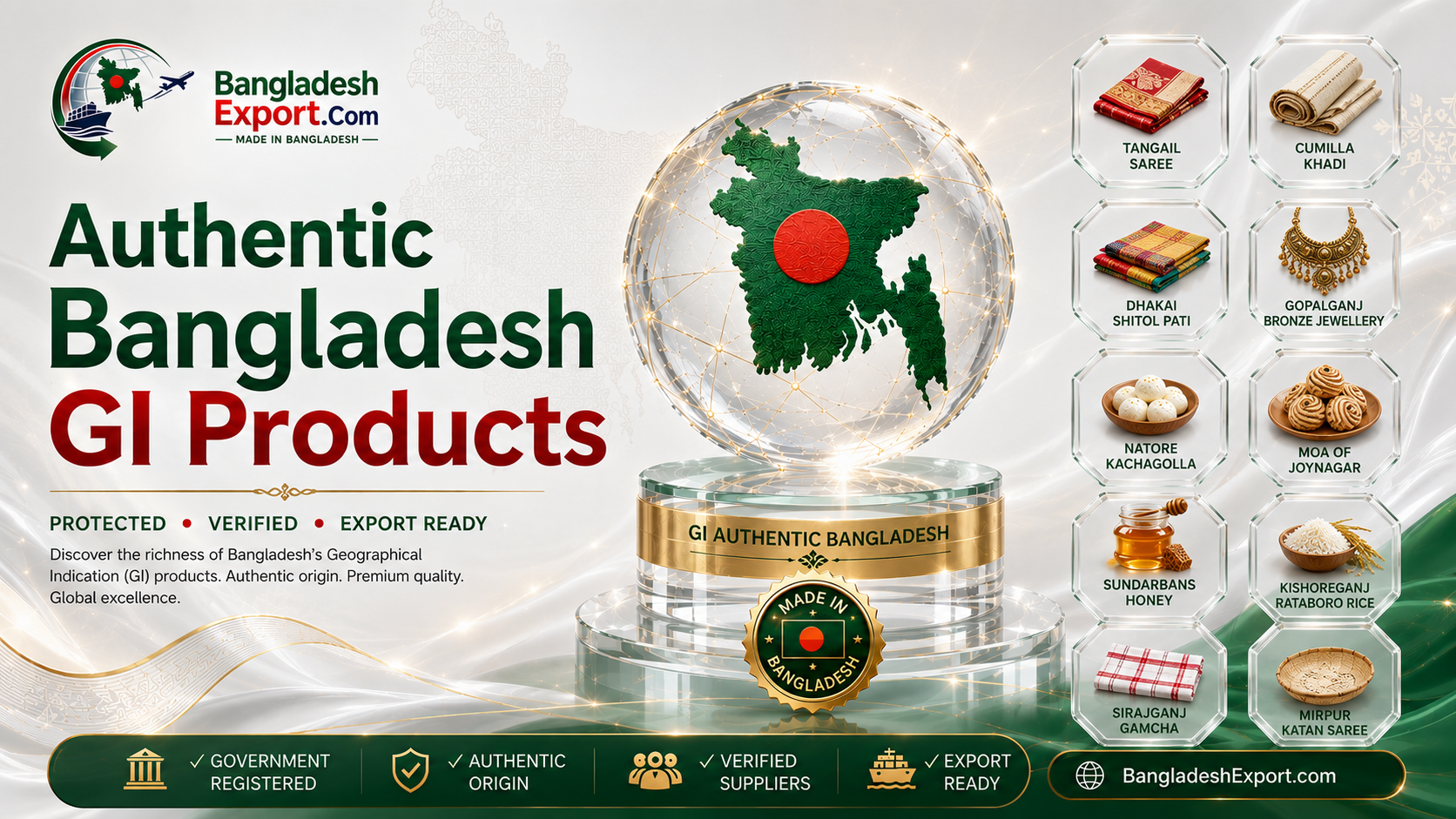
In the Bijoypur area of Netrokona district in northern Bangladesh, there's a craft that most international buyers have never heard of — but it's been producing some of the most distinctive clay-based artisanal products in South Asia for generations. Sadamati — literally meaning "pure earth" or "raw clay" in Bengali — refers to a traditional craft form that creates decorative and functional items from a specific type of white clay found only in the Bijoypur region. Registered as a Bangladesh GI product in 2024, Sadamati of Bijoypur represents one of the country's most niche heritage crafts — and for buyers in the artisan-home-décor, fair-trade, and craft-collector segments, it offers a genuinely distinctive product with a story that almost no competing craft can match.
This guide is for international home-décor importers, fair-trade retailers, craft collectors, and artisan-goods distributors sourcing authentic Sadamati of Bijoypur directly from verified Bangladeshi artisans. We'll cover the craft's history, the 2024 GI registration, the Bijoypur production region, the clay-sourcing and crafting technique, quality characteristics, export markets, HS codes, packaging and shipping, authenticity verification, and direct sourcing from verified handicraft suppliers on BangladeshExport.com.
📜 The Clay Craft Heritage of Bijoypur
Buyers can verify the official list of Bangladesh's registered Geographical Indication (GI) products through the Bangladesh Trade Portal maintained by the Government of Bangladesh. Refer to the official GI products page for the latest registrations and updates:
bangladeshtradeportal.gov.bd — GI Products Page
The Bijoypur region of Netrokona district sits on a geological formation that produces a distinctive white clay — locally called "sada mati" — with properties that make it uniquely suited for fine craft work. The clay is fine-grained, pliable when wet, holds shape well when molded, and fires to a pale cream-to-white color that is visually distinct from the reddish-brown terracotta produced in other Bangladeshi clay-craft regions. Local artisan families — primarily from the traditional potter caste (Kumbhakar) — have worked with this clay for generations, developing techniques for creating decorative items, small sculptures, ritual objects, and household articles that are distinctively pale-colored and finely detailed.
The craft tradition in Bijoypur predates the British colonial period, with local oral histories tracing continuous clay-craft practice back at least 200–300 years. The region's clay craft was historically patronized by local zamindars (landlords) and served local ritual and household needs — Hindu temple decoration, Buddhist meditation objects, Muslim household items, and seasonal festival decorations. The craft survived through the colonial and post-independence periods on a small scale, maintained by a few dedicated artisan families who preserved the techniques across generations.
The 2024 GI registration — part of the historic wave that expanded Bangladesh's GI register from ~20 to 60+ products — formally recognized the "Sadamati of Bijoypur" as a distinct craft product, protecting the name internationally and distinguishing it from terracotta products from other Bangladeshi regions (such as the better-known terracotta of Comilla and Rajshahi) and from Indian clay craft traditions.
🏛️ GI Registration & the Bijoypur Production Region
Sadamati of Bijoypur was registered as a Bangladesh GI product in 2024 by DPDT. The registered production region is Bijoypur in Netrokona district — a relatively narrow geographic scope, reflecting the specific geological conditions that produce the distinctive white clay. The GI registration covers decorative and functional clay items produced from Bijoypur white clay using traditional hand-molding and firing techniques.
The legal implication for buyers is significant. Clay items sold as "Sadamati of Bijoypur" in any WTO member state must genuinely be produced from Bijoypur white clay using traditional techniques. Terracotta from other Bangladeshi regions, Indian clay craft, and any factory-produced ceramic items marketed under the Sadamati name cannot legally carry the GI-protected designation.
Verification follows the standard four-layer framework in our GI verification guide: DPDT registration certificate, BSCIC artisan registration, Bijoypur production proof, and BangladeshExport.com multi-source supplier verification. For broader context, see our complete 60-product GI list and our Shital-Pati guide (a related Bangladeshi GI handicraft).
🏺 The Craft Technique — From Clay to Finished Product
What makes Sadamati distinctive is the raw material — the Bijoypur white clay — and the traditional hand-molding technique. The production process involves:
Clay sourcing: The white clay is extracted from specific locations in the Bijoypur area, typically from shallow pits (2–5 meters deep) where the geological deposit is accessible. The raw clay is then cleaned of impurities (stones, organic matter), soaked in water for several days to achieve proper plasticity, and kneaded by hand to a uniform consistency. The clay's natural whiteness is its defining characteristic — no bleaching or chemical treatment is used.
Molding and shaping: Traditional Sadamati items are hand-molded — either on a potter's wheel (for symmetrical items like bowls and vases) or by hand-pressing into molds (for sculptural and decorative items). The artisan's skill is in achieving thin, even walls and crisp decorative details — the white clay's fine grain allows for more detailed work than coarser terracotta clays.
Drying and finishing: After molding, items are air-dried in shade for 2–5 days until the moisture content is sufficiently reduced for firing. Surface finishing — smoothing, carving, incised decoration — is done at the leather-hard stage (partially dried but still workable). Traditional Sadamati decoration includes geometric patterns, floral motifs, and narrative scenes from Bengali folklore.
Firing: Items are fired in traditional open-pit kilns using wood or agricultural waste fuel. Firing temperatures are relatively low (800–1,000°C) compared to industrial ceramics (1,200°C+), which preserves the clay's natural pale color. The firing process takes 6–12 hours, with items stacked carefully to ensure even heat distribution. After firing, the items have a distinctive pale cream-to-white color with subtle natural variations from the firing process.
Production time: A typical Sadamati item takes 5–14 days from clay preparation through finished product, depending on complexity. Larger sculptural pieces can take 3–6 weeks. Production is necessarily small-batch — each item is individually hand-crafted.
📊 Quality Characteristics & Grading
| Grade | Clay Quality | Craftsmanship | Finish | Retail Range (USD) |
|---|---|---|---|---|
| A Premium (Sculptural) | Pure white, fine-grained | Intricate hand-carved detail | Smooth, pale cream | 30–120 |
| A Standard (Decorative) | White, standard grain | Standard decorative motifs | Smooth, light cream | 12–40 |
| B Grade (Functional) | Off-white clay | Simple shapes | Standard finish | 5–15 |
Authentic premium Sadamati has these characteristics: pale cream-to-white color (distinctly lighter than reddish terracotta), fine-grained surface texture, crisp decorative detail (the white clay allows finer work than terracotta), light weight relative to size (the clay is less dense than terracotta clay), and slight natural color variations from the traditional open-pit firing (a hallmark of hand-crafted rather than factory-produced items).
🌍 Export Markets & Buyer Industries
Sadamati export demand is concentrated in artisan-home-décor, fair-trade, and craft-collector segments — niche markets that value hand-crafted provenance and natural materials.
- European Union (Germany, France, UK): Fair-trade retailers, artisan home-décor boutiques, and museum gift shops. EU buyers value the hand-craft provenance, the natural white clay, and the story of a little-known Bangladeshi craft. Retail EUR 10–80 per item.
- USA and Canada: Artisan-goods retailers, fair-trade shops, and Bangladeshi-American diaspora buyers. Retail USD 12–90 per item.
- Japan: Premium niche market. Japanese craft collectors value the hand-molding technique and the natural pale color. Retail USD 25–120 per item.
- Middle East (UAE, Saudi Arabia): Bangladeshi diaspora demand for decorative home items. Retail USD 8–50 per item.
🏷️ HS Codes & Customs Classification
Sadamati falls under chapter 69 (ceramic products). Our DB contains the directly relevant code:
| HS Code | Description | Typical Use |
|---|---|---|
| 69139000 | Statuettes and other ornamental articles (excl. porcelain or china) | Sadamati decorative items and sculptures (most accurate classification) |
HS 69139000 (ornamental ceramic articles, excl. porcelain) is the standard classification for hand-crafted decorative clay items like Sadamati. For functional items (bowls, vases), HS 69120000 (ceramic tableware/household articles) may also apply. See our HS code directory for full tariff details.
📦 Packaging & Shipping
Sadamati items are fragile ceramics requiring careful packaging. Each item is individually wrapped in bubble wrap and packed in rigid cardboard boxes with cushioning material (shredded paper or foam peanuts). Include the exporter's label with DPDT GI registration number and "Handcrafted in Bangladesh" marking. Sea freight is viable for bulk orders; air freight for premium individual pieces.
✅ Authenticity Verification
Use this checklist: (1) pale cream-to-white color (not reddish-brown terracotta); (2) fine-grained surface texture; (3) hand-crafted irregularities (not factory-perfect); (4) light weight relative to size; (5) traditional open-pit firing color variations; (6) DPDT GI registration certificate; (7) Bijoypur production-region documentation.
🤝 Sourcing Verified Sadamati Artisans
- Browse verified handicraft suppliers: View 255 verified Handicrafts & Cottage suppliers — filter for clay/ceramic specialists.
- Post a free RFQ: Submit a Request for Quotation specifying "Sadamati of Bijoypur" with item type, quantity, and destination.
- Order samples first: For new suppliers, order 3–5 small items as a trial.
- Finalize directly with the artisan: Communicate via in-platform messaging. No commission.
If you're a Bijoypur Sadamati artisan reading this: register as a supplier on BangladeshExport.com (free), select "Handicrafts & Cottage" as your category, and upload your DPDT GI registration certificate and BSCIC artisan registration.
Relevant industry support includes the Netrokona Chamber of Commerce & Industry (the GI production-region chamber) and the broader Bangladesh exporters' association directory.
🚀 Source Authentic Sadamati of Bijoypur — Free RFQ
Post a free Request for Quotation on BangladeshExport.com for authentic Sadamati clay craft from verified Bijoypur artisans. Specify item type, quantity, and destination — verified artisans respond within 24–72 hours.
🚀 Post a Free RFQ → 🔍 Browse 255 Verified Handicraft Suppliers🎯 Conclusion
Sadamati of Bijoypur is one of Bangladesh's most distinctive — and least known — heritage crafts. The pale white clay, the hand-molding technique, and the Bijoypur-specific geological origin create a product that is genuinely unique in South Asian clay craft. For buyers serving artisan-home-décor, fair-trade, or craft-collector segments, authentic Sadamati offers a defensible premium position with a story that almost no competing craft can match. BangladeshExport.com makes sourcing free, transparent, and built on multi-source verification — start with a free RFQ today, or browse our verified handicraft supplier directory.
For the complete catalog of 60+ Bangladesh GI products, see our complete GI products list. For related Bangladeshi GI handicrafts, see our Shital-Pati guide and our Shotoronji guide. For broader context, see our 2026 global demand analysis.
❓ Frequently Asked Questions
What makes Sadamati of Bijoypur a GI product?
Sadamati of Bijoypur was registered as a Bangladesh GI product by DPDT in 2024. The registration protects the "Sadamati of Bijoypur" name for decorative and functional clay items produced from the distinctive white clay found in the Bijoypur area of Netrokona district, using traditional hand-molding and open-pit firing techniques. The registration distinguishes Sadamati from terracotta products from other regions and from factory-produced ceramics.
How is Sadamati different from terracotta?
Three main differences. First, the clay: Sadamati uses distinctive white clay from Bijoypur, while terracotta uses reddish-brown clay from other regions. Second, the color: Sadamati fires to pale cream-to-white, while terracotta fires to reddish-brown. Third, the detail: the white clay's fine grain allows for more detailed hand-carving and incised decoration than coarser terracotta clay.
What is the HS code for Sadamati exports?
Sadamati decorative items use HS code 69139000 — statuettes and other ornamental articles, excl. porcelain or china. For functional items (bowls, vases), HS 69120000 (ceramic tableware/household articles) may apply.
How do I verify that Sadamati is authentic?
Seven-point checklist: (1) pale cream-to-white color (not reddish-brown); (2) fine-grained surface; (3) hand-crafted irregularities; (4) light weight relative to size; (5) traditional open-pit firing color variations; (6) DPDT GI registration certificate; (7) Bijoypur production-region documentation. See the section above for full details.
What is the MOQ for Sadamati items?
Typical MOQ is 20–100 pieces, depending on item complexity. For first-time buyers, artisans may accept a 3–5 piece sample order. Production lead time is 4–8 weeks for bulk orders.
Where can I find verified Sadamati suppliers?
BangladeshExport.com hosts 255 verified Handicrafts & Cottage suppliers. Post a free RFQ specifying "Sadamati of Bijoypur" and verified artisans will respond within 24–72 hours.