Khadi of Comilla: Bangladesh Heritage Handspun GI Fabric — Buyer's Guide (2026)
Khadi of Comilla — Bangladesh's 2024 GI handspun fabric, Gandhi-independence heritage. Buyer's guide: charkha-spinning tradition, 9-point authenticity checklist (slub/grip/burn test), HS 52081100, sustainable-fashion export markets, 1,180 verified textile suppliers.
Khadi — sometimes spelled "khaddar" — is the handspun, handwoven fabric that became synonymous with India's independence movement under Gandhi, but fewer people know that Comilla (now officially Cumilla) in eastern Bangladesh developed its own distinctive Khadi tradition that earned a 2024 GI registration. Comilla Khadi is woven from cotton yarn spun on a charkha (traditional spinning wheel), then woven on a pit loom in the specific weaving clusters around Comilla's Mainamati area. The fabric has a characteristic slubby texture, a soft hand-feel, and an earthy authenticity that no power-loom fabric can replicate. For buyers in the sustainable-fashion, organic-textile, and ethical-clothing segments, Comilla Khadi is one of the most authentic heritage fabrics still in commercial production.
This guide is for international fashion buyers, sustainable-textile importers, ethnic-wear brands, and craft-fashion retailers who want to source authentic Comilla Khadi directly from verified Bangladeshi weavers. We'll cover the fabric's independence-movement history, the 2024 GI registration, the charkha-to-loom production process, quality characteristics, export markets, HS codes, packaging, the all-important authenticity verification (Khadi is heavily counterfeited), and direct sourcing from verified textile suppliers on BangladeshExport.com.
📜 Khadi, Gandhi, and the Comilla Tradition
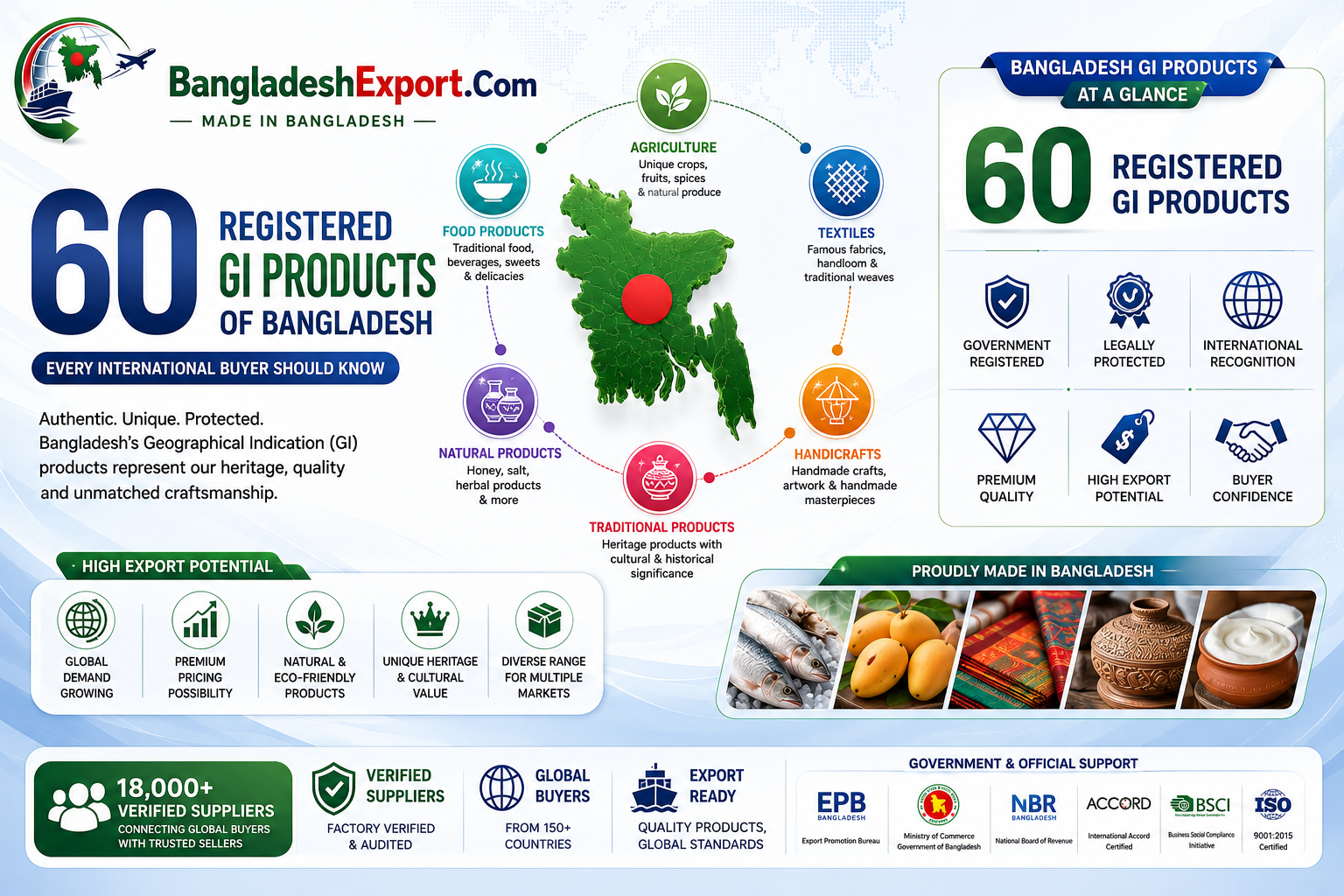
Buyers can verify the official list of Bangladesh's registered Geographical Indication (GI) products through the Bangladesh Trade Portal maintained by the Government of Bangladesh. Refer to the official GI products page for the latest registrations and updates:
bangladeshtradeportal.gov.bd — GI Products Page
Khadi's modern history begins with Mahatma Gandhi, who in 1918 promoted handspun khadi as both an economic strategy for rural India and a symbolic rejection of British mill cloth. The Khadi movement became a cornerstone of the Indian independence struggle — and the weaving clusters of Comilla (then part of British Bengal's Tippera district) became one of the major Khadi production centers, supplying fabric both to the independence movement and to everyday Bengali consumers who preferred the breathable, earthy fabric for the region's hot humid climate.
What made Comilla particularly suited to Khadi production was a combination of factors: a long pre-existing handloom weaving tradition in the Mainamati area, the availability of quality cotton from local farms, and the social organization of the weaving community (predominantly members of the traditional weaver caste, with strong cooperative structures). By the 1930s and 1940s, Comilla Khadi had developed distinctive characteristics — a slightly coarser texture than Khadi from other regions, a preference for natural earthy colors, and a particular skill in weaving the thicker khaddar variant used for shawls, sarongs, and unstitched fabric.
After Bangladesh's independence in 1971, the Khadi industry in Comilla faced the same pressures as other handloom clusters: competition from cheaper power-loom fabric, declining interest among younger weavers, and the loss of traditional spinning skills. The Bangladesh Handloom Board and BSCIC supported the cluster through raw-material subsidies, design development, and market access programs. The 2024 GI registration — part of the historic 2024 wave that expanded Bangladesh's GI register from ~20 to 60+ products — gave Comilla Khadi formal legal recognition and protected the "Khadi of Comilla" name internationally, distinguishing it from Indian Khadi (which has its own GI registration from 2014–15) and from power-loom "khadi-style" fabrics.
🏛️ GI Registration & the Comilla Production Region
Khadi of Comilla was registered as a Bangladesh GI product in 2024 by DPDT. The registered production region is Comilla district (officially Cumilla since the 2018 spelling reform) in eastern Bangladesh — with the Mainamati, Comilla Sadar, Burichang, and Chandina upazilas as the primary weaving clusters. The GI registration covers Khadi fabric produced using the traditional charkha-spun cotton yarn and pit-loom weaving technique, distinct from Indian Khadi and from power-loom "khadi-style" fabric.
The legal implication for buyers is significant. A fabric sold as "Comilla Khadi" or "Khadi of Comilla" in any WTO member state must genuinely be handspun and handwoven in the registered Comilla region. Power-loom fabric with khadi-look texture, Indian Khadi marketed under the Comilla name, and any blended or synthetic fabric using the Khadi designation cannot legally carry the GI-protected name. This gives buyers enforceable rights against counterfeits in destination markets — and given that Khadi is one of the most counterfeited heritage textiles globally, this protection has real commercial value.
Verification follows the standard four-layer framework we describe in our GI verification guide: DPDT registration certificate, Bangladesh Handloom Board certification, Comilla production-region proof, and BangladeshExport.com multi-source supplier verification. For broader context, see our complete 60-product GI list and our Tangail Saree guide (a related Bangladeshi handloom GI textile).
🧶 From Charkha to Loom — The Production Process
What makes Khadi structurally different from any power-loom fabric is the handspun yarn. You cannot replicate Khadi by machine-weaving machine-spun yarn — the yarn itself is the defining characteristic. Here's how the process works in Comilla:
Cotton preparation: Raw cotton (typically sourced from local Bangladesh cotton farms or imported from India) is cleaned, carded, and rolled into small elongated rolls called "punis." Each puni is about 30 cm long and contains a measured amount of cotton fiber — enough for a few minutes of spinning.
Charkha spinning: The puni is spun into yarn using a charkha — the traditional spinning wheel that Gandhi made famous. The spinner (typically a woman working from home) drafts the cotton fiber by hand while turning the wheel, producing a continuous yarn of the desired thickness. The skill is in the drafting — too thick and the yarn is coarse, too thin and it breaks. Hand-spun yarn has natural thickness variations (called "slubs") along its length — these slubs are the visual hallmark of authentic Khadi and are impossible to replicate with machine spinning.
Pit-loom weaving: The spun yarn is wound onto bobbins, warped onto the loom, and woven on a traditional pit loom — the same type of loom used for Tangail Sarees and Shotoronji. The weaver sits in a shallow pit, using body weight for tension, and passes the weft shuttle through the warp shed. The weaving is slow — perhaps 2–4 meters of fabric per day for a skilled weaver, depending on yarn thickness and weave complexity. The fabric produced has a slightly loose, breathable structure that distinguishes it from tightly-woven power-loom fabric.
Finishing: After weaving, the fabric is washed, sometimes starched lightly, and pressed. Traditional Khadi is sold unbleached and undyed in its natural off-white color, or dyed with natural dyes (indigo, madder, turmeric) for colored variants. Modern commercial Khadi sometimes uses azo-free chemical dyes for a wider color range.
Production time: Spinning enough yarn for one meter of Khadi fabric takes 4–8 hours of charkha work. Weaving that meter takes 30–60 minutes on the pit loom. A typical Comilla Khadi saree (5.5 meters) thus requires roughly 25–50 hours of spinning plus 3–5 hours of weaving — plus finishing. This is the structural production-time floor, and it's why authentic Khadi cannot be cheap.
📊 Quality Characteristics & Grading
Comilla Khadi is graded by yarn count (thickness), weave density, fabric weight, and the type of cotton used. Here's the practical buyer's breakdown:
| Grade | Yarn Count | Fabric Weight | Typical Use | Retail Range (USD/meter) |
|---|---|---|---|---|
| A Premium (Fine) | 80s–100s count | 60–90 g/m² | Premium apparel, summer shirts, scarves | 6–15 |
| A Standard (Medium) | 60s–80s count | 90–140 g/m² | Standard apparel, sarees, unstitched fabric | 3–8 |
| B Grade (Coarse — Khaddar) | 40s–60s count | 140–220 g/m² | Shawls, winter wear, sarongs, home textiles | 2–5 |
| C Grade (Heavy) | 20s–40s count | 220–350 g/m² | Upholstery, bags, heavy stoles | 1.5–3 |
Yarn count refers to the thickness of the yarn — higher count means finer yarn. A 100s count yarn means that 1 pound of yarn produces 100 hanks of 840 yards each. Premium Khadi uses 80s–100s count for fine breathable summer fabric; the coarser khaddar variant (40s–60s count) is used for winter shawls and sarongs. The fabric weight per square meter is a useful buyer-facing metric — it directly affects drape, opacity, and end-use suitability.
🌍 Export Markets & Buyer Industries
Khadi export demand is concentrated in sustainable-fashion, organic-textile, and ethical-clothing segments — markets that value hand-craft provenance and low-impact production.
- European Union (Germany, France, UK, Netherlands): The largest export market by value. Sustainable-fashion brands, organic-textile retailers, and ethical-clothing boutiques source Comilla Khadi for limited-edition collections. EU buyers value the handspun provenance, the Gandhi-independence narrative, and the natural-dye options. Retail EUR 8–20 per meter.
- USA and Canada: Growing demand from sustainable-fashion brands, yoga/spiritual-wear retailers, and Bangladeshi-American diaspora ethnic-wear buyers. Retail USD 8–18 per meter. The "slow fashion" movement has driven renewed interest in Khadi as an alternative to mass-produced cotton.
- India: Historic cultural affinity market — Indian consumers value Khadi as a heritage fabric. Indian Khadi Village Industries Commission (KVIC) regulates Indian Khadi, but Comilla Khadi (Bangladeshi GI) has niche demand among Indian buyers seeking the distinctively textured Comilla variant. Retail INR 200–800 per meter.
- Japan: Premium niche market. Japanese sustainable-fashion buyers and craft-textile enthusiasts value Comilla Khadi's handspun texture. Retail USD 12–25 per meter.
- Middle East (UAE, Saudi Arabia): Diaspora demand for traditional Bengali ethnic wear made from Comilla Khadi. Retail USD 5–12 per meter.
- Australia, Singapore: Growing sustainable-fashion markets. Retail USD 6–15 per meter.
If you're building a sustainable or ethical-fashion portfolio, Comilla Khadi offers a genuinely distinctive value proposition: handspun yarn provenance (the strongest authenticity marker), traditional low-impact production (no factory energy use, no chemical processing for natural variants), the Gandhi heritage narrative, GI legal protection, and a texture that no power-loom fabric can replicate. Few competing textiles match this combination.
🏷️ HS Codes & Customs Classification
Bangladesh uses the 8-digit HS code system. Comilla Khadi fabric is classified under chapter 52 (cotton fabrics). Our DB contains the directly relevant cotton fabric codes:
| HS Code | Description | Typical Use |
|---|---|---|
| 52081100 | Unbleached plain woven cotton fabrics, ≥85% cotton, ≤100 g/m² | Comilla Khadi fine grade (premium apparel weight) |
| 52082100 | Bleached plain woven cotton fabrics, ≥85% cotton, ≤100 g/m² | Comilla Khadi bleached retail grade |
HS 52081100 (unbleached cotton fabric, ≤100 g/m²) fits the fine-grade Comilla Khadi (60–90 g/m²) precisely — and matches the same HS code used for premium Dhakai Muslin. For heavier Khadi variants (the khaddar 140+ g/m²), HS 52083100 or 52084100 would apply (heavier cotton fabric subheadings). Finished Khadi garments (shirts, sarees) use chapter 62 garment codes. Always confirm the HS code with your destination-country customs broker. See our HS code directory for full tariff details.
📦 Packaging & Shipping
Khadi is a breathable cotton textile — proper packaging preserves the fabric's character and prevents moisture damage.
- Fabric form (by meter): Fold along natural weave lines and roll onto acid-free cardboard tubes for premium shipments. For bulk orders, fold into standard textile bales (typically 50–100 meters per bale) wrapped in breathable cotton cloth.
- Finished garment form: Folded individually with acid-free tissue paper between layers. Premium retail packaging uses recycled cardboard boxes with the exporter's GI branding.
- Inner wrapping: Breathable cotton or muslin cloth — avoid plastic direct contact, which can trap moisture and cause mildew in humid transit conditions.
- Outer packaging: Woven PP bags for bulk fabric bales, rigid cardboard boxes for finished garments. Include the exporter's label, DPDT GI registration number, country-of-origin marking ("Handspun Handwoven in Bangladesh"), and care instructions.
- Shipping mode: Sea freight (20–35 days) is viable for bulk fabric orders — Khadi is not time-sensitive. Air freight (3–7 days) is reserved for urgent sample shipments or premium finished-garment orders.
- Documentation: Certificate of Origin (Cumilla Chamber of Commerce or Bangladesh Handloom Board), DPDT GI registration certificate copy, Bangladesh Handloom Board certification, packing list, commercial invoice. Organic-certified shipments include USDA/EU Organic certification; fair-trade-certified shipments include WFTO/FLO documentation. See our export documentation guide.
✅ Spotting the Fakes — Khadi Authenticity Checklist
Counterfeit Khadi is a massive problem globally. Power-loom "khadi-style" fabric with simulated slub texture, Indian Khadi mislabeled as Comilla, and even blended cotton-polyester fabric marketed as "khadi" all appear in international markets. The handspun-yarn distinction is the strongest authenticity test — use this checklist:
- Slub distribution test: Authentic handspun Khadi has irregularly-spaced slubs (thicker yarn sections) along both warp and weft. Power-loom "khadi-style" fabric has slubs on the weft only, regularly spaced, often mechanically induced.
- Reverse-side texture: Authentic Khadi has a slightly napped, soft reverse side — the handspun yarn creates a subtle fuzz. Power-loom fabric has a smooth, flat reverse.
- Grip test: Authentic Khadi fabric has a slight "grip" texture when you rub it between your fingers — the handspun yarn creates micro-friction. Power-loom cotton feels slick and smooth.
- Tear test (with permission): Authentic handspun yarn tears irregularly, with fibers pulling out at different lengths. Machine-spun yarn tears cleanly along a straight line.
- Burn test: Authentic 100% cotton Khadi burns with a paper-like smell and leaves grey ash. Blended fabric (cotton-polyester) melts with a plastic smell and leaves a hard bead.
- Translucency test: Hold the fabric against light. Authentic handspun Khadi has slight thickness variations visible — lighter and darker patches from yarn thickness variation. Power-loom fabric has uniform opacity.
- Bangladesh Handloom Board certification: Authentic Comilla Khadi carries Handloom Board certification with a registration number — request this from the exporter.
- DPDT GI registration certificate: The exporter must hold a valid DPDT GI registration for Khadi of Comilla. Request the registration number and verify independently.
- Production region documentation: Confirm the weaving location is in Comilla district (Mainamati, Comilla Sadar, Burichang, or Chandina upazilas). A "Comilla Khadi" supplier with an address in Dhaka or another district is suspect.
For the full four-layer verification framework — including how BangladeshExport.com cross-checks textile suppliers against the Handloom Board, BSCIC, and EPB registries — see our GI verification guide.
🤝 Sourcing Verified Comilla Khadi Weavers
BangladeshExport.com hosts verified Bangladeshi textile manufacturers, including handloom Khadi specialists. Here's the practical sourcing workflow:
- Browse verified textile suppliers: View 1,180 verified Textiles & Fabrics suppliers — the largest textile supplier category on our platform. Filter for handloom and Khadi specialists. Look for the "Verified" badge.
- Post a free RFQ: Submit a Request for Quotation specifying "Khadi of Comilla" with grade (A Premium Fine / A Standard / B Coarse / C Heavy), yarn count requirement, fabric weight, quantity, target price, and destination country. Verified weavers respond within 24–72 hours.
- Check weaver credentials: On each supplier profile, verify Bangladesh Handloom Board registration, BSCIC cooperative registration, EPB registration, and DPDT GI registration. For premium orders, request natural-dye certification and WFTO fair-trade certification. Given the severe counterfeiting problem, request a fabric sample for physical authenticity testing.
- Order a sample first: For new supplier relationships, order 5–10 meters of fabric at a slightly higher per-meter price. Conduct the slub distribution test, grip test, and burn test before placing a multi-thousand-meter bulk order.
- Finalize directly with the weaver or cooperative: Communicate via in-platform messaging, negotiate payment terms (L/C recommended for first orders over USD 5,000), arrange pre-shipment inspection. BangladeshExport.com takes no commission on any deal.
If you're a Comilla Khadi weaver or cooperative reading this: register as a supplier on BangladeshExport.com (free), select "Textiles & Fabrics" as your category, and upload your DPDT GI registration certificate and Bangladesh Handloom Board certification. Our verification team will validate your documents at no cost.
Relevant industry support includes the Cumilla Chamber of Commerce & Industry (the GI production-region chamber) and the broader Bangladesh exporters' association directory.
🚀 Source Authentic Comilla Khadi — Free RFQ
Post a free Request for Quotation on BangladeshExport.com for authentic handspun Comilla Khadi from verified weaver cooperatives. Specify grade, yarn count, fabric weight, quantity, and destination — verified suppliers respond within 24–72 hours. Sustainable-fashion and fair-trade-certified cooperatives available. No middlemen, no commission, completely free for buyers.
🚀 Post a Free RFQ → 🔍 Browse 1,180 Verified Textile Suppliers🎯 Conclusion — Why Comilla Khadi Is Worth the Sourcing Effort
Comilla Khadi is one of those rare textiles where the story is genuinely inseparable from the product — handspun yarn, handwoven fabric, a Gandhi-independence heritage, and a 2024 GI registration that legally protects the name internationally. For buyers serving sustainable-fashion, organic-textile, or ethical-clothing segments, authentic Comilla Khadi offers a defensible premium position with a narrative that no power-loom fabric can replicate. The supply is constrained (the charkha-spinning bottleneck is structural), the counterfeiting problem is real, and the verification requires care — but for buyers willing to invest the effort, Comilla Khadi delivers a genuinely distinctive product.
The buyers who succeed with Comilla Khadi are those who source directly from verified Comilla weavers, conduct physical authenticity testing on samples, document the GI and Handloom Board provenance rigorously, and build multi-year relationships with weaving cooperatives. BangladeshExport.com makes that process free, transparent, and built on multi-source verification — start with a free RFQ today, or browse our verified textile supplier directory.
For the full catalog of 60+ Bangladesh GI products, see our complete GI products list. For a related Bangladeshi handloom GI textile, see our Tangail Saree guide. For broader context on Bangladesh GI product export trends, see our 2026 global demand analysis.
❓ Frequently Asked Questions
What makes Comilla Khadi a GI product?
Khadi of Comilla was registered as a Bangladesh GI product by DPDT in 2024. The registration legally protects the "Khadi of Comilla" name for fabric handspun on a charkha and handwoven on a pit loom in Comilla district using traditional techniques. The registration distinguishes Comilla Khadi from Indian Khadi (which has its own GI registration from 2014–15) and from power-loom "khadi-style" fabric that dominates the cheaper end of the market.
How is Khadi different from regular cotton fabric?
Three structural differences. First, the yarn: Khadi uses handspun yarn (spun on a charkha), while regular cotton fabric uses machine-spun yarn. Handspun yarn has natural thickness variations (slubs) that give Khadi its characteristic texture. Second, the weaving: Khadi is handwoven on a pit loom, while regular cotton is power-loom woven. Third, the fabric character: Khadi is breathable, slightly loose-woven, and has a soft hand-feel with subtle texture — power-loom cotton is denser, smoother, and more uniform. The handspun yarn is the defining difference — no machine can replicate it.
How is Comilla Khadi different from Indian Khadi?
Both use the same basic charkha-spinning and pit-loom-weaving technique, but they are legally and regionally distinct. Comilla Khadi is registered with DPDT (Bangladesh, 2024) and produced in Comilla district, Bangladesh. Indian Khadi is registered with the Indian GI registry (2014–15) and produced across multiple Indian states (Gujarat, West Bengal, Uttar Pradesh, etc.) under KVIC regulation. The yarn texture, weaving style, and traditional color palettes also differ regionally. Under TRIPS, the two names are protected separately — buyers should specify Comilla Khadi when sourcing from Bangladesh.
What is the HS code for Comilla Khadi exports?
Comilla Khadi fabric is classified under HS code 52081100 (unbleached plain woven cotton fabric, ≥85% cotton, ≤100 g/m²) for fine-grade premium apparel weight, or 52082100 for bleached retail-grade fabric. Heavier Khadi variants (khaddar, 140+ g/m²) use 52083100 or 52084100. Finished Khadi garments (shirts, sarees) use chapter 62 garment codes.
How do I verify that Comilla Khadi is authentic?
Nine-point checklist: (1) slub distribution test — irregular slubs on both warp and weft indicate handspun yarn; (2) reverse-side texture — soft and slightly napped; (3) grip test — slight micro-friction between fingers; (4) tear test — irregular tear with fibers at different lengths; (5) burn test — paper smell and grey ash for 100% cotton; (6) translucency test — slight thickness variations visible against light; (7) Bangladesh Handloom Board certification; (8) DPDT GI registration certificate; (9) production region documentation (Comilla district, ideally Mainamati, Comilla Sadar, Burichang, or Chandina upazilas). Full checklist is in the section above.
How many verified Comilla Khadi suppliers are on BangladeshExport.com?
BangladeshExport.com hosts 1,180 verified Textiles & Fabrics suppliers — the largest textile supplier category on our platform. Not all are Khadi specialists — the charkha-spinning bottleneck limits Khadi production to a relatively small number of dedicated cooperatives. Post a free RFQ specifying "Khadi of Comilla" with your grade and quantity requirements, and verified Comilla Khadi weavers will respond within 24–72 hours.
What is the minimum order quantity (MOQ) for Comilla Khadi?
Typical MOQ is 50–500 meters of fabric for production orders, depending on grade. For first-time buyers, weavers often accept a 5–10 meter sample order at a slightly higher per-meter price. Premium fine-grade Khadi (80s–100s count) typically has MOQs of 50–100 meters with 4–8 week lead time (the charkha-spinning bottleneck is real). Coarse-grade khaddar can have MOQs of 200–500 meters with 3–6 week lead time.