Bronze Jewelry of Gopalganj: Bangladesh Heritage GI Metalcraft — Buyer's Guide (2026)
Bronze Jewelry of Gopalganj — Bangladesh's 2024 GI metalcraft, traditional lost-wax casting technique. Buyer's guide: warm golden-bronze alloy, HS 71171900, 7-point authenticity, 255 verified handicraft suppliers.
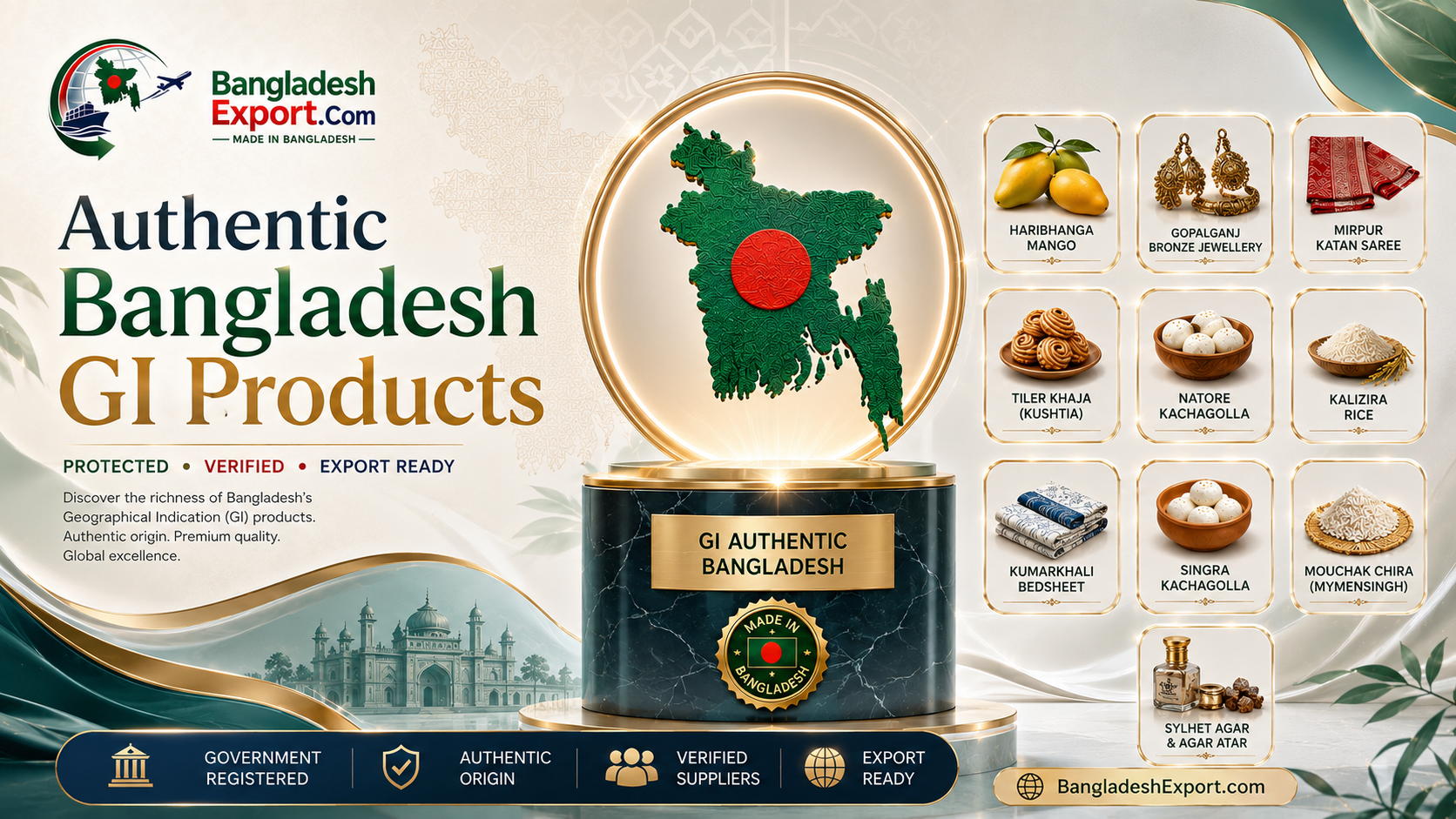
In the Gopalganj district of southern Bangladesh, there's a metalcraft tradition that's been producing distinctive bronze jewelry and ornamental items for generations. The Bronze Jewelry of Gopalganj — registered as a Bangladesh GI product in 2024 — represents a niche but culturally significant heritage craft. Using traditional lost-wax casting techniques passed down through artisan families of the traditional Kamar (metalworker) caste, Gopalganj bronze artisans create earrings, necklaces, bracelets, rings, and decorative ornaments with a distinctive warm golden-brown patina that mass-produced brass or bronze jewelry cannot replicate. The specific copper-tin alloy used in Gopalganj — with a higher copper content than standard industrial bronze — produces the warm color that is the hallmark of authentic Gopalgakh bronze. For buyers in the artisan-jewelry, fair-trade-accessories, and craft-gift segments, authentic Gopalganj bronze jewelry offers a genuinely unique product with heritage provenance and the individual character of hand-cast production.
This guide is for international jewelry importers, fair-trade accessory retailers, craft-gift distributors, museum-gift-shop buyers, and artisan-goods brands sourcing authentic Bronze Jewelry of Gopalganj. We'll cover the craft's centuries-old history, the 2024 GI registration, the lost-wax casting technique, quality characteristics and grading, export markets, HS codes, packaging and shipping, authenticity verification, and direct sourcing from verified handicraft suppliers on BangladeshExport.com.
📜 History & the Gopalganj Metalcraft Tradition
Buyers can verify the official list of Bangladesh's registered Geographical Indication (GI) products through the Bangladesh Trade Portal: bangladeshtradeportal.gov.bd — GI Products Page
The bronze metalcraft tradition in Gopalganj dates back several centuries, with artisan families — typically from the traditional Kamar (metalworker) caste — maintaining the techniques across generations. The craft was historically patronized by local zamindars (landlords) for decorative items, ceremonial objects, and personal jewelry. The Gopalganj region's position in the marshy delta of southwestern Bangladesh meant that metal crafting was one of the few specialized trades that could thrive alongside the dominant rice agriculture — the raw materials (copper and tin) were imported, but the crafting skill was local.
The specific bronze alloy used in Gopalganj — a copper-tin blend with approximately 85–90% copper and 10–15% tin — produces a warmer, more golden-brown color than standard industrial bronze (which typically has higher tin content and a cooler, more yellow appearance). This alloy distinction is one of the defining characteristics that separates Gopalganj bronze from other metalcraft traditions. The higher copper content also makes the alloy more malleable — easier to cast, file, and finish by hand — which is why the lost-wax technique works particularly well with this alloy.
The 2024 GI registration — part of the historic wave — formally protected the "Bronze Jewelry of Gopalganj" name. See our complete 60-product GI list and our Chhanamukhi of Brahmanbaria guide for the related Bangladeshi GI metalcraft (which uses sand-casting rather than lost-wax casting, and produces decorative items rather than wearable jewelry).
🏛️ GI Registration & Production Region
Bronze Jewelry of Gopalganj was registered by DPDT in 2024. The production region is Gopalganj district in southwestern Bangladesh. The GI registration covers bronze jewelry and ornamental items produced using the traditional lost-wax casting technique with the characteristic high-copper bronze alloy. Verification follows our GI verification guide.
🔨 The Lost-Wax Casting Technique — Each Piece Unique
Gopalganj bronze jewelry is made using the traditional lost-wax casting technique (cera perdue) — one of the oldest metal-casting methods in human history, dating back over 6,000 years. The technique is fundamentally different from sand-casting (used for Chhanamukhi) or die-casting (used for mass-produced jewelry). In lost-wax casting, each piece requires a unique wax model that is destroyed in the process — meaning no two pieces are ever exactly identical.
The process: (1) The artisan creates a detailed wax model of the desired jewelry piece (earring, necklace pendant, bracelet, ring) by hand-shaping and carving microcrystalline beeswax. (2) The wax model is attached to a wax sprue tree (a central wax rod with multiple models branching off, allowing several pieces to be cast simultaneously). (3) The entire wax tree is coated in layers of investment clay — a fine clay slurry that hardens around the wax, creating a heat-resistant mold. (4) The mold is heated in a kiln, melting out the wax (the "lost wax" step) and leaving a hollow cavity in the exact shape of the original wax model. (5) Molten bronze (the high-copper alloy, melted at approximately 1,000°C) is poured into the hollow cavity. (6) After cooling, the clay mold is broken away, revealing the cast bronze pieces. (7) Each piece is hand-finished: filing, sanding, polishing, and applying the characteristic patina.
Production time: A standard piece takes 2–4 days from wax model to finished product. Premium pieces with intricate detail take 5–8 days. Because each wax model is unique and destroyed in the process, every cast piece is genuinely one-of-a-kind — even when the artisan creates "matching" pieces, subtle differences in the wax carving, the clay mold, and the metal flow produce individual character.
📊 Quality Characteristics & Grading
| Grade | Craftsmanship | Finish | Patina | Retail Range (USD) |
|---|---|---|---|---|
| A Premium (Sculptural) | Intricate hand-carved wax, complex motifs | Hand-polished to mirror finish | Deep, rich golden-brown | 15–60 |
| A Standard | Standard motifs, geometric patterns | Standard polish | Standard golden-brown | 5–15 |
| B Grade | Simple designs, minimal detail | Basic finish | Lighter patina | 2–5 |
Authentic premium Gopalganj bronze jewelry has these characteristics: warm golden-brown color (from the high-copper alloy — distinctly warmer than standard bronze's cooler yellow tone), hand-cast irregularities (each piece is unique — slight variations in surface, weight, and detail are the artisan's signature), visible casting marks on the reverse (a hallmark of lost-wax production), natural patina that deepens with age and skin contact, and a substantial feel (the copper-tin alloy is denser than aluminum or thin brass imitations). The patina development is a key selling point — factory items have artificially applied patinas that wear off, while authentic Gopalganj bronze's patina develops naturally from the alloy's interaction with air and skin oils.
🌍 Export Markets & Buyer Industries
- European Union (Germany, France, UK, Netherlands): Fair-trade accessory retail and artisan-jewelry boutiques. EU buyers value the lost-wax casting provenance, the hand-cast uniqueness, and the warm golden-brown patina. Retail EUR 5–40 per piece.
- USA and Canada: Artisan-jewelry retailers, fair-trade shops, and Bangladeshi-American diaspora gift buyers. The "each piece is unique" characteristic is a strong selling point for US buyers who value individuality. Retail USD 5–40 per piece.
- Japan: Premium niche market. Japanese craft collectors value the lost-wax technique (which has parallels with Japanese traditional metalwork) and the natural patina development. Retail USD 10–50 per piece.
- Middle East (UAE, Saudi Arabia): Bangladeshi diaspora gift demand. Retail USD 3–20 per piece.
🏷️ HS Codes & Customs Classification
| HS Code | Description | Typical Use |
|---|---|---|
| 71171900 | Imitation jewelry of base metal, nes (bronze jewelry classification) | Gopalganj bronze jewelry (earrings, necklaces, bracelets, rings) |
| 83062900 | Statuettes and other ornaments of base metal | For decorative bronze items (bowls, figurines) |
📦 Packaging & Shipping
Individual jewelry pieces in cotton pouches within small cardboard boxes. Premium retail packaging includes a product card with the artisan's name, GI registration number, and care instructions ("wipe with soft cloth, avoid chemical cleaners that strip patina"). Sea freight viable for bulk orders. Documentation: Certificate of Origin (Gopalganj Chamber), DPDT GI registration, BSCIC artisan registration. See our export documentation guide.
✅ Authenticity Verification
Seven-point checklist: (1) warm golden-brown bronze color (not shiny brass-yellow or cool standard-bronze yellow); (2) hand-cast irregularities (no two pieces identical — slight variations in surface, weight, and detail); (3) lost-wax casting marks visible on the reverse (small irregularities where the sprue was cut); (4) natural patina (uneven — darker in recesses, lighter on high points — a sign of natural development, not artificial application); (5) substantial weight (the copper-tin alloy is denser than aluminum or thin brass); (6) DPDT GI registration; (7) Gopalganj production documentation.
🤝 Sourcing Verified Bronze Jewelry Artisans
- Browse verified handicraft suppliers: View 255 verified Handicrafts & Cottage suppliers.
- Post a free RFQ: Submit a Request for Quotation specifying "Bronze Jewelry of Gopalganj" with item type, quantity, and destination.
- Check credentials: Verify BSCIC artisan registration, DPDT GI registration.
- Order samples: 10–30 pieces trial.
- Finalize directly: L/C for orders over USD 2,000. No commission.
For Gopalganj bronze artisans: register as a supplier on BangladeshExport.com (free). Relevant industry support: Gopalganj Chamber of Commerce & Industry and the broader Bangladesh exporters' association directory.
🚀 Source Authentic Gopalganj Bronze Jewelry — Free RFQ
Post a free RFQ for authentic Bronze Jewelry of Gopalganj from verified artisans. Specify item type, quantity, and destination — each piece is unique (hand-cast, no two identical).
🚀 Post a Free RFQ → 🔍 Browse 255 Verified Handicraft Suppliers🎯 Conclusion
Bronze Jewelry of Gopalganj is a niche but genuinely distinctive Bangladeshi GI metalcraft — the lost-wax casting technique (each piece unique), the high-copper alloy (warm golden-brown color), the natural patina development, and the artisan heritage create a product that mass-produced jewelry cannot replicate. For buyers serving fair-trade-accessory, artisan-jewelry, or craft-gift segments, authentic Gopalganj bronze offers a defensible premium position. BangladeshExport.com makes sourcing free and transparent — start with a free RFQ today.
For the complete catalog of 60+ Bangladesh GI products, see our complete GI products list. For the related Bangladeshi GI metalcraft (sand-casting decorative items), see our Chhanamukhi of Brahmanbaria guide. For broader context, see our 2026 global demand analysis.
❓ Frequently Asked Questions
What makes Bronze Jewelry of Gopalganj a GI product?
Bronze Jewelry of Gopalganj was registered as a Bangladesh GI product by DPDT in 2024. The registration protects the name for bronze jewelry and ornamental items produced in Gopalganj district using the traditional lost-wax casting technique with a distinctive high-copper bronze alloy (85–90% copper, 10–15% tin).
How is Gopalganj bronze different from regular brass jewelry?
Three main differences. First, alloy: Gopalganj bronze is copper-tin (warmer golden-brown); brass is copper-zinc (brighter yellow). Second, technique: Gopalganj uses lost-wax casting (each piece unique); most brass jewelry is machine-stamped or die-cast (identical pieces). Third, patina: Gopalganj bronze develops a natural patina that deepens with age; brass patina is less stable.
What is the HS code for bronze jewelry exports?
Bronze jewelry uses HS code 71171900 (imitation jewelry of base metal, nes) or 83062900 (ornaments of base metal) for decorative items.
How do I verify that bronze jewelry is authentic?
Seven-point checklist: (1) warm golden-brown color; (2) hand-cast irregularities; (3) lost-wax casting marks on reverse; (4) natural uneven patina; (5) substantial weight; (6) DPDT GI registration; (7) Gopalganj production documentation.
What is the MOQ for bronze jewelry?
Typical MOQ is 30–200 pieces. For first-time buyers, artisans may accept 10–30 piece trials. Lead time 2–4 weeks for bulk orders.
Where can I find verified bronze jewelry suppliers?
BangladeshExport.com hosts 255 verified Handicrafts & Cottage suppliers. Post a free RFQ specifying "Bronze Jewelry of Gopalganj" and verified artisans will respond within 24–72 hours.