DBH Finance Q3 Profit Down 22% Due To Higher Provisions, Lower Investment Income
Despite surge in interest income, DBH Finance experienced 22.35% YoY decline in profit to Tk 251.22 million in July-September; investment income fell 75.8%.
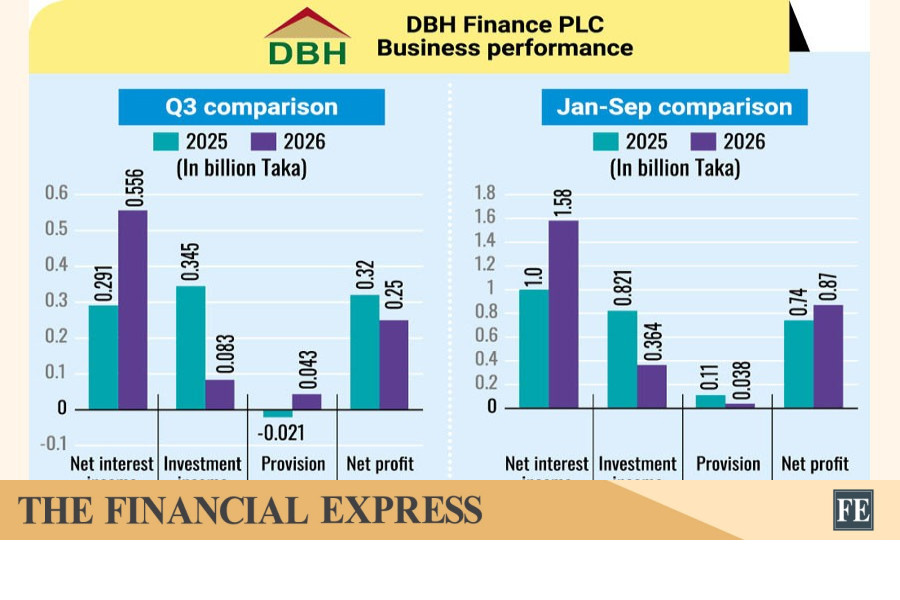
📉 Despite a surge in interest income, DBH Finance experienced a 22.35 per cent year-on-year decline in profit, to Tk 251.22 million, in July-September (Q3). A significant fall in investment income and provisions for unrealised losses in securities investment led to the erosion in earnings. The company endured a 75.8 per cent decline in investment income in the quarter to September, compared with the corresponding period a year ago.
📊 The chief financial officer of DBH Finance, Abdul Ahad, said a decline in the interest rates of Treasury bonds and Treasury bills dragged down investment income in Q3 compared with the same quarter of the previous year. The amount of investment also declined in Q3 this year compared with the previous year. As a result, income from investments fell to Tk 83.83 million in Q3 this year from Tk 345.31 million in the same quarter last year.
💰 Treasury yields and investment income
The decline in DBH Finance''s investment income reflects the broader trend in Bangladesh''s fixed-income market. Treasury bond and bill yields have been declining in recent months as excess liquidity in the banking system — driven by weak private sector credit demand — has pushed down the rates that the government needs to pay on its borrowings. For financial institutions like DBH Finance that hold significant portfolios of government securities, this decline in yields translates directly into lower investment income.
The dynamic illustrates the challenging environment facing Bangladesh''s non-bank financial institutions (NBFIs). With private sector credit growth stuck below 5% for six straight months, NBFIs are struggling to find attractive lending opportunities. Many have turned to government securities as a relatively safe place to park their funds — but the resulting decline in Treasury yields has reduced the returns on these investments, squeezing NBFIs'' profitability.
👥 Provisions for unrealised losses
Besides the decline in investment income, the company had to set aside Tk 43.50 million as a provision in July-September this year for unrealised losses on securities in its portfolio. A year ago, it had a net provision reversal of Tk 21.68 million in the same quarter. That means money set aside earlier was released back to the income statement, but in Q3 FY26, the company had to set aside fresh provisions — a swing of roughly Tk 65 million in provisioning that contributed to the profit decline.
The provisions for unrealised losses reflect mark-to-market valuation adjustments on DBH Finance''s securities portfolio. When interest rates rise, the market value of existing fixed-income securities falls — requiring holders to recognise unrealised losses through provisioning. The fact that DBH Finance had to make fresh provisions in Q3 suggests that the market value of its securities portfolio declined during the quarter — possibly due to interest rate volatility or other market factors.
🏛 Net interest income growth
However, the company''s net interest income rose significantly in the quarter to September as interest paid on deposits and borrowing declined during the quarter. This positive development reflects DBH Finance''s ability to reduce its funding costs — possibly by replacing higher-cost deposits and borrowings with lower-cost alternatives. The growth in net interest income partially offset the decline in investment income — but it was not enough to prevent the overall profit decline.
The combination of declining investment income, fresh provisions, and growing net interest income reflects the complex operating environment facing NBFIs in Bangladesh. They need to navigate weak private sector credit demand, declining Treasury yields, interest rate volatility, and provisioning requirements — all while trying to maintain profitability and grow their businesses.
🌏 Looking ahead
For DBH Finance, the Q3 profit decline is a reminder of the challenges facing NBFIs in the current macroeconomic environment. The company''s ability to grow net interest income is positive — but it needs to address the structural decline in investment income and the provisioning pressures to restore profit growth.
For Bangladesh''s broader NBFI sector, DBH Finance''s Q3 results reflect the systemic challenges facing the industry. With private sector credit demand weak, Treasury yields declining, and banking sector stress constraining overall financial system liquidity, NBFIs are facing a particularly challenging operating environment. The coming quarters will show whether the sector can navigate these challenges — or whether more NBFIs will face the kind of profit pressures that DBH Finance experienced in Q3.
This news was originally published by The Financial Express. For the full original report, please visit: https://thefinancialexpress.com.bd/stock/dbh-finances-q3-profit-down-22pc-due-to-provision-lower-investment-income
📬 Get Bangladesh Trade News in your inbox
Weekly digest of export industry news, policy updates, and market analysis.
📰 Related Stories