Tk 12,000 Crore Stuck in Interbank Legal Battles Over LC Guarantees in Bangladesh
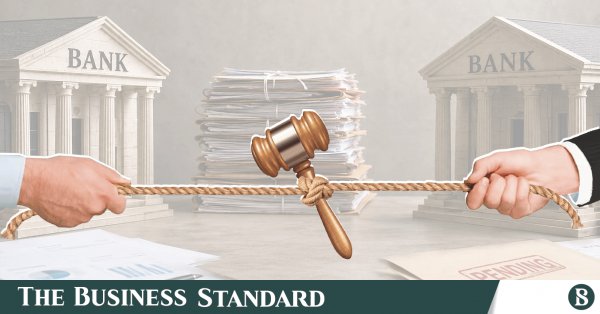
Dhaka, August 17, 2026 — Already struggling under a huge non-performing loan crisis and a severe demand slump, Bangladesh's banking sector faces another challenge: escalating legal battles between banks. Rising disputes over Inland Bill Purchase (IBP) facilities and Letter of Credit (LC) bank guarantees have entangled over Tk 12,000 crore in Money Loan Courts countrywide, signalling a breakdown in inter-bank trust that threatens the efficiency of the entire trade finance system.
📊 The Scale of the Problem
Data from the Supreme Court and money loan courts reveal the staggering scale of interbank litigation:
- 💰 Tk 12,000 crore — total amount stuck in 7,354 pending cases nationwide (as of June 2026)
- 💰 Tk 6,500 crore — stuck in 3,634 cases in just 4 Dhaka money loan courts
- 📈 578 lawsuits — filed by banks against other banks in Jan-June 2026 (Tk 2,000 crore)
- 📈 843 lawsuits — filed in 2025 (Tk 2,000 crore)
- 📈 715 lawsuits — filed in 2024 (Tk 1,200 crore)
- 📈 1,123 lawsuits — filed in 2023 (Tk 2,500 crore)
- 📈 1,223 lawsuits — filed in 2022 (Tk 3,000 crore)
Despite the volume of litigation, case disposal remains very low. Supreme Court data show that only 72 cases involving around Tk 300 crore were disposed of in 2025, compared with just 26 cases involving about Tk 80 crore in 2024 — meaning the backlog continues to grow faster than it is being resolved.
🚧 The 23-Year Dispute: Uttara Bank vs Sonali Bank
One such case is a 23-year-old dispute between Uttara Bank and Sonali Bank that began in 2002 over 57 post-dated cheques issued by Chattogram Tobacco Company. Chattogram-based Prime Global Ltd presented the cheques to Uttara Bank and obtained IBP financing against them. The cheques were drawn on Sonali Bank accounts, which endorsed each as “Good for Payment” and later reconfirmed the assurance in writing.
Relying on the assurance, Uttara Bank extended around Tk 15.46 crore in IBP financing to Prime Global. But all 57 cheques were dishonoured between November 2002 and February 2003. Uttara Bank subsequently filed a case with a Dhaka money loan court in 2003, seeking around Tk 17.88 crore. The timeline of this case illustrates the problem:
- 📅 2002 — cheques dishonoured, dispute began
- 📅 2003 — Uttara Bank filed case in Money Loan Court
- 📅 2006 — court issued decree against Sonali Bank
- 📅 2007 — Sonali Bank challenged decree in High Court
- 📅 2025 (August) — Appellate Division upheld the verdict
- 🚧 2026 (current) — Money Loan Court has yet to implement decree
Repeated calls and text messages to Sonali Bank Managing Director Shawkat Ali Khan seeking comment on the matter went unanswered — reflecting the lack of accountability that perpetuates such disputes.
📜 How IBP and LC Guarantees Work
IBP (Inland Bill Purchase) is a commercial financing facility offered by banks. Under the facility, banks provide cash or advance payment against bills or documents to individuals or suppliers soon after goods are delivered, typically against a domestic LC or a sales contract.
Imran Ahmed Bhuiyan, banking and company law expert, told TBS that Section 2(c)(2) of the Money Loan Court Act 2003 covers liabilities arising from IBP, guarantees, indemnities, LCs, and other financial arrangements. He explained that LCs are widely used in domestic and international trade, where one bank may act as a guarantor for another:
- 🏢 Two local banks — one provides guarantee, other negotiates
- 🌐 Local bank and foreign bank — cross-border trade finance
- 💰 Guarantor bank liability — if guarantor fails to pay, negotiating bank sues
- 📜 Money Loan Court jurisdiction — covers all such interbank disputes
👥 Expert View: Need for Arbitration
Mohammad A (Rumee) Ali, former chairman of AB Bank, said many countries use arbitration tribunals to settle such disputes, while courts in developed countries often require parties to pursue alternative dispute resolution (ADR) before litigation. “Bangladesh could adopt such mechanisms,” he said, calling for clear guidelines empowering the central bank to act against banks whose conduct leads to such disputes.
The proposed reforms include:
- 📜 Arbitration tribunals — dedicated interbank dispute resolution
- 🤝 ADR requirements — mandatory mediation before litigation
- 🏛️ BB enforcement powers — central bank authority over bank conduct
- ⏳ Faster case disposal — reducing 23-year timelines
- 💰 Capital recovery — unblocking Tk 12,000 crore for productive lending
🌐 Why This Matters for Bangladesh's Trade and Export
The Tk 12,000 crore stuck in interbank legal battles has significant implications for Bangladesh's export economy:
- 💰 Reduced lending capacity — capital locked in litigation cannot finance trade
- 🚧 Trade finance disruption — IBP and LC are critical for RMG and export trade
- 🤝 Erosion of inter-bank trust — banks reluctant to provide guarantees
- 💰 Higher trade finance costs — risk premiums passed to exporters and importers
- 🚧 Export competitiveness erosion — slower LC processing delays shipments
- 📈 Investor confidence risk — dysfunctional interbank system deters FDI
For an export economy that processes billions of dollars in LCs annually for RMG, pharmaceutical, and agricultural exports, the breakdown of interbank trust is not merely a banking sector issue — it is a direct threat to export competitiveness. Every taka locked in litigation is capital that cannot finance the trade transactions that power Bangladesh's export engine.
This news was originally published by The Business Standard. For the full original report, please visit: https://www.tbsnews.net/economy/banking/tk12000cr-stuck-interbank-legal-battles-over-lc-guarantees-1516971
Related on BangladeshExport
📬 Get Bangladesh Trade News in your inbox
Weekly digest of export industry news, policy updates, and market analysis.
📰 Related Stories