Gas Shortage Halts Production at Over 100 Bangladesh Factories Including Meghna and TK Group
Gazipur, August 16, 2026 — Factories dependent on gas and power across Bangladesh are struggling with severe fuel shortages, with more than 100 factories halting production over the past week and another 150-plus significantly reducing output. The crisis has hit essential commodity producers, pharmaceuticals, ceramics, and steel manufacturers — with major industrial groups including Meghna Group, TK Group, and ACI Limited reporting widespread shutdowns. Industrialists say the country has been facing a severe gas supply shortage for about a month, with the crisis intensifying over the past week.
📊 The Scale of Factory Shutdowns
On Saturday, Prothom Alo gathered information from factories in Narayanganj, Narsingdi, Savar, Gazipur, Chattogram, Habiganj, Mymensingh, and Khulna. The findings:
- 🏭 100+ factories halted — complete production stoppage in past week
- 📉 150+ factories reduced — significantly reduced production without full shutdown
- 🏭 50+ factories from major groups — belong to large industrial conglomerates
- 🌾 Essential commodities hit — sugar, wheat, edible oil, lentils production affected
- 🚧 Worst-hit areas — Narayanganj, Narsingdi, Chattogram
🏭 Meghna Group: 40 of 57 Factories Shut
More than two-thirds of the factories owned by Meghna Group of Industries (MGI) — one of the country's leading industrial groups — are currently shut. Company officials said that as of Saturday afternoon, 40 of the group's 57 factories had completely halted production. A large share of these factories produce essential commodities. The remaining factories are producing small quantities of selected products only.
🏭 TK Group: Most Factories Stopped
Another major industrial group, TK Group, has 28 factories. Most of them have stopped production, said group director Mohammad Mostafa Haider. He said only one of its gas-dependent factories around Dhaka was operating on a limited scale, while the others had shut down. Most of the closed factories produce essential commodities.
TK Group also has several factories in the northern region and in Jessore and Khulna. These plants depend on electricity, but production there is also being disrupted by load-shedding. Mostafa Haider said some of these areas were experiencing load-shedding 8 to 10 times a day.
🏭 ACI Limited: Production Down 30-50%+
Production has also fallen across several factories operated by ACI Limited. The company has factories around Dhaka including:
- 🧂 Salt factory — in Rupganj, Narayanganj
- 🍞 Flour and pharmaceutical plants — in Bandar area
- 🧴 Napkins, diapers, agri inputs — in Konabari and Tongi, Gazipur
- 🏍️ Motorcycles and electrical equipment — also in Gazipur
Production at all of these factories has fallen well below target. Company officials said production had fallen by 30 percent at some facilities, 50 percent at others, and even more at some plants. Salt production has been particularly badly affected.
ACI Limited Executive Director Quamrul Hassan told Prothom Alo: “On one hand, we are struggling with the power shortage. On the other, the generators we used to run on gas can no longer operate because there is no gas. Production at boiler-dependent factories has also fallen drastically because of the gas shortage. All of this is causing us substantial financial losses.”
💰 Diesel Alternative: Costly Stopgap
Some factories in the pharmaceutical, steel, and cold-storage sectors are using diesel as an alternative fuel to keep production going on a limited scale. But this has significantly increased their costs — with diesel use up 390 percent at some factories according to earlier reports. The cost escalation directly impacts export competitiveness and consumer prices.
📦 Supply Chain Impact: Sugar Prices Rising
The gas crisis has begun affecting supplies at Narayanganj's Nitaiganj, one of the country's largest wholesale markets:
- 🍬 No sugar trucks — have entered the market in the past 3 days
- 💰 Sugar price up Tk 7/kg — wholesale price risen due to production shortage
- 🥙 Edible oil production — also disrupted
- 🍚 Essential commodity supply — under threat across categories
👥 Worker Impact: Sitting Idle
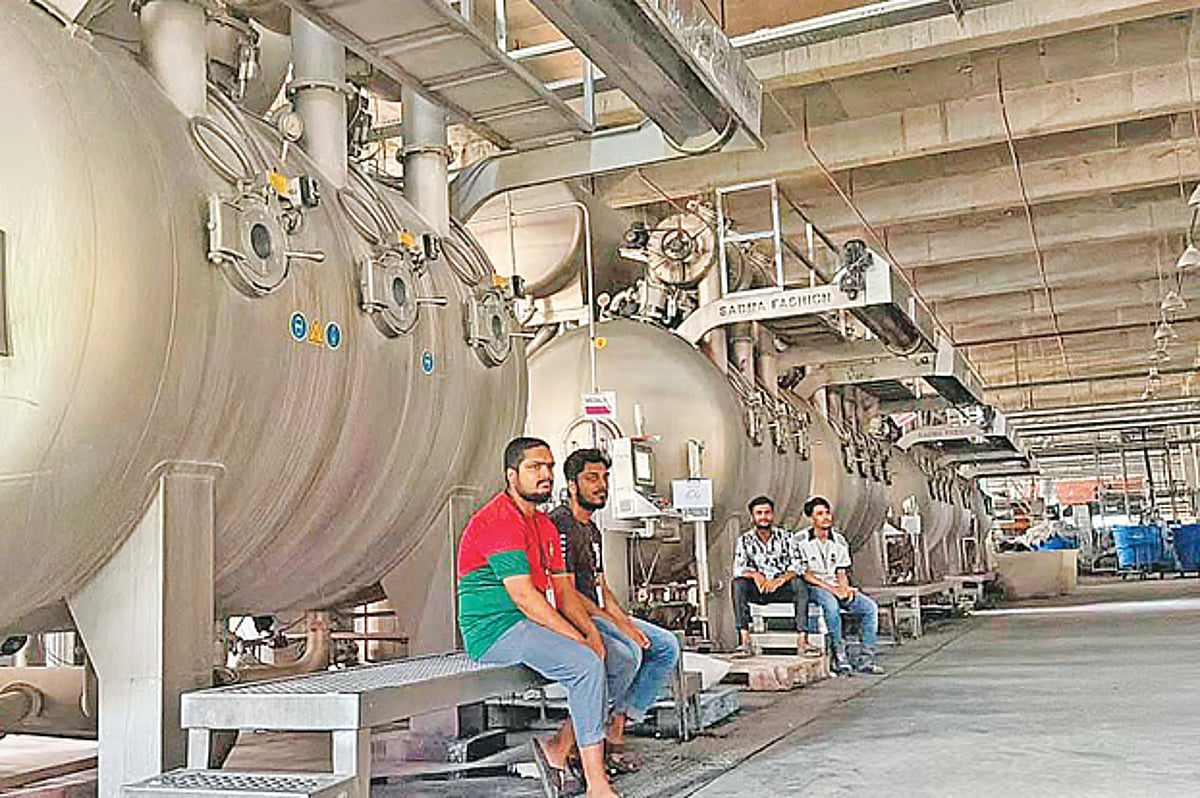
With gas pressure too low to run machinery, workers at many factories have been left sitting idle. At Sadma Fashion Ltd in the Mouchak area of Gazipur, workers were photographed sitting with no work because of the lack of gas pressure. The worker idle time has several cascading effects:
- 💰 Wage pressure — workers need income despite factory closures
- 👥 Labour unrest risk — prolonged idle time can trigger protests
- 🚧 Skill erosion — extended production stops reduce worker proficiency
- 📈 Production backlog — export order delays accumulate
🌐 Strategic Context: Energy Crisis and Export Competitiveness
The factory shutdowns come as Finance Minister Amir Khosru Mahmud Chowdhury has warned that the energy crisis will take at least two years to resolve. For Bangladesh's export economy, the gas shortage has direct competitive implications:
- 👕 RMG sector — factories dependent on gas for captive power and machinery
- 💊 Pharmaceuticals — boiler-dependent production disrupted
- 🧵 Textiles — dyeing and processing require gas
- 🌾 Agro-processing — food processing plants need gas for operations
- 🏭 Steel and ceramics — energy-intensive production halted
With over 100 factories completely shut and 150+ running at reduced capacity — including factories owned by some of Bangladesh's largest industrial groups — the gas crisis represents one of the most significant threats to industrial production and export competitiveness in recent years. The impact on essential commodity prices (sugar up Tk 7/kg) adds a consumer welfare dimension that could further complicate the inflation challenge already squeezing Bangladesh's middle class and eroding export wage competitiveness.
This news was originally published by Prothom Alo English. For the full original report, please visit: https://en.prothomalo.com/business/local/agj4v1benw
📬 Get Bangladesh Trade News in your inbox
Weekly digest of export industry news, policy updates, and market analysis.
📰 Related Stories