Bangladesh Energy Crisis Will Take Two Years to Resolve, Says Finance Minister Amir Khosru
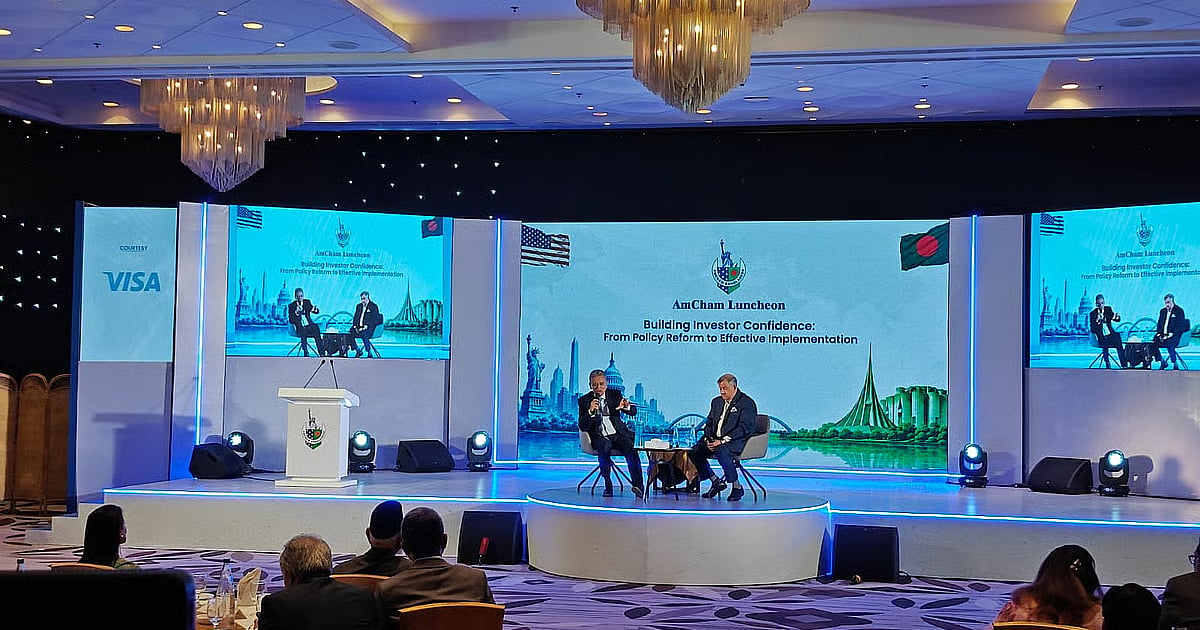
Dhaka, August 16, 2026 — The ongoing energy crisis will take at least two years to resolve, Finance and Planning Minister Amir Khasru Mahmud Chowdhury has said. Speaking as chief guest at an event organised by the American Chamber of Commerce in Bangladesh (AmCham) at Hotel InterContinental on Sunday afternoon, the minister warned that the problems surrounding gas and electricity could not be resolved within six months or a year and would require at least two years.
⚡ The Two-Year Timeline Explained
Explaining the timeframe, the finance minister said it would take around one and a half to two years to build a floating LNG terminal — meaning the crisis could not be resolved before then. Key points from his address:
- ⏳ 2 years minimum — to fully resolve energy crisis
- 🚢 1.5-2 years — to build a floating LNG terminal
- 🚧 Not resolvable in 6-12 months — gas and electricity problems deep-rooted
- 🔌 Energy policy coming — to be published within weeks
- 🚧 Caution needed for next 2 years — minister warned
“The economy cannot move forward without gas and electricity. However, we are swiftly taking whatever measures are possible,” Amir Khasru said.
🔍 Root Causes and Government Actions
The finance minister identified several root causes and ongoing government responses:
- 🔍 Gas exploration neglected — was neglected for a long time, now being resumed
- ☀️ Solar power work underway — renewable energy expansion
- 🚢 Coal-based power — work also in progress
- 📊 Energy mix assessment — determining how much of each type needed
- 📜 Energy policy — to be published within next few weeks
“Gas exploration was neglected for a long time; now it is being resumed. Work is also under way on solar power and coal. We are determining how much of each type of energy will be required. The energy policy will be published within the next few weeks. People will then know what needs to be done. We will have to remain cautious over the next two years,” the minister said.
🏛️ AmCham Event: Restoring Investor Confidence
The seminar focused on restoring investor confidence through policy reforms and effective implementation. AmCham President Syed Mohammad Kamal chaired the event, where business leaders raised various concerns. In his concluding remarks, Kamal said: “We do not merely want to identify the challenges; we want to be part of the solution. This event has therefore been organised to rebuild confidence among businesses. More such initiatives will be held in the future.”
💰 Revenue and Taxation Reforms
Speaking on the government's plans to increase revenue collection, the finance minister said:
- 📜 Separation of functions — implementation and policy functions to be separated
- 📊 Tax base broadening — government seeking to widen tax net
- 🏭 Fixed-rate taxation — for small businesses being developed
- 💻 Database creation — alongside taxation system
💸 Banking Sector and Stock Market
On the banking sector, the finance minister said it was facing a severe capital shortfall that was too large for the government to cover. With the volume of non-performing loans also remaining high, he said alternative sources of financing were therefore needed. On the stock market, Amir Khasru said the government had been receiving warning signals and had subsequently introduced changes. “We need more listed companies,” he said.
🌐 Strategic Context: Energy Crisis and Export Economy
The two-year energy crisis timeline has significant implications for Bangladesh's export economy:
- 🏭 Factory production disruption — gas shortage already halting 100+ factories
- 💰 Higher production costs — diesel use up 390% at factories amid gas shortage
- 🚧 Export competitiveness erosion — higher energy costs raise product prices
- 📈 Investor confidence risk — energy uncertainty deters FDI
- 💰 Forex pressure — LNG imports strain dollar reserves
- 🚧 LDC graduation complication — energy reliability critical for post-LDC competitiveness
The finance minister's candid two-year assessment — delivered at an AmCham event focused on investor confidence — signals government recognition that the energy crisis is a structural challenge requiring sustained, multi-year investment. The upcoming energy policy publication and the resumption of gas exploration are positive steps, but the two-year timeline means that Bangladesh's export industries will need to navigate significant energy constraints through at least mid-2028 — making energy efficiency, alternative fuel sourcing, and production planning critical survival skills for the intervening period.
The energy crisis affects different export sectors in different ways. The RMG sector — which depends on gas for factory operations and captive power generation — faces production halts and cost escalation. The pharmaceutical sector requires reliable electricity for cold chain and precision manufacturing. The leather and agro-processing sectors face similar challenges with perishable goods that require uninterrupted power for storage and processing. For all these sectors, the two-year timeline means that energy cost management, captive power investment, and fuel-switching strategies (from gas to diesel, solar, or grid electricity) will be essential operational priorities — adding to production costs that ultimately affect export competitiveness in the global marketplace.
This news was originally published by Prothom Alo English. For the full original report, please visit: https://en.prothomalo.com/business/local/o4le3hugn7
Related on BangladeshExport
📬 Get Bangladesh Trade News in your inbox
Weekly digest of export industry news, policy updates, and market analysis.
📰 Related Stories