Chattogram Customs to Auction Tk 9,000 Crore Abandoned Goods at Port
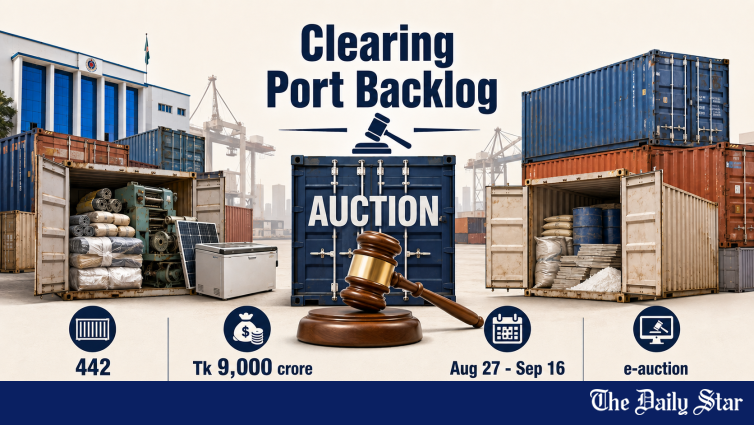
Chattogram, August 24, 2026 — Chattogram customs house is set to auction goods from 442 containers from August 27 to September 16 as part of efforts to clear long-abandoned consignments occupying valuable space at Chattogram port. Around 2.4 lakh tonnes of imported goods worth nearly Tk 9,000 crore have been lying abandoned at the port for years, occupying about 18 percent of its total capacity, according to port and customs officials.
📊 The Scale of the Problem
- 💰 Total value: ~Tk 9,000 crore
- 📏 Total volume: ~2.4 lakh tonnes
- 📦 Containers: 442
- 📈 Port capacity occupied: ~18%
- 📅 Import period: 2013-2024 (up to 11 years abandoned)
- 📅 Auction dates: August 27 - September 16, 2026
- 📦 Lots: 210 (in two e-auctions)
The abandoned consignments, imported between 2013 and 2024, include various chemicals, machinery and machinery parts, fabrics, yarn, plastic waste, tiles, salt, paper, household goods and other items. The prolonged storage has not only blocked port space but also deprived the government of revenue and caused financial losses to shipping agents who are unable to reposition their containers for active trade.
🚧 Why Goods Are Abandoned
Customs officials said importers often abandon consignments when market prices fall below import costs, when original documents or clearance permits are unavailable, or when importers refuse to pay fines imposed for import irregularities. Some consignments have been sitting at the port for over a decade, deteriorating in condition and occupying space that could be used for active trade cargo. The financial losses from this abandonment are substantial — not only in terms of the goods themselves, but also in demurrage charges, storage fees, and the opportunity cost of port capacity that could be serving legitimate trade.
💻 Digital E-Auction Process
To address the backlog, Chattogram Customs has launched two e-auctions involving 442 containers in 210 lots. The initiative aims to ease container congestion, increase port efficiency, and prevent the wastage of state resources.
- 📦 Special e-auction: 290 containers in 101 lots — includes chemicals, machinery, plastic waste, chest freezers, pipes, yarn, fabrics, solar modules, salt, paper, tiles, household goods, and 86 old empty containers. No reserve price has been set for these consignments.
- 📦 Regular e-auction: 152 containers in 109 lots — includes capital machinery, fabrics, PVC flex banners, chemicals, air-conditioner parts, tiles, stainless steel coils, scanners, badminton rackets, elevators, and salt.
The entire auction process will be conducted digitally through the customs e-auction platform to ensure transparency and accountability. Bidders are required to upload a scanned copy of a security deposit equivalent to at least 10 percent of their proposed bid amount and submit the original documents within the stipulated time.
📜 Amendments to Auction Rules
Port and customs officials said delays in the auction process have allowed many consignments to deteriorate, resulting in further losses and wastage of valuable foreign currency. The authorities have taken several measures, including amendments to auction rules, to expedite the disposal of abandoned goods. The National Board of Revenue (NBR) expects the technology-driven auction process to help increase the operational capacity of Chattogram port, ease container congestion, and ensure more effective management of state resources.
🌐 Strategic Context for Bangladesh's Export Economy
The Tk 9,000 crore abandoned goods crisis at Chattogram port highlights a critical bottleneck in Bangladesh's trade logistics infrastructure. When 18 percent of port capacity is occupied by abandoned consignments — some dating back over a decade — it directly reduces the port's throughput capacity, increases congestion, raises demurrage costs for legitimate importers and exporters, and slows the overall trade facilitation process that the export economy depends on.
For the export economy, port congestion is particularly damaging because it affects the import of raw materials (fabric, yarn, chemicals) that feed the RMG and pharmaceuticals export supply chains. The Commerce Minister's recent acknowledgment that Bangladesh's logistics costs are 16 percent of GDP — well above the international average of 10 percent — is directly connected to this kind of port inefficiency. The e-auction initiative is a positive step, but it highlights the need for systemic reform: faster customs clearance procedures, stricter enforcement of storage time limits, and automated processes that prevent consignments from being abandoned in the first place.
The NBR's technology-driven approach, if successful, could become a model for addressing similar backlogs at other ports and land customs stations across Bangladesh. However, sustained improvement requires addressing the root causes that lead to abandonment — including the complex customs documentation requirements, the lengthy dispute resolution process for seized goods, and the lack of automated triggers that would flag consignments approaching abandonment thresholds. The BNP government's broader trade facilitation reform agenda, including the National Single Window project and the Invest Bangladesh Authority, should incorporate port efficiency improvements as a priority area alongside investment promotion and economic zone development. Without resolving these structural logistics bottlenecks, Bangladesh's export economy will continue to bear the cost of inefficiency that its regional competitors — Vietnam, Cambodia, and India — have largely resolved through port modernisation and customs automation.
This news was originally published by The Daily Star. For the full original report, please visit: https://www.thedailystar.net/business/economy/news/ctg-customs-auction-tk-9000cr-abandoned-goods-4255971
📬 Get Bangladesh Trade News in your inbox
Weekly digest of export industry news, policy updates, and market analysis.
📰 Related Stories