Bangladesh September LNG Cargoes Cost More Than Double Pre-War Rates
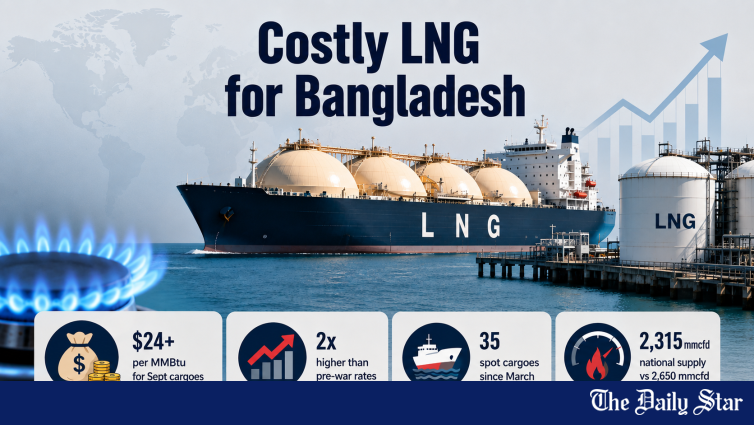
Dhaka, August 24, 2026 — Bangladesh has agreed to pay over $24 per million British thermal units (MMBtu) for two LNG cargoes to be delivered in September 2026, as the country continues to scramble for supplies amid a global market squeeze triggered by the US-Israel war on Iran. The Cabinet Committee on Government Purchase approved one cargo from Posco International Corporation at $24.625 per MMBtu for delivery on September 13-14, and another from TotalEnergies Gas & Power Ltd, UK, at $24.25 per MMBtu for September 23-24.
📊 Price Comparison
- 💰 Pre-war spot rate: $10-$12/MMBtu
- 💰 Sept cargo 1 (Posco): $24.625/MMBtu
- 💰 Sept cargo 2 (TotalEnergies): $24.25/MMBtu
- 💰 Earlier Aug (Aramco): $23.93/MMBtu
- 💰 Earlier Aug (BP Singapore): $21.778-$21.878/MMBtu
- 📈 Price increase vs pre-war: More than 2x
- 💰 Cost per cargo: ~Tk 1,000 crore (at current prices)
- 💰 Pre-war cost per cargo: ~Tk 410-490 crore
The prices are more than double the $10-$12/MMBtu that Bangladesh typically paid for spot LNG before the war began in late February this year. The latest purchases also mark another jump from the prices paid for several recent cargoes. The government approved a cargo from Aramco Trading Singapore at $21.55/MMBtu earlier this month, while two cargoes approved last week from BP Singapore were priced at $21.878 and $21.778/MMBtu. Another cargo approved on August 19 from Aramco Trading was priced at $23.93/MMBtu.
🚢 Supply Chain Disruptions
The rising prices are adding to the pressure on Bangladesh's LNG import bill at a time when the country is increasingly dependent on spot purchases to compensate for disruptions to its long-term supplies. Each LNG cargo contains around 33.6 lakh MMBtu of gas, meaning the two latest shipments will each cost roughly Tk 1,000 crore at the approved prices. At the pre-war spot-market rate of $10-$12/MMBtu, a similar cargo would have cost around Tk 410-490 crore.
Bangladesh had bought 35 spot LNG cargoes since March, according to Kpler data, as Qatar, its largest long-term supplier, cut scheduled deliveries following the outbreak of the war. The country needs roughly 10 LNG cargoes a month to maintain its imported gas supply, yet the government struggled to secure cargoes for the final week of August even after repeatedly floating tenders.
⚠ Excelerate FSRU Problems
The latest procurement difficulties emerged after the July 21 fire and subsequent technical problems at Excelerate Energy's FSRU at Moheshkhali. The terminal, one of the country's two LNG import facilities, went offline, cutting roughly 450 mmcfd from the national gas supply. The two FSRUs have a combined regasification capacity of about 1,100 mmcfd.
Although Excelerate resumed partial operations on August 6, the terminal suffered another disruption and ran out of LNG on August 19. It started supplying again on August 22. Due to the shortage in LNG supply, overall national supply is far below the usual level, at 2,315 mmcfd compared with 2,650 mmcfd, resulting in a severe crisis across all sectors, including power generation and industrial production.
🌏 Geopolitical Context
The war and disruptions to shipping through the Strait of Hormuz have affected supplies for Bangladesh, which has a long-term LNG supply contract with Qatar. The Gulf nation usually ships a significant share of its LNG through the Strait of Hormuz, through which roughly one-fifth of global oil and LNG supplies transit. Bangladesh meets nearly 30 percent of its gas demand through imported LNG, while domestic production continues to fall short of the country's total requirement of about 2,650 mmcfd, according to energy ministry data.
🌐 Strategic Context for Bangladesh's Export Economy
The escalating LNG costs represent a direct threat to Bangladesh's export economy. The energy-intensive RMG, textile, pharmaceuticals, and agro-processing sectors all depend on reliable gas supply for manufacturing operations. With each LNG cargo now costing roughly Tk 1,000 crore — more than double the pre-war cost — the fiscal burden of energy subsidies is mounting rapidly. The government already spent 43 percent of its annual LNG subsidy budget in just 1.5 months of FY27, suggesting the full-year subsidy will far exceed the allocation.
For the BNP government under Prime Minister Tarique Rahman and Finance Minister Amir Khosru, the LNG price spiral creates a difficult trade-off: continue subsidising energy imports to protect industrial production and export competitiveness, or raise energy tariffs to reduce the fiscal burden — which would further squeeze manufacturing margins already under pressure from the global economic slowdown. The Excelerate FSRU reliability issues add another layer of vulnerability, demonstrating that Bangladesh's energy infrastructure is not just exposed to geopolitical price shocks but also to technical failures that can disrupt supply at any time.
Without urgent investment in domestic gas exploration, renewable energy alternatives (including the 1,768 MWp rooftop solar potential identified by CPD for RMG factories), and LNG infrastructure resilience, Bangladesh's export economy will remain at the mercy of global LNG market volatility and infrastructure fragility for the foreseeable future. The gas shortage has already halted production at 100+ textile factories in Narsingdi, and the continuing LNG procurement difficulties threaten to extend these disruptions to other industrial sectors that depend on reliable gas supply for their manufacturing operations.
This news was originally published by The Daily Star. For the full original report, please visit: https://www.thedailystar.net/business/economy/news/sept-lng-cargoes-cost-more-double-pre-war-rates-4256056
Related on BangladeshExport
📬 Get Bangladesh Trade News in your inbox
Weekly digest of export industry news, policy updates, and market analysis.
📰 Related Stories