Bangladesh to Import 365,000 Tonnes of Fertiliser to Shore Up Stocks
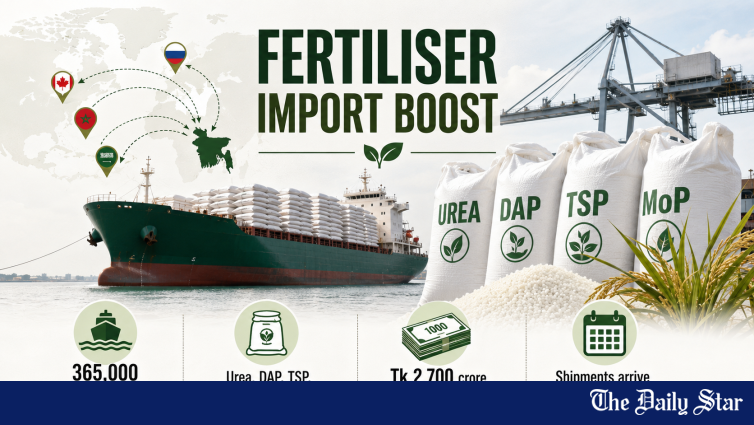
Dhaka, August 24, 2026 — The Bangladesh government is set to import 365,000 tonnes of fertiliser to build up stocks amid concerns over the supply of the essential crop nutrient due to the US-Israel war on Iran and China's export ban. The Cabinet Committee on Government Purchase (CCGP) took the decision based on proposals from the agriculture and industries ministries to buy urea, diammonium phosphate (DAP), triple superphosphate (TSP), and muriate of potash (MoP).
Bangladesh Agricultural Development Corporation (BADC) and Bangladesh Chemical Industries Corporation (BCIC), two agencies under the agriculture and industries ministries, will buy the crop production input, mostly used for rice cultivation, from Saudi Arabia, Russia, Morocco, Canada, and Karnaphuli Fertilizer Company Ltd (KAFCO). The purchases will cost Tk 2,700 crore, according to the official document.
📊 Import Details
- 💰 Total import volume: 365,000 tonnes
- 💰 Cost: Tk 2,700 crore
- 🧬 Types: Urea, DAP, TSP, MoP
- 🌐 Source countries: Saudi Arabia, Russia, Morocco, Canada, KAFCO (domestic)
- 🏢 Procuring agencies: BADC and BCIC
- 📅 Expected arrival: Mid and end of September 2026
- 📊 FY2026-27 total requirement: 5,800,000 tonnes
🌾 Previous Import and Current Domestic Production
The development comes less than a week after the high-powered purchase committee gave the go-ahead to import 115,000 tonnes of fertiliser from Canada, Russia, and Saudi Arabia to replenish stocks and ensure availability during the two major rice-cropping seasons: the current Aman season and the upcoming Boro season. "We expect the shipments of fertiliser to arrive in the middle and at the end of September," said a top official of BCIC.
Three factories, including KAFCO, are currently producing fertilisers domestically, and one more is expected to start production soon, the official said. However, with four of the country's five fertiliser factories having been shut down due to the gas crisis, domestic production remains severely constrained. Only the Ghorashal-Palash plant continues to operate alongside KAFCO and one other facility, leaving Bangladesh heavily dependent on imports to meet its annual fertiliser requirement of 5,800,000 tonnes.
⛽ Gas Crisis Impact on Fertiliser Production
Bangladesh depends heavily on imports for chemical fertiliser, and domestic production remains constrained by the diversion of gas to power generation and other industrial uses. The ongoing gas crisis — caused by the Excelerate FSRU disruptions at Moheshkhali, the elevated LNG costs of $24+/MMBtu (more than double pre-war rates), and the broader Middle East conflict — has forced the closure of four fertiliser factories that cannot secure sufficient gas supply for their production processes.
The Excelerate FSRU at Moheshkhali suffered a fire on July 21, went offline cutting 450 mmcfd from national supply, resumed partial operations on August 6, then ran out of LNG again on August 19 before restarting on August 22. National gas supply is currently at 2,315 mmcfd compared with the requirement of 2,650 mmcfd, creating a shortfall that affects all gas-dependent industries including fertiliser, textiles, steel, paper, and ceramics manufacturing.
🌏 Middle East War and China Export Ban
The Middle East war has raised concerns over fertiliser supplies, as Bangladesh imports a significant portion of its fertiliser from the Middle East. The conflict has disrupted shipping through the Strait of Hormuz and affected supply chains for energy commodities and agricultural inputs. Additionally, China's export ban on fertiliser has further tightened global supply, forcing Bangladesh to diversify its import sources and secure supplies from multiple countries.
The government's decision to source fertiliser from Saudi Arabia, Russia, Morocco, and Canada reflects a deliberate diversification strategy to reduce dependence on any single supplier or region. This approach is particularly important given that the Middle East conflict shows no sign of resolution, and Bangladesh cannot afford to have its agricultural sector — which employs roughly 40 percent of the workforce and contributes over 12 percent of GDP — compromised by supply chain disruptions beyond its control.
🌾 Agricultural Sector Context
The fertiliser import decision reflects the government's recognition that agricultural production cannot be compromised by the energy crisis. Fertiliser is a critical input for Bangladesh's rice cultivation — the country's staple food crop — as well as for jute, vegetables, and other agricultural products. Any disruption in fertiliser supply could lead to reduced crop yields, higher food prices, and increased farmer distress, which would compound the existing inflationary pressures that the CPD identified as one of the key concerns in the government's first six months.
The Agriculture Ministry has been working to reduce dependence on imported agro-products, and the Farmer Card distribution programme is underway with 350,000-400,000 cards being distributed monthly. The waiver of agricultural loans up to Tk 10,000 was identified as a positive measure by CPD. However, these initiatives are undermined by the structural constraint of domestic fertiliser production capacity being crippled by the gas crisis.
🌐 Strategic Context for Bangladesh's Export Economy
For Bangladesh's export economy, the fertiliser import decision has several implications. The Tk 2,700 crore in foreign exchange outflow for fertiliser imports adds to the mounting fiscal pressure from LNG imports (where each cargo now costs ~Tk 1,000 crore), the Tk 60,000 crore stimulus package, and the broader trade deficit. With gross reserves at $37.24 billion and remittances surging ($5+ billion in first 53 days of FY27), the country can currently absorb these costs — but the cumulative fiscal burden is growing.
The BNP government's medium-term strategy must include both immediate measures (like this fertiliser import) to maintain agricultural production, and structural measures to restore domestic production capacity. The gas crisis that has shut down four fertiliser factories is the same crisis that has halted production at 100+ textile factories in Narsingdi and forced Fu-wang Foods to lay off its factory workers. Without resolving the underlying energy supply crisis through domestic gas exploration, renewable energy investment (including the 1,768 MWp rooftop solar potential identified by CPD for RMG factories), and LNG infrastructure resilience, Bangladesh will continue to face the cascading costs of import dependence across multiple sectors — from energy to fertiliser to food — that collectively strain the fiscal position and undermine the export economy's competitiveness. The government's decision to diversify fertiliser import sources is a pragmatic response to the immediate crisis, but the long-term solution lies in restoring domestic fertiliser production capacity through reliable energy supply.
This news was originally published by The Daily Star. For the full original report, please visit: https://www.thedailystar.net/business/news/govt-import-365000-tonnes-fertiliser-shore-stocks-4255811
Related on BangladeshExport
📬 Get Bangladesh Trade News in your inbox
Weekly digest of export industry news, policy updates, and market analysis.
📰 Related Stories