Bangladesh Egg Price Hits Two-Year High at Tk 150-155 per Dozen
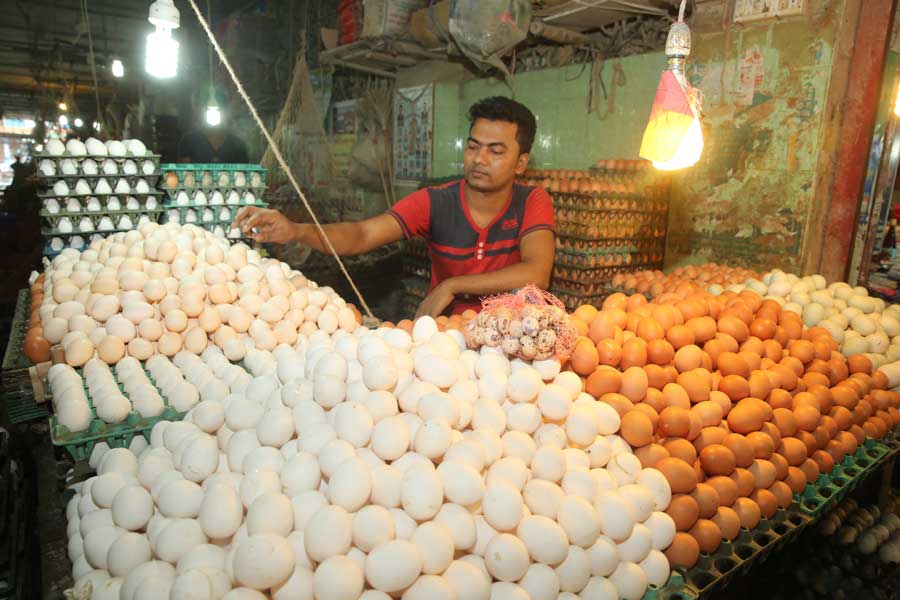
Dhaka, August 15, 2026 — The price of eggs in Bangladesh has hit a two-year high of Tk 150-155 per dozen, putting additional pressure on low-income consumers who rely heavily on eggs as an affordable source of protein. The price surge — driven by supply shortages caused by floods, farm closures, and poultry losses — comes even as green chilli prices have declined sharply following imports.
🥚 Egg Price Trajectory
According to Trading Corporation of Bangladesh (TCB) data, egg prices have shown significant volatility over the past two years:
- 📉 10-year low — Tk 110-115 per dozen (March-April 2026)
- 📈 One month ago — Tk 120-130 per dozen
- 📈 One week ago — Tk 130-140 per dozen
- 📈 Current (August 15, 2026) — Tk 150-155 per dozen (two-year high)
- 📉 Previous peak — Tk 165-180 per dozen (September-October 2024)
The current price is the highest in two years — though still below the September-October 2024 peak. The rapid price increase over the past month (from Tk 120-130 to Tk 150-155) represents a 15-25 percent jump — a significant burden for low-income households.
👥 Why Egg Prices Are Rising
Traders and industry experts cite multiple factors driving the egg price surge:
- 💧 Flood damage — many chickens died due to floods in poultry regions
- ⚡ Power shortages — poultry farm operations disrupted by electricity outages
- 🏭 Farm closures — many farms shut down during 10-year-low prices
- 💰 Six-month price debacle — farmers suffered significant losses
- 📉 Supply shortage — emerged after farm closures reduced production capacity
Anisur, an egg seller at Mohammadpur Town Hall Market, explained: “We make a profit of Tk 4.0-6.0 per dozen. Farm level prices are currently high. Many chickens have died due to floods and power shortages, which has further pushed up prices.”
🏭 Bangladesh Poultry Association Perspective
M Safiur Rahman, Secretary General of the Bangladesh Poultry Association (BPA), framed the price movement as a market demand-supply issue: “Egg prices depend on market demand and supply. Many farmers suffered significant losses due to floods and a six-month long price debacle.”
Rahman explained the cyclical nature of the poultry market:
- 📉 Low prices (March-April 2026) — 10-year low, farmers suffered losses
- 🏭 Farm closures — many farms shut down unable to sustain losses
- 📈 Supply contraction — production capacity reduced
- 📈 Price recovery — supply shortage pushes prices back up
- 🚧 Flood damage — compounded the supply shortage
This boom-bust cycle is a recurring pattern in Bangladesh's poultry sector — reflecting the industry's fragmentation and lack of coordinated production planning.
🌶️ Green Chilli Prices Decline Sharply
In contrast to eggs, the price of green chilli has declined sharply. The vegetable is now selling for Tk 140-150 per kg — down from Tk 360-380 a week ago, a 60 percent price drop. Traders said ongoing imports have helped ease the price of green chilli.
The chilli price movement illustrates how quickly government import intervention can stabilise prices:
- 📈 One week ago — Tk 360-380 per kg (extremely high)
- 📉 Current — Tk 140-150 per kg (60 percent decline)
- 📦 Cause — ongoing imports eased supply shortage
- 🏛️ Government action — earlier approved green chilli imports to cool prices
🍞 Vegetable Prices Remain High
Despite the chilli price decline, most other vegetables remain above Tk 80 per kg:
- 🍆 Long eggplants — Tk 100-120 per kg
- 🥕 Carrot — Tk 120 per kg
- 🥜 Okra — Tk 50 per kg
- 🥔 Bitter gourd — Tk 80-100 per kg
- 🍠 Ridge gourd — Tk 80 per kg
- 🍠 Bottle gourd — Tk 80 per kg
- 🍠 Pointed gourd — Tk 60 per kg
- 🍠 Ash gourd — Tk 50 per kg
- 🎃 Sweet pumpkin — Tk 50 per kg
- 🍠 Arum — Tk 70 per kg
- 🍠 Teasel gourd — Tk 80 per kg
🍚 Rice, Chicken, and Other Staples
Rice prices have remained unchanged at their previous highs:
- 🍞 Coarse varieties — Tk 55-60 per kg
- 🍞 BRRI dhan 28 and Piajam — Tk 65-66 per kg (medium quality)
- 🍞 Miniket — Tk 78-95 per kg
- 🍞 Sampa Nazir — Tk 85-98 per kg
Chicken prices also remained unchanged at their previous highs:
- 🐔 Broiler chicken — Tk 190-200 per kg
- 🐔 Sonali chicken — Tk 330-350 per kg
- 🐔 Layer chicken — Tk 340-360 per kg
Beef remained static at Tk 800-850 per kg and mutton at Tk 1,300-1,350 per kg. Onion prices remained unchanged at Tk 60-65 per kg. Potatoes are selling for Tk 30, garlic at Tk 150-180, and ginger at Tk 180-200 per kg.
📊 Food Inflation Context
The egg price surge comes amid Bangladesh's broader food inflation challenge. According to Bangladesh Bank data, food inflation accelerated to 8.7 percent in June 2026 — up from 7.71 percent in December 2025 and 8.24 percent in March 2026. The drivers include steep rises in meat, fish, fruit, vegetables, and spices prices.
For low-income households, eggs represent a critical affordable protein source — and the 15-25 percent price jump in just one month directly impacts nutrition security. The TCB and government may need to consider:
- 💰 Open Market Sales (OMS) — subsidised egg sales for low-income groups
- 📦 Import facilitation — if domestic supply remains constrained
- 🏭 Poultry sector support — credit and insurance for flood-affected farmers
- 📊 Production planning — industry coordination to reduce boom-bust cycles
- ⚡ Power supply priority — ensure poultry farms get reliable electricity
🌐 Strategic Context: Food Security and Inflation Management
For Bangladesh's export economy, food inflation is not just a welfare issue — it directly affects industrial competitiveness. When food prices rise, workers demand higher wages, which raises manufacturing costs and erodes export margins. The egg price surge, while a single commodity, is symptomatic of broader food inflation pressures that:
- 💰 Pressure wages — workers need higher pay to afford food
- 🏭 Raise production costs — higher wages flow through to factory costs
- 📈 Erode export margins — Bangladeshi exports become less price-competitive
- 👥 Drive migration — skilled workers may emigrate for better living standards
- 🏛️ Political pressure — food inflation can destabilise governments
The government's swift action on green chilli imports — which brought prices down 60 percent in a week — demonstrates that targeted intervention can be effective. Whether similar agility can be applied to egg supply challenges, through poultry sector support and flood recovery assistance, will determine whether egg prices stabilise or continue climbing in the coming weeks.
This news was originally published by The Financial Express. For the full original report, please visit: https://thefinancialexpress.com.bd/trade/egg-price-hits-two-yr-high-chilli-gets-largely-cheaper
📬 Get Bangladesh Trade News in your inbox
Weekly digest of export industry news, policy updates, and market analysis.
📰 Related Stories