Bangladesh ADP Spending Crisis: Tk 1.08 Trillion Unspent in FY2025-26
Government agencies spent less than half of revised Tk 2.09 trillion ADP allocation in 11 months, as execution rate halves from 92.74% in FY2022 to 48% in FY2026 amid political transitions and procurement law amendments
Dhaka, July 27, 2026 — Government agencies in Bangladesh have exposed their weakest capacity in implementing development programmes, as an unprecedented slowdown in public spending left over Tk 1.0 trillion unspent until the penultimate month of the last fiscal year, squeezing Bangladesh's economic growth and raising serious questions about the country's ability to deliver on its development agenda, analysts say. ⚠
📊 Although the government agencies recovered from bleak Annual Development Programme (ADP) execution performance four years ago, their capacity has kept plunging year on year ever since, with execution rates falling to historic lows in FY2025-26. The findings, reported by The Financial Express based on Planning Commission and Implementation Monitoring and Evaluation Division (IMED) data, paint a stark picture of governance and implementation failure across Bangladesh's development pipeline.
💰 Tk 1.08 Trillion Unspent in 11 Months
📋 Planning Commission officials have said that when the Annual Development Programme is prepared, almost all the ministries and agencies demand higher funds, but after receiving allocations, they cannot spend as much when the year ends. The FY2025-26 ADP execution picture is particularly damning:
- 💲 Original ADP allocation (FY2025-26): Tk 2.38 trillion for all government ministries and agencies
- 📉 Revised outlay: Cut to Tk 2.09 trillion after eight months (February 2026)
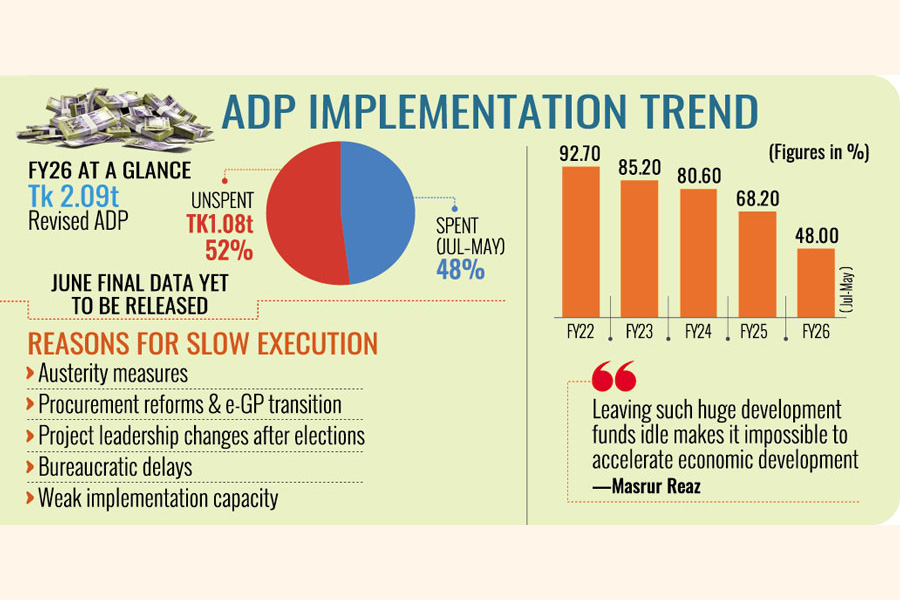
- ⚠ Spent by May 2026: Less than half (48 percent) of the Tk 2.09 trillion revised allocation
- 📜 Unspent in 11 months: Tk 1.08 trillion (52 percent of revised ADP)
- 📈 Average monthly expenditure: Roughly Tk 80 billion
📊 Although the IMED has yet to release the official final report for June, the execution trends show that even with one month remaining in the fiscal year, the pace of spending would need to roughly triple to absorb the unspent balance — an outcome that is virtually impossible given historical spending patterns.
📈 Long-Term Decline in ADP Execution
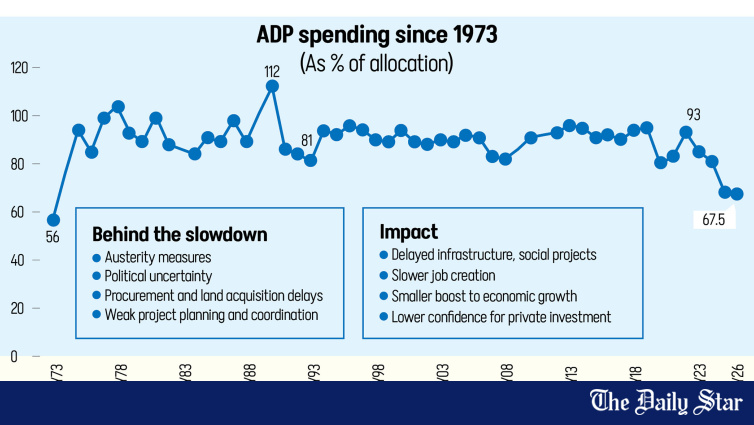
📊 The current slump is not an isolated event but the latest point in a multi-year decline in ADP execution capacity. According to IMED data, the execution rate has fallen every year since FY2022:
- ✅ FY2022: 92.74 percent of Tk 2.19-trillion ADP allocations spent
- 📉 FY2023: 85.17 percent
- 📉 FY2024: 80.63 percent
- 📉 FY2025: 68.18 percent
- ⚠ FY2026 (11 months): Approximately 48 percent
📊 The data shows that ADP execution capacity has roughly halved over the four-year period — a trajectory that economists describe as unsustainable and one that directly translates into slower economic growth, weaker public service delivery, and reduced job creation.
📊 GDP Growth Contraction for Two Quarters
📈 According to the latest statistics from the Bangladesh Bureau of Statistics (BBS), the gross domestic product (GDP) growth contracted for two consecutive quarters in FY2026, dipping to 3.03 percent in the second quarter (October-December 2025) and further slowing to 2.22 percent in the third quarter (January-March 2026) at constant prices. These are extremely low growth rates by Bangladesh's historical standards and reflect the cumulative impact of weak ADP execution, energy sector disruptions, and broader macroeconomic headwinds.
📊 Over the last three consecutive years, Bangladesh's economic growth has been recorded at:
- 📈 FY2024: 4.22 percent
- 📈 FY2025: 3.49 percent
- 📈 FY2026: 4.14 percent
⚠ The industrial sector hit a notable slump in FY2026, recording a negative growth rate of 0.28 percent — a contraction that has not been noticed in recent years. Agricultural growth eased to 1.74 percent, while the services sector slowed to 3.52 percent, painting a picture of broad-based economic deceleration across all major sectors.
🏛 Multiple Causes Behind the Slump
📜 Planning Commission and IMED officials have identified several reasons for the growth deceleration and ADP execution decline:
- 👥 Lack of capacity and efficiency in public agencies responsible for project implementation
- 🧭 Government's austerity stance in response to fiscal pressures
- ⚠ Massive inefficiency in public procurement processes
- 🧭 Bureaucratic tangles and startup delays in project mobilisation
- 📜 Amendment of the Public Procurement Act (PPA) — the bill passed parliament on April 9, transitioning procurement entirely to the electronic Government Procurement (e-GP) platform
🏛 Political Transitions Disrupted Implementation
📋 The national elections in February 2026 created operational inertia following subsequent political shifts. Many Project Directors (PDs) went missing or fled, forcing the authorities to appoint new leadership and delaying execution. The interim government had previously paused, scrapped, or downsized allocations for numerous projects while adjusting development priorities, contributing to the slowdown.
⚠ "Persistent skills shortages and institutional inefficiencies" continued to hamper timely project completion, the IMED and Planning Commission officials said. The combination of political transition, amended procurement law, and capacity gaps has created a perfect storm of implementation paralysis across multiple ministries and agencies.
🤝 Economist Warns of Multidimensional Shock
🏛 Dr Masrur Reaz, Chairman of Policy Exchange Bangladesh, says leaving such huge development funds idle makes it impossible to develop a country and its economy. He warned of the broader consequences in an interview with The Financial Express:
"When a significant amount of ADP development funds remains unspent, it generates a multidimensional shock across the economy. Unexecuted projects fail to generate essential public services and infrastructure needed to spur private investment as well as employment."
📊 The economist called for a structural overhaul of project monitoring, suggesting that the government should establish its own functional monitoring and evaluation cell to track project progress in real time, rather than relying on periodic reporting that often arrives too late to course-correct.
📈 Implications for Bangladesh's Reform Agenda
🌏 The slowdown in development spending has direct implications for Bangladesh's broader macroeconomic trajectory. With the IMF programme setting reform milestones for public financial management, and international ratings agencies adopting a more cautious stance on Bangladesh's sovereign credit profile, weak ADP execution represents both a symptom and a cause of the country's broader economic challenges.
📊 The unspent Tk 1.08 trillion is not simply a budgetary line item — it represents unbuilt roads, undelivered healthcare facilities, unfinished power projects, and unimplemented education programmes that would have generated jobs, enhanced productivity, and supported private investment. The opportunity cost of weak implementation, in terms of foregone growth and development impact, far exceeds the nominal budget figure.
🏛 For the new BNP-led government, restoring ADP execution capacity will be one of the most important tests of its governance reform agenda. The combination of streamlined procurement processes, professionalised project management, real-time monitoring systems, and political stability will be essential to reverse the multi-year decline and ensure that future ADP allocations translate into tangible development outcomes on the ground.
📊 With the FY2026-27 ADP already underway, the coming months will reveal whether the government's reform rhetoric can translate into measurable improvements in implementation capacity — or whether the worrying trend of declining ADP execution will continue to constrain Bangladesh's longer-term development trajectory.
This news was originally published by The Financial Express. For the full original report, please visit: https://thefinancialexpress.com.bd/economy/development-spending-dips-to-a-very-worrying-level
📬 Get Bangladesh Trade News in your inbox
Weekly digest of export industry news, policy updates, and market analysis.
📰 Related Stories