Bangladesh Classified Loan Accounts Double to 45.83 Lakh as Retail Defaults Surge
NPL ratio rises to 32.7% of total outstanding loans; cottage industry worst hit at 52.8% classified ratio; Bangladesh Bank warns of mass retail-level deterioration
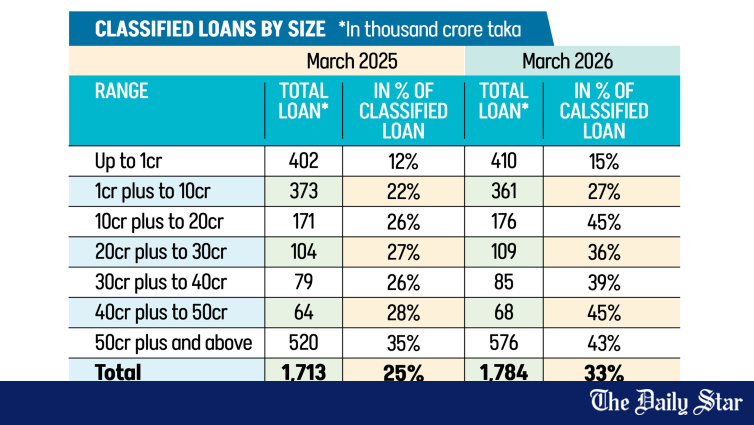
Dhaka, July 25, 2026 — The number of classified loan accounts in Bangladesh's banking sector more than doubled in a year, reaching a staggering 45.83 lakh in March 2026, with the most dramatic surge seen in retail loan accounts, according to the latest Bangladesh Bank (BB) report. 📊
📈 The number of accounts with classified loans of up to Tk 1 crore rose to 45.43 lakh at the end of March 2026, marking a sharp rise from 21.63 lakh accounts a year earlier.
📉 NPL Ratio Rises to 32.7% — "Alarming"
The central bank said overall nonperforming loans (NPLs) as a share of total outstanding loans increased to 32.7 percent in March 2026 from 24.6 percent a year ago, terming the rising NPL ratio "alarming." 📉
💬 Bangladesh Bank stated in its "Banking Sector Update" report published on July 23:
"This indicates a mass retail-level deterioration, which can stem from the rising cost of living and household indebtedness, a slowdown in SME activity, and weak repayment capacity in agricultural and small-trading segments."
"Although high-value defaults create larger monetary shocks, the explosion in small-account defaults is a warning sign of widespread financial stress."
🏦 Bank-Type Vulnerability Analysis
The BB report highlighted which types of banks are most vulnerable: 🏦
- ⚠️ Islamic banks — Particularly vulnerable, signalling weak credit discipline and governance issues
- ⚠️ State-owned banks — Also particularly vulnerable
- ✅ Foreign banks — Maintain very low default levels, reflecting stricter risk management
- ✅ New banks (post-2016) — Lower default levels
📊 Between March 2025 and March 2026, classified loans rose at ALL banks except foreign banks and new banks that began operations in 2016 or later.
🏭 Industry-Wise Breakdown — Cottage Industry Worst Hit
The report revealed stark differences in classified loan ratios across industries: 🏭
- 🏠 Cottage industry: 52.8% classified ratio — highest vulnerability, reflecting severe repayment stress among the smallest business entities
- 📦 CMSME and informal sectors: Represent 21.4% of total loans but account for 34.2% of classified loans — disproportionate credit quality concerns
- 🏭 Large industry: Accounts for 58.7% of total loans and 39% of classified loans — biggest contributor to NPLs by volume
- 💼 Trade and commerce: Accounts for 32% of total loans; classified loans are 43.8% of its total
👥 Root Cause — "Willful Defaulters" and Large Corporate Groups
The central bank report said the banking crisis is primarily driven by "willful defaulters" and large corporate groups rather than small individual borrowers. 🏛️
💬 BB stated:
"This pattern may suggest weaknesses in credit appraisal and monitoring systems for high-value loans or the impact of sectoral and macroeconomic shocks affecting large borrowers."
"This indicates deep-rooted stress in the real economy, possibly due to global economic challenges and weak financial discipline."
💊 Retail Lending — High Inflation Eroding Repayment Capacity
Md Mahiul Islam, Deputy Managing Director and Head of Retail Banking at BRAC Bank, provided industry perspective: 💬
"The lack of proper credit risk appraisal might be one reason for the spike in classified loans for loan amounts of up to Tk 1 crore. A portion could be consumer and credit card loans. Here, high inflation and the erosion of purchasing power may be a factor."
📊 BRAC Bank's NPL ratio for retail and SME loans is less than 3%, compared to the sector-wide 32.7% — demonstrating that proper credit appraisal and regular client monitoring can make a significant difference.
⚠️ What This Means for Bangladesh's Economy
The doubling of classified loan accounts has severe implications: 📉
- 🏦 Banking sector stability — 32.7% NPL ratio threatens the entire financial system
- 💰 Credit contraction — Banks with high NPLs can't lend to productive sectors
- 💼 Economic slowdown — Less credit means less investment and job creation
- 👥 Household financial stress — Retail defaults indicate widespread household financial distress
- 🏭 Industrial stress — 43.8% classified ratio in trade/commerce shows deep economic stress
- 🏠 Cottage industry crisis — 52.8% classified ratio threatens the smallest businesses
The Bangladesh Bank report serves as a stark warning: without decisive action on willful defaulters, improved credit governance, and structural banking reforms, the NPL crisis will continue to deepen — threatening the stability of the entire financial system and the broader economy. 🇧🇩
This news was originally published by The Daily Star. For the full original report, please visit: https://www.thedailystar.net/business/economy/news/classified-loan-accounts-double-retail-defaults-surge-4232251
📬 Get Bangladesh Trade News in your inbox
Weekly digest of export industry news, policy updates, and market analysis.
📰 Related Stories