HS Codes for Bangladesh Garments: Complete 2026 Guide
Complete HS code reference for Bangladesh garment exports including knitwear (HS 61), woven (HS 62), home textiles (HS 63), and footwear (HS 64).
HS Codes for Bangladesh Garments: Complete 2026 Guide for Importers
Harmonized System (HS) codes are the foundation of international trade classification, determining everything from customs duty rates to trade statistics. For buyers sourcing garments from Bangladesh, understanding the relevant HS codes is essential for calculating landed costs, ensuring compliance, and claiming preferential duty rates under trade agreements. This comprehensive guide covers all major garment HS codes used in Bangladesh's $40+ billion RMG export sector.
What are HS Codes?
The Harmonized System is an internationally standardized 6-digit classification system maintained by the World Customs Organization (WCO). Each country may extend the 6-digit code with additional digits for national tariff purposes — Bangladesh uses 8-digit codes. HS codes determine the customs duty rate, VAT, supplementary duty, and other taxes applicable to imported goods. They also determine eligibility for preferential duty treatment under trade agreements like the EU EBA and Japan-Bangladesh EPA.
HS Chapter 61: Knitted Apparel (Bangladesh's Largest Export)
HS Chapter 61 covers garments produced by knitting or crocheting. This is Bangladesh's largest export category, worth $18.78 billion annually. Key codes include: HS 6109 (T-shirts and singlets, knitted) — Bangladesh's single largest export line at $6.2 billion; HS 6110 (Sweaters, pullovers, sweatshirts) — $5.1 billion; HS 6103 (Men's/boys' suits, trousers, knitted) — $3.8 billion; HS 6104 (Women's/girls' suits, dresses, knitted) — $2.9 billion. All Chapter 61 items enter the EU duty-free under EBA, while Japan provides preferential rates under the 2026 EPA.
HS Chapter 62: Woven Apparel
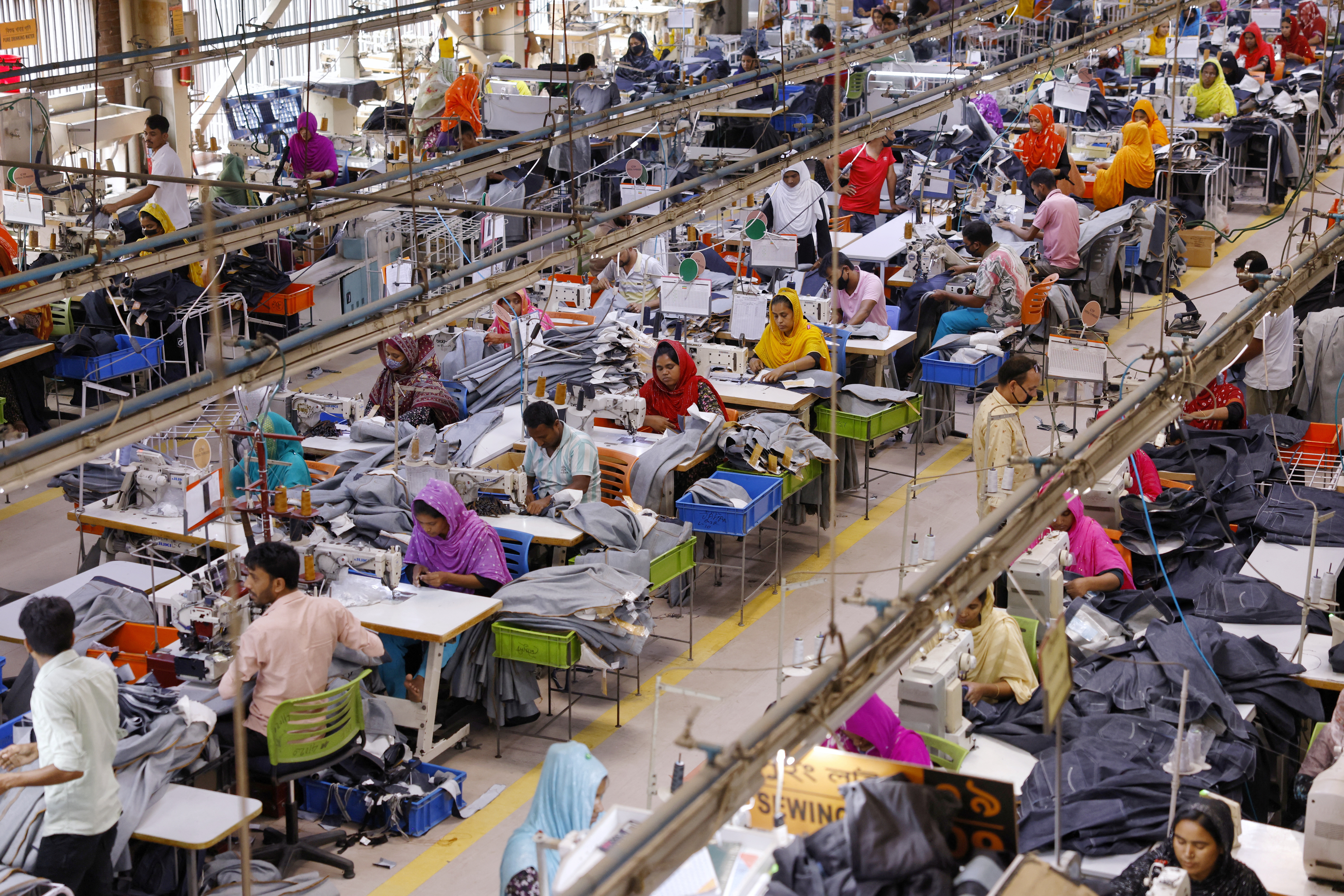
HS Chapter 62 covers garments made from woven fabrics. Bangladesh's woven garment exports total $16.53 billion annually. Key codes: HS 6203 (Men's/boys' suits, trousers, woven) — $3.6 billion; HS 6204 (Women's/girls' suits, dresses, woven) — $3.1 billion; HS 6205 (Men's/boys' shirts, woven) — $4.2 billion; HS 6202 (Women's/girls' overcoats, jackets, woven) — $2.9 billion. Woven garments require different factory setups than knitwear, with separate cutting, sewing, and finishing departments.
Duty Rates for Key Garment HS Codes
In Bangladesh, the customs duty on garment imports is 25% (CD) + 15% (VAT) + 0% (SD for most items) + 5% (AIT) + 5% (AT). However, for exports FROM Bangladesh, the destination country's import duty applies. Under EU EBA, all garment HS codes enter the EU at 0% duty. Under the Japan-Bangladesh EPA, duties are being phased out over 10 years. In the USA (no preferential agreement), the MFN duty on cotton T-shirts (HS 6109) is 16.6%, on synthetic shirts 32%, and on trousers 15.9%.
Rules of Origin for Preferential Duty
To claim preferential duty under EU EBA, garments must meet the "double transformation" rule of origin: the fabric must be woven/knitted in Bangladesh (or another EBA-eligible country), AND the garment must be cut and sewn in Bangladesh. For the Japan EPA, the rule is similar but allows cumulation with ASEAN and SAARC countries. Buyers must ensure their supplier obtains the correct Certificate of Origin (Form A for EU, Form JP for Japan) from the EPB.
How to Verify HS Codes
Buyers can verify HS codes using BangladeshExport.com's HS Code Lookup tool, which provides duty rates for all 7,498 codes in the Bangladesh customs tariff. The tool includes a landed cost calculator that computes the total duty burden based on CIF value. For official verification, the NBR publishes the complete customs tariff at nbr.gov.bd, with 99 chapter PDFs available for download.
Common HS Code Mistakes to Avoid
Incorrect HS code classification can lead to duty overpayment, customs delays, or penalties. Common mistakes include: confusing knitted (Chapter 61) with woven (Chapter 62) garments; misclassifying baby garments (HS 6111/6209); using wrong fiber composition codes; and failing to declare special features (waterproof, fire-resistant) that affect classification. Always consult with a licensed customs broker for complex classifications.
Use the BangladeshExport.com HS Code Lookup at /hs-codes for real-time duty calculations and supplier matching by HS code.