Pressure On Bangladesh Forex Rises As External Debt Service Surges: Interest Payments Triple In 5 Years
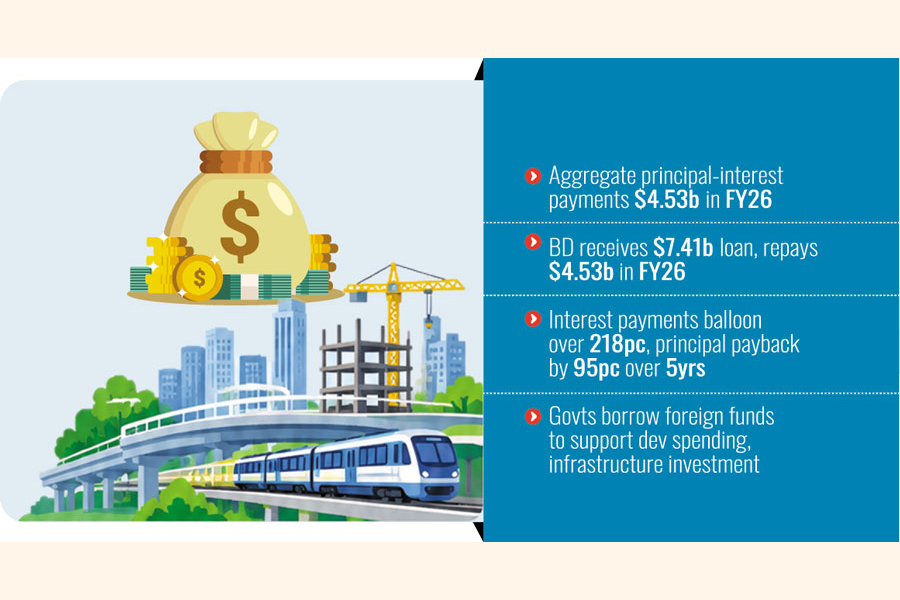
Bangladesh paid $1.56 billion in interest against external loans in FY26, up from $491 million in FY22; principal repayments reached $2.98 billion, almost twice the level of six years ago.
💰 Bangladesh feels the pinch of growing external borrowing as pressure builds up on its foreign-exchange buffers from incremental debt-service payouts, officials say. Out of an aggregate debt servicing, interest payments have more than tripled and principal payback nearly doubled over the past five years, according to latest official statistics. The rising debt service burden represents a significant and growing claim on the country''s foreign exchange resources — and underscores the macroeconomic consequences of Bangladesh''s increasing reliance on external financing.
📊 The government paid $1.56 billion in interest against external loans in the fiscal year (FY) 2025-26 alone, compared to around $491.25 million in FY2021-22, according to provisional data available with the Economic Relations Division (ERD). Principal repayments against outstanding medium- to long-term loans (MLTs) reached $2.98 billion in FY2026, almost twice the approximately $1.53 billion paid six years earlier. The aggregate principal and interest payments amounted to around $4.53 billion during the last fiscal year, reflecting the growing cost of servicing foreign loans contracted by successive governments to finance infrastructure, energy, transport and other development projects.
🏛 The trajectory of external debt service
The trajectory of Bangladesh''s external debt service is striking. In just five years, interest payments have more than tripled (from $491 million to $1.56 billion), while principal repayments have nearly doubled (from $1.53 billion to $2.98 billion). The aggregate debt service burden has grown from around $2 billion in FY22 to $4.53 billion in FY26 — an increase of more than 125% in just five years.
This trajectory reflects several factors. First, Bangladesh has been borrowing increasing amounts from external sources to finance its development priorities — including infrastructure projects like the Padma Bridge, the Karnaphuli Tunnel, the Rooppur Nuclear Power Plant, and various metro rail and highway projects. Second, some of the loans contracted in earlier years have begun to enter their repayment periods, adding to the annual debt service burden. Third, the depreciation of the Bangladeshi taka against the US dollar has increased the local currency cost of servicing dollar-denominated external debt.
👥 Impact on foreign exchange reserves
The rising external debt service burden puts direct pressure on Bangladesh''s foreign exchange reserves. Foreign exchange reserves have been under sustained pressure in recent years due to a combination of factors: elevated import costs (particularly for fuel and food), reduced export growth, slower remittance inflows, and the broader macroeconomic challenges facing the country. The additional claim of $4.53 billion in external debt service in FY26 represents a significant draw on the country''s reserves.
Bangladesh''s foreign exchange reserves have declined from their peak of around $48 billion in 2021 to less than $20 billion currently — a significant erosion that has constrained the central bank''s ability to intervene in the foreign exchange market and support the value of the taka. The rising external debt service burden adds to the pressures on reserves, creating a vicious cycle where reserve depletion increases the country''s vulnerability to external shocks.
💰 Composition of external debt
Bangladesh''s external debt is composed of several categories:
- 📊 Multilateral debt: Loans from the World Bank, Asian Development Bank, IMF, and other multilateral institutions. These loans typically have concessional terms (low interest rates, long grace periods, long maturities) and are used to finance development projects.
- 📊 Bilateral debt: Loans from individual countries, including Japan (through JICA), China (through China Exim Bank), India, and others. These loans have varying terms depending on the lender and the project.
- 📊 Supplier''s credit: Short-term trade credit extended by foreign suppliers, typically for the purchase of capital machinery and equipment.
- 📊 Commercial debt: Bonds, bank loans, and other commercial borrowings from international capital markets. Bangladesh''s recent debut sovereign bond is an example of commercial external debt.
The composition of Bangladesh''s external debt matters because different types of debt have different cost and risk profiles. Multilateral debt is typically the cheapest and most stable, while commercial debt carries higher interest rates and greater exposure to market conditions. As Bangladesh''s external debt has grown, the share of higher-cost commercial debt has also increased — contributing to the rapid rise in interest payments.
🌏 Looking ahead
For Bangladesh, the rising external debt service burden is a critical macroeconomic challenge that requires careful management. The country needs to continue borrowing externally to finance its development priorities — but it also needs to ensure that the debt remains sustainable and that the debt service burden does not become a destabilising claim on foreign exchange reserves.
Several steps could help manage the external debt service challenge:
- ✅ Prioritise concessional borrowing: Focus on multilateral and bilateral concessional loans rather than higher-cost commercial debt.
- ✅ Improve project implementation: Ensure that borrowed funds are used efficiently to generate the economic returns needed to service the debt.
- ✅ Strengthen export growth: Boost export earnings to generate the foreign exchange needed to service external debt.
- ✅ Enhance revenue mobilisation: Increase domestic revenue collection to reduce reliance on external borrowing.
- ✅ Debt sustainability analysis: Conduct regular debt sustainability analysis to ensure that new borrowing remains within sustainable limits.
The proposed IMF programme — with its emphasis on revenue mobilisation, macroeconomic stabilisation, and structural reform — should help Bangladesh manage its external debt service challenge. The IMF financing itself would provide some external support, while the associated reform conditions would help address the underlying fiscal and external imbalances that have contributed to the rising debt service burden.
The coming years will show whether Bangladesh can successfully manage its rising external debt service burden while continuing to finance its development priorities. The trajectory of foreign exchange reserves, the country''s ability to attract concessional financing, and the success of structural reforms will all be critical determinants of the outcome.
This news was originally published by The Financial Express. For the full original report, please visit: https://thefinancialexpress.com.bd/economy/pressure-on-forex-rises-as-external-debt-service-surges
📬 Get Bangladesh Trade News in your inbox
Weekly digest of export industry news, policy updates, and market analysis.
📰 Related Stories